.jpg)
Murcia
Ask someone from the port of Cartagena about their inland neighbors, and they might call them green bellies. It is a jab about vegetables, and the people of Murcia do not much care for it, but there is pride buried in the insult. This is a city defined by its huerta, the ring of intensely fertile market gardens that has fed it for over a thousand years and sent fruit and vegetables across Spain and Europe. Murcia is the seventh-largest city in the country, home to close to 480,000 people, and it wears its greenness as an identity as much as an industry.
Founded by an Emir
Murcia was born in 825, when the Moorish emir Abd al-Rahman II founded it in the center of the Segura River valley. That origin still shows. Stretches of the old Moorish city wall survive, standing in pointed contrast to what came later: a skyline of baroque churches so lavish that Murcia is known as the baroque city of the Levante, southeastern Spain. It is not a place that trades on drama. Set inland while the crowds decamp to the coast each summer, Murcia is a services city and a university town, at its liveliest during the school year, threaded with pedestrian streets and green squares. The Segura valley around it is among the most productive in Spain, and the emirs who founded the city prized exactly what modern Murcia still lives on, the marriage of river, sun, and worked soil.
Salzillo's Living Wood
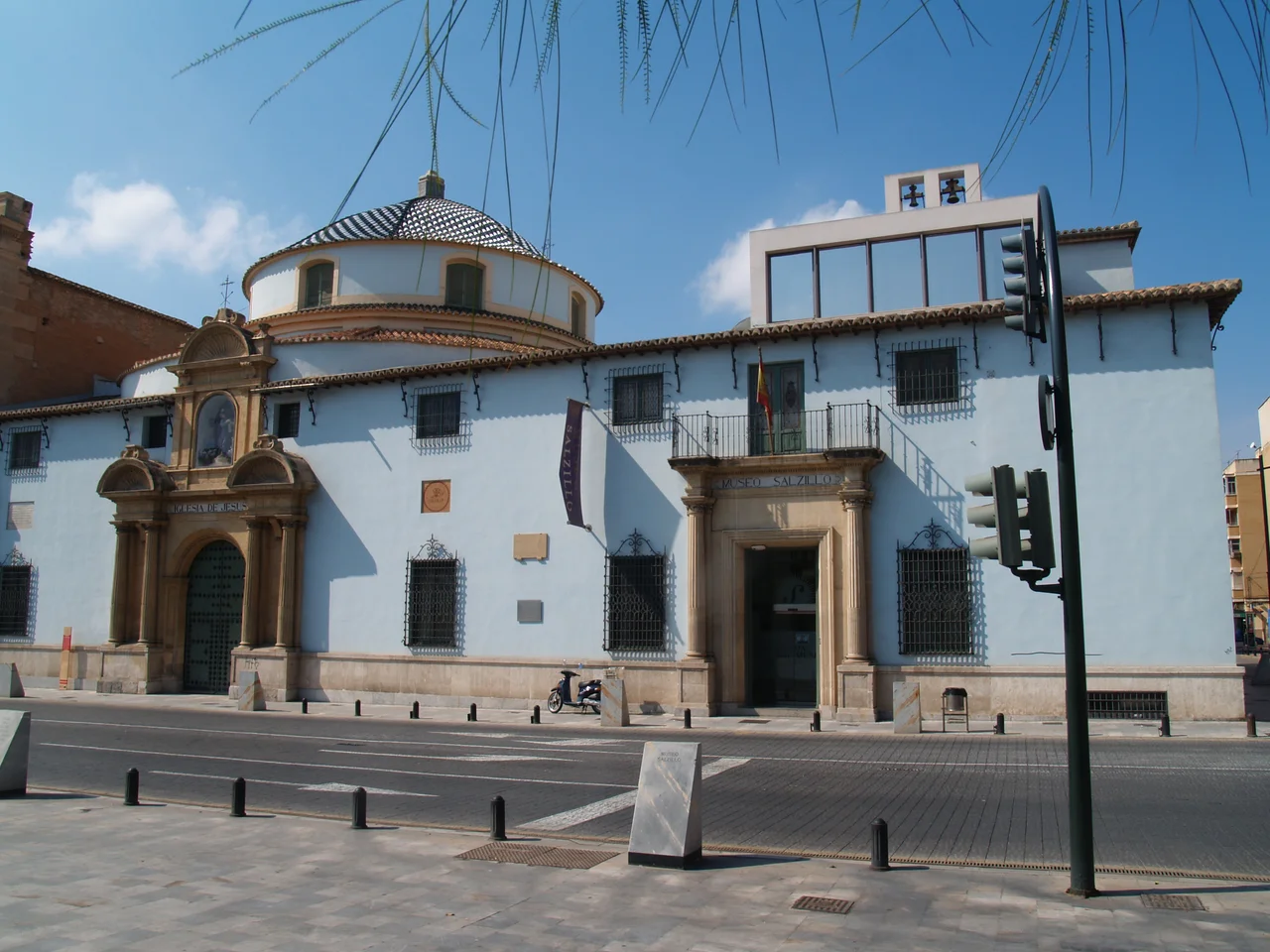
The city's most singular treasure is the work of one sculptor. Francisco Salzillo carved most of the pasos, the processional figures, that fill Murcia's streets during Semana Santa, Holy Week. His angels, saints, and virgins are polychromed wood, their faces and hands rendered with such tenderness that they seem to breathe. A museum devoted to him also holds the Belen de Salzillo, an intricate nativity retelling the birth of Jesus in miniature figures. For a city known abroad for its produce, this quiet mastery in carved wood is the deeper local pride. During Holy Week the figures leave the museum and take to the streets on the shoulders of bearers, and for a few nights the baroque city becomes a moving gallery of Salzillo's art.
The Christ on the Mountain
Visible from almost anywhere in Murcia, a Moorish castle crowns the Monteagudo mountain just outside town, and atop it stands a great statue of Christ with open arms, a Christian crown placed on a Muslim fortress. You can climb up, park below, and walk to the summit, where the figure's feet are said to be larger than footballs and the whole huerta spreads out below. For an even wider view, locals head into the hills behind the city, to El Valle or the Fuensanta sanctuary, and time their arrival for sunset, when the valley and its patchwork of gardens catch the last light.
Where the City Ends
Murcia sits within easy reach of very different landscapes. To the west rise the pine-clad heights of the Sierra Espuna regional park, near cliffs like the Paredes de Leiva that draw climbers to open new routes each year. To the south and east lie the beaches, some still nearly untouched between Mazarron and Aguilas, others thronged in summer, like La Manga, the slender strip of land that separates the open Mediterranean from the warm inland lagoon of the Mar Menor. And 50 kilometers away waits Cartagena, the ancient Roman port, close enough that the two cities trade their friendly insults across the huerta that made Murcia what it is. Getting here is easy enough: fast AVE trains link Murcia to Madrid in a few hours, and Alicante's international airport lies about an hour up the coast.
From the Air
Coordinates 37.99 N, 1.13 W, inland in southeastern Spain on the River Segura. From the air Murcia is unmistakable: a compact baroque city set in a vast green sea of irrigated huerta, with the cathedral's ornate bell tower at its heart and the castle-topped Monteagudo mountain rising nearby, crowned by its open-armed statue of Christ. Fly at 2,000 to 4,000 feet in clear conditions. Nearest airports: Region de Murcia at Corvera (LEMI) about 25 km south, Murcia-San Javier (LELC) on the Mar Menor, and Alicante-Elche (LEAL), about an hour away with the widest range of flights.
Nearby Stories
- Siege of Guardamar 5.5 km away
- Bajo de la Campana Phoenician Shipwreck 6.4 km away
- Battle of Helike 7.8 km away
- Agost 14 km away
- Mazarrón 23 km away
- Cabo de Gata-Nijar Natural Park 116 km away
- Castle of Alarcon 139 km away
- Alcazaba of Almería 149 km away