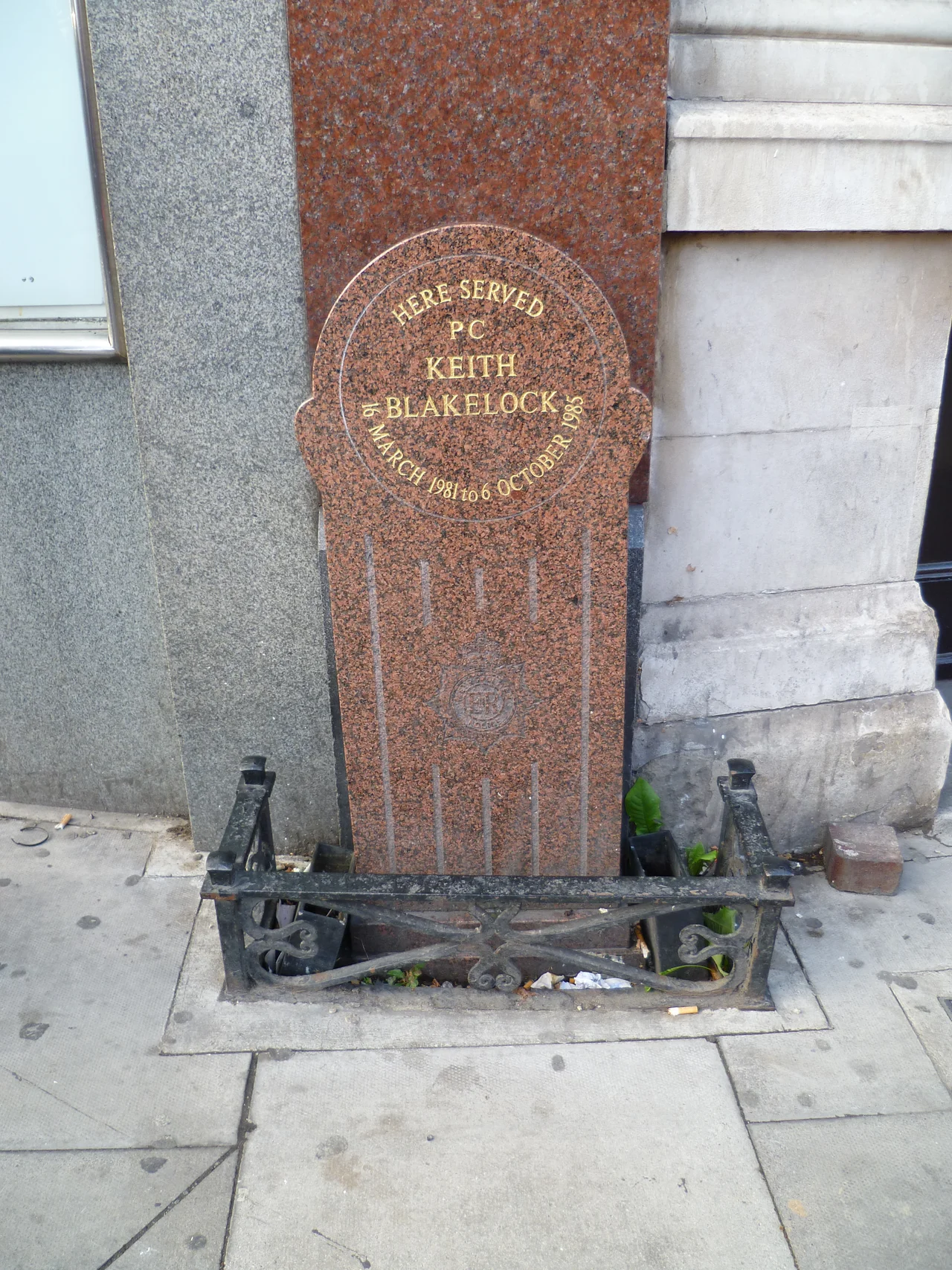

Murder of Keith Blakelock
Keith Henry Blakelock was forty years old, a home beat officer in Muswell Hill, married to Elizabeth, father to three boys named Mark, Kevin and Lee. He had joined the Metropolitan Police on 14 November 1980, late by the standards of his service - he was thirty-five when he signed on - and he worked the kind of beat where the constable's name is known on every street. On the night of 6 October 1985 he was sent with eleven other officers in Serial 502 to protect the firefighters working through the second night of a riot on the Broadwater Farm estate in Tottenham. He stumbled. A crowd closed in. By the time his colleagues fought their way back to him, he had been struck more than forty times with machetes or similar weapons, and a six-inch knife had been driven into his neck up to the hilt. He was the first British police officer killed in a riot since 1833.
Broadwater Farm
The Broadwater Farm estate, built between 1967 and 1973 in the Borough of Haringey, was a product of the post-war push to clear London's slums and rehouse the displaced in modern high-rise blocks. It consisted of 1,063 flats in twelve blocks raised on stilts, linked by first-floor outdoor walkways; no homes or shops sat at ground level, because of the risk of flooding from the buried River Moselle. In 1985 about 3,400 people lived there, 49 per cent white and 43 per cent African-Caribbean. By 1976 the estate was already being called a sink. A Department of the Environment report had recommended its demolition by 1980. The walkways meant the estate could be crossed without ever touching the ground, and combined with the ground-level parking, they had created what residents and police alike called a rabbit warren. The Royal Institute of British Architects blamed the council for using Broadwater Farm as a gathering point for tenants it considered problems, at rents too low to maintain the buildings. By the spring of 1985, residents and police were already in open hostility: bricks, bottles and beer barrels rained down on officers from the first-floor walkways.
Cynthia Jarrett
On Saturday 5 October 1985, police stopped a young black man called Floyd Jarrett on a vague suspicion that his vehicle's tax disc was wrong. The suspicion was groundless; the deeper suspicion that the car was stolen also turned out to be groundless. Several hours later, officers decided to search the home of his mother, Cynthia Jarrett, a 49-year-old woman who lived about a mile from Broadwater Farm. They entered without a warrant, using Floyd's keys, while she and her family were watching television. Mrs Jarrett collapsed and died of heart failure during the search. Her family said an officer had pushed her; the officer denied it. The same officer tried to revive her with mouth-to-mouth, without success. The pathologist later told the inquest that she had a heart condition that probably gave her only months to live, and that the fall might have been a precipitating factor. The jury returned a verdict of accidental death. The community heard only that an officer had entered without a warrant and that a Black woman had died on the floor of her own front room.
The Riot
The journalist David Rose later described Cynthia Jarrett's death as 'not just a spark but a flamethrower aimed at a powder keg.' Crowds began gathering outside Tottenham police station before dawn on Sunday 6 October; the Jarrett family appealed for calm, and the immediate crowd dispersed. Through the day, however, anger spread through the estate. By evening a crowd of around 500 mostly young Black men was setting fire to cars, throwing petrol bombs, and dropping concrete blocks from the walkways onto police helmets. Two journalists from the BBC and one from the Press Association were shot; at least thirty shots were fired from three firearms - the first time guns had been fired by rioters in mainland Britain. 250 officers were injured that night. The Commissioner authorised plastic bullets and CS gas for the first time in a British riot, but the senior officers on the ground refused to use them. The rioting went on into the early hours of Monday morning, and somewhere in the smoke, Serial 502 had been driven back to Tangmere block and a single officer had fallen.
The Tottenham Three
Detectives faced enormous pressure to find Blakelock's killers and very little evidence. The crime scene had been impossible to secure for hours. In the months that followed, 359 people were arrested, most interviewed without lawyers. Three adults - Winston Silcott, Engin Raghip and Mark Braithwaite - and three youths were charged with the murder. Silcott, Raghip and Braithwaite, who became known as the Tottenham Three, were convicted in 1987 largely on the basis of untaped confessions. A long, broadly supported campaign to overturn the convictions followed; in 1991 the Court of Appeal quashed all three, after Electrostatic Detection Apparatus testing revealed that detectives' notes of an interview in which Silcott appeared to incriminate himself had probably been tampered with. Two detectives were charged with perverting the course of justice in 1992; they were acquitted in 1994. The murder investigation was reopened in 1992 and again in 2003. In 2013, Nicholas Jacobs became the seventh person charged with Blakelock's murder. He was found not guilty in April 2014. No one has been convicted.
What Remains
PC Blakelock and the other constables of Serial 502 received the Queen's Gallantry Medal in 1988. His son Lee, who was eight when his father died, joined Durham Constabulary in 2000. Keith Blakelock is buried in East Finchley Cemetery. Broadwater Farm survived its near-demolition: a regeneration project after the riot brought new investment and ground-level activity into the estate, although the buildings themselves remain largely intact. The story holds two truths that can be hard to hold together. A police officer was killed doing his job protecting firefighters. A Black community that had been treated for years as a problem to be policed was, that weekend, mourning a woman who had died in her own home during a search the police should never have made. Both losses were real. Neither has been fully resolved by the courts or by time.
From the Air
Broadwater Farm estate sits at 51.5946° N, 0.0822° W in Tottenham, in the London Borough of Haringey, four miles north of central London. From above, look for the distinctive cluster of twelve high-rise blocks raised on stilts and linked by elevated walkways, immediately east of Lordship Lane and the green of Lordship Recreation Ground. The North Circular Road (A406) runs along the northern edge. London City (EGLC) is the nearest major airport (about 8 nm south-east); Stansted (EGSS) lies north-east; Luton (EGGW) north-west. Tottenham Hale and Wood Green Underground stations are the nearest rail links.
Nearby Stories
- Stevenage 5.7 km away
- Malling Abbey 5.7 km away
- 1952 Farnborough Airshow Crash 7.7 km away
- Ingatestone Hall 8.2 km away
- Hellfire Caves 9.1 km away
- The Carrington Event: The Solar Storm That Could Happen Again 9.8 km away
- Bletchley Park 16 km away
- Castle Hedingham 23 km away