
Murder of Yvonne Fletcher
She had told her parents at the age of three that she wanted to be a police officer, and she had done it the hard way. Yvonne Joyce Fletcher, born 15 June 1958 in the Wiltshire village of Semley, was 5 ft 2 in tall - shorter than the 5 ft 4 in minimum the Metropolitan Police required. She was rejected by several forces, and considered applying to the Royal Hong Kong Police Force. In March 1977 the Met accepted her anyway, onto its twenty-week training course. She was twenty-five years old on 17 April 1984 when she was sent with around thirty other officers to St James's Square to monitor a demonstration outside the Libyan embassy. Her colleagues at Bow Street called her Super Fletch. She was engaged to be married to a fellow constable, Michael Liddle, who was on duty with her that day. She was struck by a single bullet fired from a first-floor window of the embassy at about ten past ten that morning. She died shortly afterwards in Westminster Hospital.
The People's Bureau
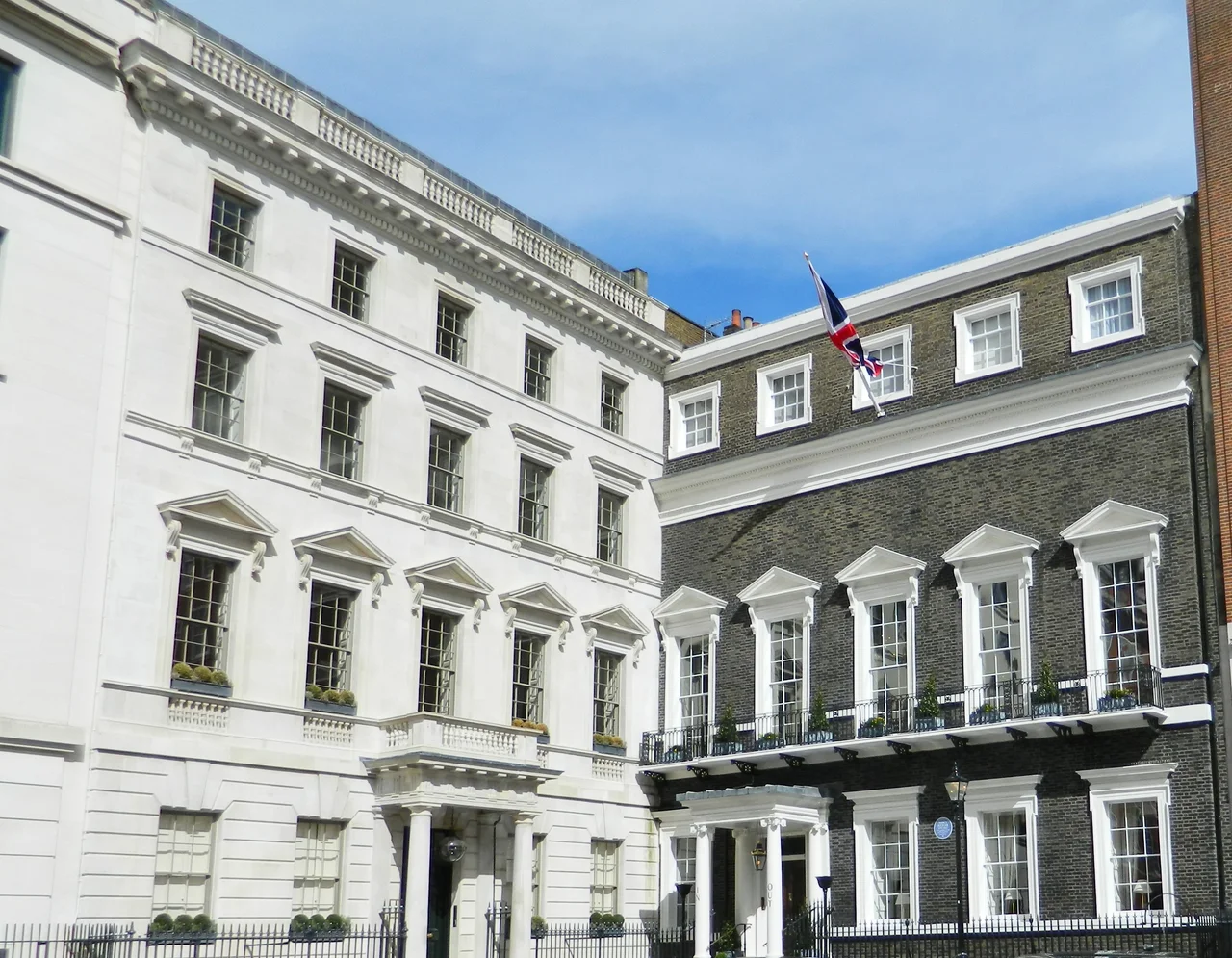
Since 1979 there had been no Libyan ambassador in London. A 'Revolutionary Committee' was in nominal charge of the embassy at 5 St James's Square, which had been renamed the 'People's Bureau' in line with Muammar Gaddafi's political experiment, the Jamahiriya. By the early 1980s, Gaddafi had begun ordering the killing of exiled opponents - bombings at London newsagents, shootings in Manchester. In 1980 Moussa Koussa, the People's Bureau Secretary, was expelled from the UK after telling The Times that Libya planned to murder two opponents of the regime living in Britain. In February 1983 the existing staff at the bureau were recalled, and a four-man committee of student revolutionaries took control. On 10 and 11 March 1984, bombs were planted in London and Manchester at sites associated with Libyan dissidents. Five Libyans linked to the attacks were deported. The British government, balancing trade and oil concerns against an increasingly volatile diplomatic relationship, told Tripoli that 'criminal actions in the United Kingdom must cease.'
Seventeenth of April
On 16 April 1984 two students were publicly hanged at the University of Tripoli for their opposition to Gaddafi. In response, members of the Libyan National Salvation Front - exiles in Britain - planned a demonstration outside the People's Bureau for the next morning. Overnight on 16-17 April the bureau sent three options to Tripoli for handling the protest: confront the demonstrators outside, fire on them from inside, or have the British government stop the protest. Tripoli authorised the second option. GCHQ intercepted and decrypted the messages, but - according to the historian Richard J. Aldrich - probably did not work on them outside the agency's 9am-to-5pm office hours, and the intelligence reached MI5 only after the shooting. One of the Libyans at the bureau also told a workman placing crowd barriers that morning that there were guns inside and there would be trouble. The workman passed the warning to the police. No action was taken. At about 10:18am two gunmen opened fire from a first-floor window of the embassy with Sterling submachine guns. Eleven Libyan demonstrators were wounded. WPC Fletcher was hit; she fell beside her fiance, and they could not initially get her to safety because the gunmen continued firing.
Eleven Days
Armed police surrounded the embassy. Diplomatic protection under the 1961 Vienna Convention, incorporated into UK law in the Diplomatic Privileges Act 1964, meant the gunmen could not be arrested inside. After eleven days of negotiation, the thirty people inside the building were expelled from the country on 27 April 1984. The UK severed diplomatic relations with Libya. In retaliation, Libya arrested six British nationals; four of them spent nine months in captivity before being released. The inquest into Fletcher's death later returned the finding that she had been killed by 'a bullet coming from one of two windows on the west side of the front on the first floor of the Libyan People's Bureau.' The shooter was never publicly identified beyond a strong probability, although in 2012 The Sunday Telegraph named Salah Eddin Khalifa, who had left the embassy by a back door within minutes of the shooting, before the police perimeter closed. No charges were ever brought against him.
The Long Investigation
In July 1999, after a long warming of relations, the Libyan government formally accepted general responsibility for the actions of those inside the bureau, paid £250,000 in compensation to Fletcher's family, and agreed to cooperate with the murder inquiry. In 1986 the murder had already played a role in Margaret Thatcher's decision to let American aircraft use RAF bases for the bombing of Libya; she said so explicitly in the House of Commons. In November 2015 the Metropolitan Police arrested Saleh Ibrahim Mabrouk, a close ally of Gaddafi and a key member of the revolutionary committee that had controlled the embassy in 1984; he had claimed political asylum in the UK in 2011. Charges of conspiracy to murder were dropped in May 2017 because key evidence could not be presented in court on national security grounds. Fletcher's former Bow Street colleague John Murray, who had cradled her in the back of the police van as she was driven to hospital, kept pushing. In November 2021 the High Court of Justice found Mabrouk jointly liable for Fletcher's murder in a civil case Murray had brought. Mabrouk became, in civil law, responsible for the death. No one has been criminally convicted.
St James's Square
The film director Michael Winner wrote to The Times eight days after the shooting, suggesting a memorial in the square 'to commemorate not only the horrific death of this brave young girl, but also be a constant reminder to her killers of the feelings of the British people.' Donations poured in, and Winner set up the Police Memorial Trust. Yvonne Fletcher became its first honoree. On 1 February 1985 Margaret Thatcher unveiled a simple granite and Portland stone pillar in the north-east corner of St James's Square, facing the former embassy. Westminster City Council rounded the kerb beside it into a small viewing platform. A cherry tree was planted in the square in 1984. A stained glass window by Henry Haig was dedicated to her at St Leonard's Church, Semley, in 1988. The Diplomatic and Consular Premises Act 1987 was passed in response to the case, giving the government the power to strip diplomatic status from premises being misused. Forty-two years on, fresh flowers still appear at the memorial. She was twenty-five years old. She was a person, not a symbol, and her name remains attached to a small bend in the pavement of a London square.
From the Air
The site of the shooting is at 51.5078° N, 0.1350° W in St James's Square, in the City of Westminster, immediately south of Piccadilly. From the air look for the small leafy square just east of Green Park and St James's Palace; the former Libyan embassy at No. 5 sits on the west side of the square, and Yvonne Fletcher's memorial pillar stands diagonally opposite, in the north-east corner. London Heliport (EGLW) is the only central helicopter base; London City (EGLC) lies east, Heathrow (EGLL) west. Central London is restricted Class A airspace. On the ground, the easiest approach is from Pall Mall to the south or Piccadilly to the north.
Nearby Stories
- Stevenage 5.7 km away
- Malling Abbey 5.7 km away
- 1952 Farnborough Airshow Crash 7.7 km away
- Ingatestone Hall 8.2 km away
- Hellfire Caves 9.1 km away
- The Carrington Event: The Solar Storm That Could Happen Again 9.8 km away
- Bletchley Park 16 km away
- Castle Hedingham 23 km away