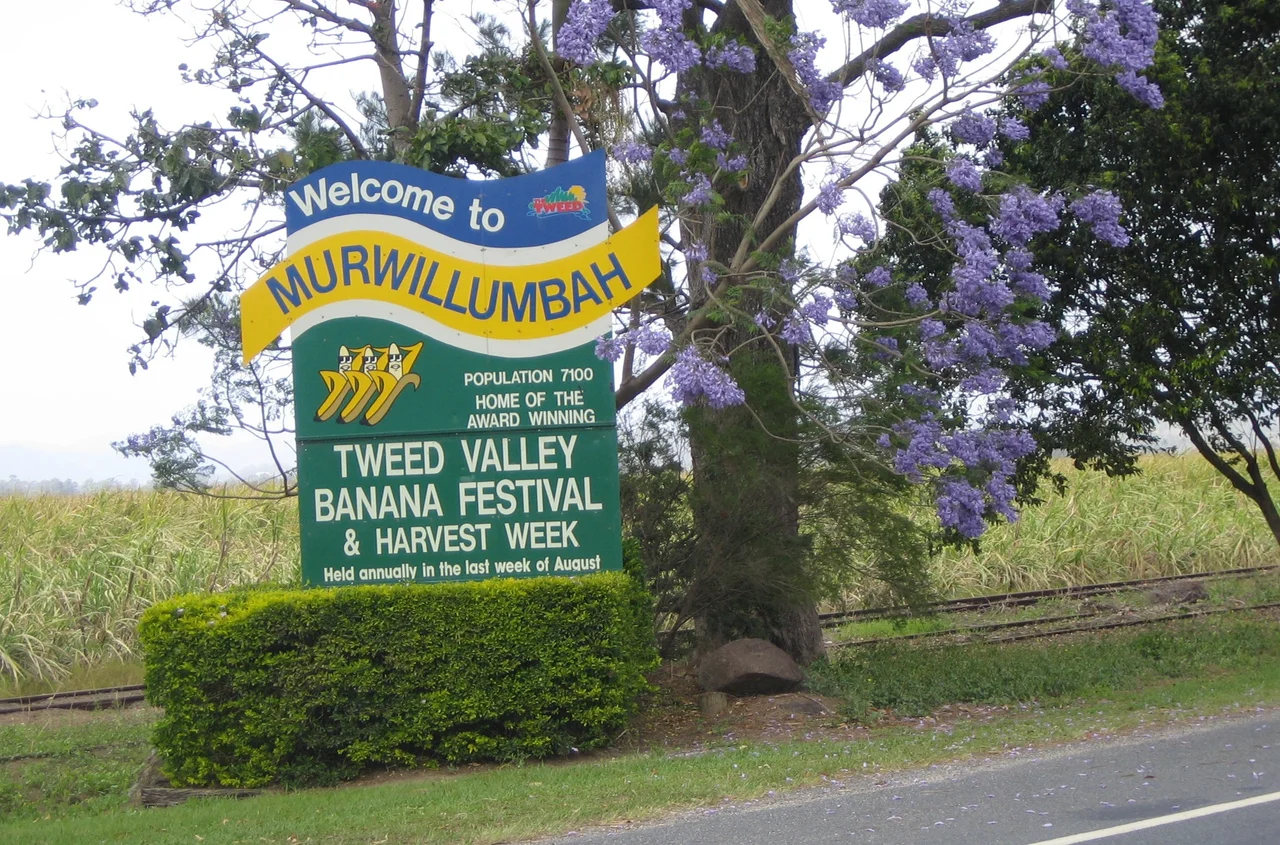

Murwillumbah
The whole town sits inside a volcano. Not an active one, but the eroded ruin of an enormous shield volcano that erupted more than twenty million years ago, its collapsed crater now a vast green caldera of rainforest and sugarcane. Murwillumbah lies on the floor of that ancient bowl, on the banks of the Tweed River, in the far northeast corner of New South Wales, just thirteen kilometres south of the Queensland border. At its centre rises the worn volcanic plug that once fed the eruption: Wollumbin, also called Mount Warning, the first piece of the Australian mainland to catch the sun each morning. The locals shorten the town's tongue-twisting name to 'M'bah'.
Wollumbin, the Cloud Catcher
The peak that dominates every view from Murwillumbah is sacred. To the Bundjalung people, Wollumbin means 'cloud catcher', and the summit is a place of ceremony and initiation, a declared Aboriginal Place under the National Parks and Wildlife Act. Out of respect for that significance, the traditional owners ask that visitors do not climb it. The mountain holds a quiet geographic distinction too: standing where it does, roughly fourteen kilometres west-southwest of the town, it is the first point on the Australian continent to be touched by the rising sun. To watch dawn break over the caldera, with cloud snagged on the old volcanic core, is to understand exactly how the mountain earned its name.
The Heist That Was Never Solved
On 22 November 1978, Murwillumbah became the scene of the largest bank robbery in Australian history. A crew known as the Magnetic Drill Gang broke through the rear of the Bank of New South Wales, and using a diamond-tipped electromagnetic drill and a surgeon's cystoscope to see inside, worked for hours to penetrate the vault. They escaped with just over 1.7 million Australian dollars in cash, then jammed the safe shut behind them. The crime was not even discovered until a security guard noticed an open door the next morning, and it took bank staff, police, and finally council workers nine hours to crack the safe and confirm it was empty. Nearly half a century later, the money has never been recovered and the case remains unsolved.
An Art-Deco Town That Keeps Reinventing Itself
Fire and flood have repeatedly forced Murwillumbah to rebuild, and the rebuilding gave it character. After a blaze destroyed most of the business district in 1907, the town rose again, and much of its handsome streetscape carries the clean lines of the 1920s and 1930s. The river that gives the town life also threatens it: protected by levees that cannot hold back the worst of it, Murwillumbah has flooded again and again, with the 2022 deluge the highest on record. Yet the town has reinvented itself as an arts and lifestyle hub in the lush Tweed hinterland, surrounded by alternative retreats, a Hare Krishna community, and the green caldera's tropical farms. The annual Tweed Banana Festival, among the oldest festivals in Australia, has run here for decades.
The People of the Caldera
For a town of fewer than ten thousand, Murwillumbah has launched a remarkable number of lives. The surfer Stephanie Gilmore was born here in 1988 and went on to win eight World Surf League titles, the most in the history of women's professional surfing, and the only surfer ever to take a world title in a debut season. Bob Bellear, born in the Tweed region, became the first Aboriginal Australian appointed as a judge. Eric Willis, the 34th Premier of New South Wales, came from here too, as did a long roster of rugby league and union internationals. The valley has drawn filmmakers as well: the town has doubled as a movie location, and the nearby jungle has hosted the British reality series I'm a Celebrity... Get Me Out of Here!
From the Air
Murwillumbah lies at roughly 28.33 degrees S, 153.38 degrees E, on the Tweed River within the great Tweed Volcano caldera. The unmistakable landmark is Wollumbin (Mount Warning), the steep volcanic plug rising about 14 km southwest of town to 1,157 metres, often ringed with cloud at dawn. The town's small grass airfield, Whittle Field (YMUR), named for local WWII Spitfire pilot Bob Whittle, has an 800-metre runway used by the aero club and charter and crop-dusting operations; there are no scheduled flights. Gold Coast Airport (YBCG / OOL) is roughly 40 km north. A viewing altitude of 3,000-5,000 feet shows the caldera rim, the cane fields on the valley floor, and the river threading through town. Morning light over the caldera is spectacular but mountain cloud and valley fog are common.
Nearby Stories
- David Fleay Wildlife Park 2.4 km away
- Bangalow 6.8 km away
- Purga Aboriginal Cemetery 48 km away
- Spicers Gap Road 61 km away
- Bald Rock National Park 88 km away
- HMS Porpoise (1799) 674 km away
- Wreck Reefs 703 km away
- SS Elingamite: Gold, Fog, and a Captain Wrongly Blamed 1817 km away