
Museum of Life and Science
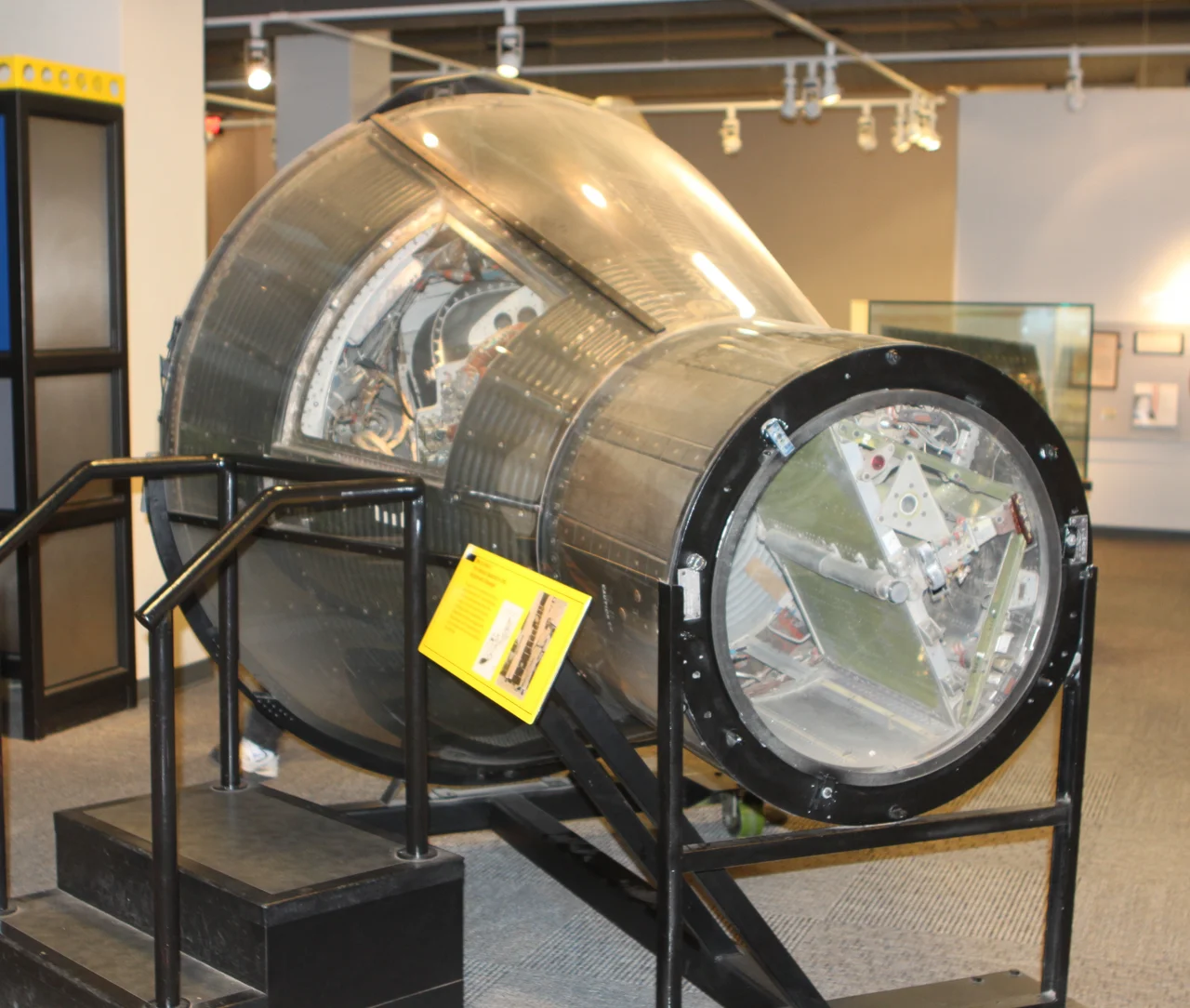
There is a Mercury space capsule sitting inside a museum building in north Durham, and a chimpanzee named Enos used to ride inside it. On November 29, 1961, Enos became the only chimpanzee, and the third primate, to orbit Earth - a flight that proved the Mercury capsule was safe enough for a human, three months before John Glenn climbed in himself. The capsule eventually wound up here, on the campus of what is now the Museum of Life and Science, on loan from the Smithsonian. It is one of the strangest and most genuine collections of space artifacts you'll find anywhere outside Washington: a Moon rock, Neil Armstrong's dosimeter, pieces of an Apollo Lunar Rover, a full-sized mockup of a Lunar Module. None of it should be here. All of it is.
The Little Green Hut
The museum did not begin as anything grand. In its early years it was a small green building on Murray Avenue in the Northgate Park neighborhood, run on a shoestring, focused on local natural history and a few hands-on exhibits for children. The thing that changed it was a person. Richard "Dick" Wescott showed up as a volunteer, became the curator, and by 1970 was the executive director - though he kept curating, kept building exhibits with his own hands, kept finding ways to connect a small Durham museum to people far above its weight class. James E. Webb, the second NASA administrator and a native of North Carolina, had a soft spot for his home state. So did Louis Purnell at the National Air and Space Museum and Michael Collins, the Apollo 11 command module pilot. Wescott built relationships with all of them. The Smithsonian started loaning artifacts. By the mid-1970s the little green hut had one of the finest collections of space memorabilia in the country - and a walking tour through a rocket launch designed specifically for blind visitors, decades before that kind of accessibility work was standard.
Dinosaurs by Hand
Wescott built dinosaurs too. In 1967 he completed what he called the Prehistoric Trail - more than twenty life-size plaster models of amphibians, reptiles, and dinosaurs lining a wooded path along Ellerbe Creek. Seymouria. Eryops. Dimetrodon. Plateosaurus. Camptosaurus. A Brontosaurus visible from Murray Avenue, looming above passing cars. He built them by hand, with the help of a small crew of volunteers and his "right hand," the late Willie Holloway, after a personal visit to the museum by Dr. Louis Leakey. The trail was renamed the Dinosaur Trail in 1986. Hurricane Fran wrecked it in 1996, and most of the models eventually fell into disrepair - but the Brontosaurus survived, and when vandals tore off its neck and head in June 2009 the museum and the surrounding neighborhood rebuilt the thing as a community project. A new dinosaur trail opened on the museum's north tract in July 2009, full of Albertosaurus, Styracosaurus, and a juvenile Parasaurolophus you can climb on.
Wolves, Tortoises, Butterflies
The museum's expansion through the late 1990s and 2000s - a project called BioQuest - turned 84 acres of post-industrial land into one of the more unusual zoos in the Southeast. The three-story glass Magic Wings Butterfly House opened on April 17, 1999, packed with hundreds of tropical butterflies and an insectarium tucked into one corner. Explore the Wild followed in May 2006: American black bears, lemurs, radiated tortoises, and, most importantly, red wolves. The museum is part of the official Species Survival Plan for red wolves - one of the rarest mammals on Earth, with only a few dozen left in the wild. In spring 2017 the museum's red wolf pair had a litter of four pups. Those four pups represented two percent of the entire red wolf population at that moment. In 2018 the museum joined the international effort to rescue radiated tortoises after the discovery of 10,000 of them held illegally in a Madagascar house in April. The same year, Catch the Wind let visitors sail remote-control boats on a 5,000-square-foot pond while listening to recorded poems about wind.
Hideaway Woods and Earth Moves
What the museum has done best, over the decades, is treat children as competent. Hideaway Woods opened in 2015 - two acres of nature play built around eight treehouses, a flowing stream, and an enclosed space for the smallest kids. There are no signs telling you what to do. You just climb and splash. The Earth Moves exhibit opened in 2019: a sandstone cave you can crawl through, a 20-foot waterfall whose flow you can change, towers and arches you can build from real stones. The main museum building still houses weather, sound, math, and a hands-on lab for daily experiments. The narrow-gauge C.P. Huntington train still runs along Ellerbe Creek. The farmyard still keeps alpacas and pigs. And the Mercury capsule still sits in the Aerospace gallery, the same space that flew a chimpanzee around the planet sixty-five years ago, parked now in a museum that almost never built any of this and somehow built all of it.
From the Air
Coordinates 36.029°N, 78.897°W in north Durham, North Carolina, in the Northgate Park neighborhood about 2.5 miles north of downtown. Recommended viewing altitude 1,500-2,500 ft AGL. The 84-acre campus is bisected by Murray Avenue; from the air the main building, the glass dome of the Magic Wings Butterfly House, the wooded Dinosaur Trail loop, and the Catch the Wind sailboat pond are visible. Nearest airport is Raleigh-Durham International (KRDU), 14 nm southeast. Person County (KTDF) lies to the north.
Nearby Stories
- Orange County Speedway 3.7 km away
- Tobacco Road 8.7 km away
- Haw River 15 km away
- Johnston County, North Carolina 18 km away
- Soul City, North Carolina 25 km away
- Chinqua Penn Plantation 29 km away
- North Carolina Aviation Museum 40 km away
- Cherry Hill Plantation 45 km away