.jpg)
Museum of the Home
In 1714, the widows of ironmongers moved into a row of 14 newly built four-room almshouses on Kingsland Road in Shoreditch, funded by a bequest from Sir Robert Geffrye, a merchant who had served as Lord Mayor of London and Master of the Ironmongers' Company. By 1911, the Ironmongers' Company decided the area had become too dangerous for pensioners and moved them to the country. The London County Council bought the buildings and opened a museum on the site in 1914, originally intended to serve the local furniture trade as a reference collection. Three hundred years after the widows moved in, the question of whose home gets remembered — and whose name the building should carry — remains unresolved.
From Almshouse to Museum
The original almshouses were funded by Robert Geffrye's estate and designed to house up to 56 elderly women, widows of ironmongers, in modest but dignified four-room houses with a large shared garden. When the Ironmongers' Company sold the property to the London County Council in 1911, the buildings were repurposed. The museum opened on 2 April 1914. The area of Kingsland Road was at that time a centre of the furniture trade, so the museum's initial purpose was practical: a reference collection of furniture and historic interiors to inspire local manufacturers. As furniture production moved away, the focus shifted to school children and general visitors. From 1935 to 1940, curator Marjorie Quennell introduced period room settings — rooms furnished and decorated to represent specific historical moments — that became the museum's defining approach and remained so for the rest of the 20th century. After the abolition of the Inner London Education Authority, the museum became an independent charitable trust in 1991.
Four Centuries of Home
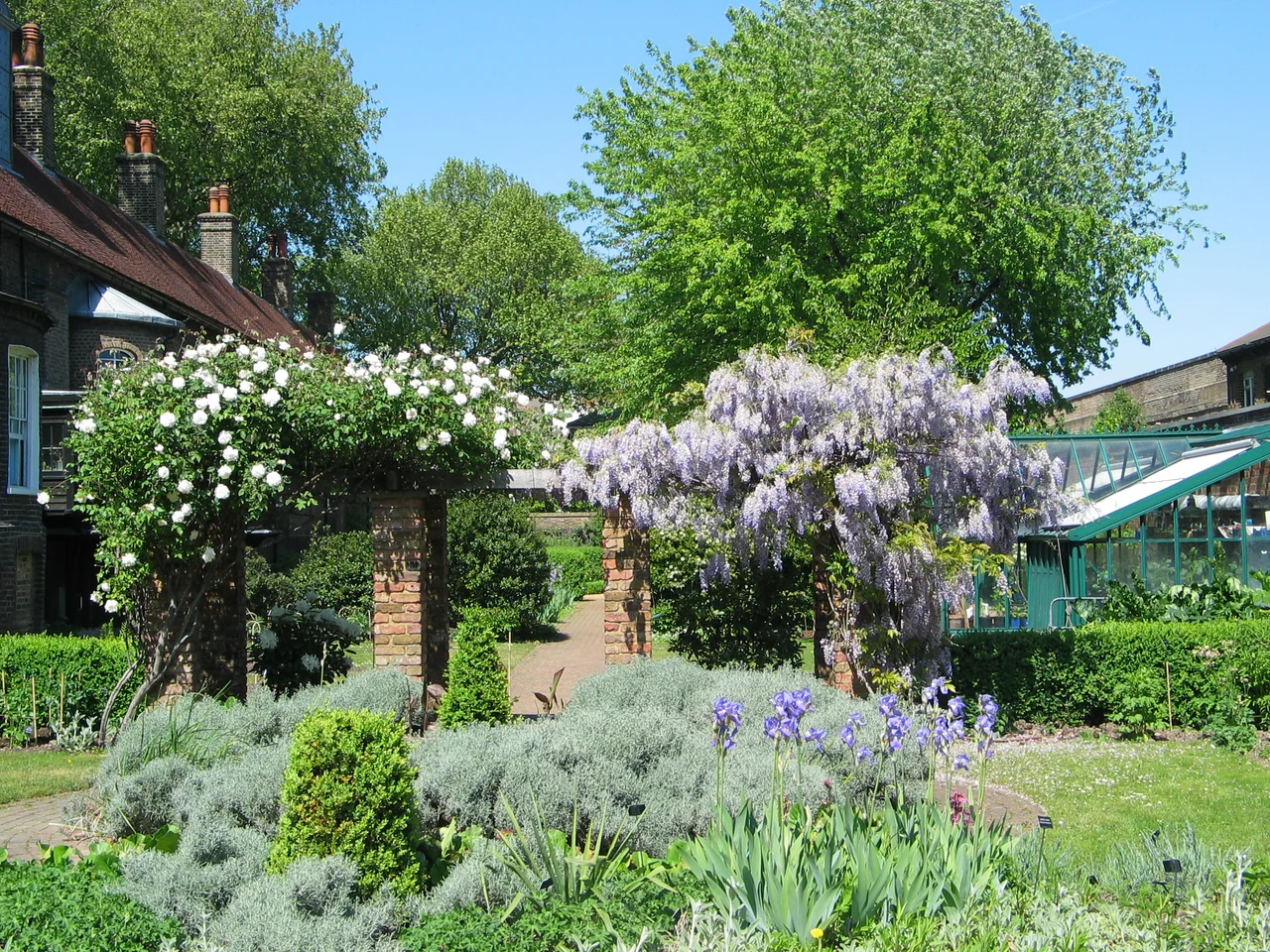
The museum's core achievement is a sequential walk through the history of the domestic interior. Period rooms represent living spaces from the 1600s through to a 1998 loft apartment — tracing not just changes in furniture and decoration, but in how people conceived of the home itself: its privacy, its social functions, its relationship to work and family. The rooms are populated with objects that accumulate meaning over time. A 1630 parlour has different concerns from a 1870 drawing room; the 1976 West Indian front room that appeared after the 2021 reopening — with its glittery cushions, pineapple ice bucket, and souvenirs from St Vincent — had concerns different from either. The Times described it as 'a proper home with cheering clutter.' After an £18 million renovation funded by the Heritage Lottery Fund, the museum reopened in June 2021 with 80 per cent more exhibition space and 50 per cent more public space, including new basement galleries, a café, a learning pavilion, and replanted gardens.
The Statue Question
The museum's formal name was the Geffrye Museum until 2019, when it announced a name change to the Museum of the Home in anticipation of the renovation. Robert Geffrye's statue stands on the front of the building. His wealth — which funded the almshouses and, ultimately, the museum — derived significantly from his involvement in the slave trade through the Royal African Company. In July 2020, the museum consulted local people about whether to remove the statue: 79.4% voted to take it down. Under pressure from the then Culture Secretary Oliver Dowden, who threatened to remove the museum's funding if the statue was relocated, the board of trustees chose instead to 'reinterpret and contextualise' it in place. A sign was added at the base. In November 2021, the museum published a revised statement saying that the statue 'does not promote the sense of belonging that is so important for our visitors' — indicating that the question remained alive, however constrained the options.
What Home Means
The Museum of the Home distinguishes itself from most history museums by its subject: not kings, battles, or great events, but the space where ordinary life happens. The collections and programming explore the psychological and emotional relationships people have with home — the sense of safety or constraint it provides, the ways different communities have shaped domestic space to reflect their values, the objects through which people make a house into something that belongs to them. Exhibitions in recent years have examined disability and home through toys and games; explored the Vietnamese diaspora's relationship to ideas of belonging; presented quilts made by survivors of trauma. The museum's acquisition with Tate of Rebecca Solomon's 1861 painting 'A Young Teacher' reflects its interest in recovering lives that mainstream cultural institutions have overlooked. Entry is free. The gardens — replanted and reopened — remain some of the most serene outdoor spaces in east London.
From the Air
The Museum of the Home is located at 51.5317°N, 0.0762°W on Kingsland Road in Hoxton, east London. From the air, the museum is identifiable by its distinctive Georgian almshouse frontage — a symmetrical row of red-brick buildings set back from Kingsland Road with a forecourt and garden. The area sits east of the City of London, north of Shoreditch. Hoxton Overground station is nearby. Nearest airport is London City (LCY), approximately 8km southeast. Recommended viewing altitude: 1,000–1,500 feet.
Nearby Stories
- Stevenage 5.7 km away
- Malling Abbey 5.7 km away
- 1952 Farnborough Airshow Crash 7.7 km away
- Ingatestone Hall 8.2 km away
- Hellfire Caves 9.1 km away
- The Carrington Event: The Solar Storm That Could Happen Again 9.8 km away
- Bletchley Park 16 km away
- Castle Hedingham 23 km away