_01.jpg)
Mustafa Pasha Mosque
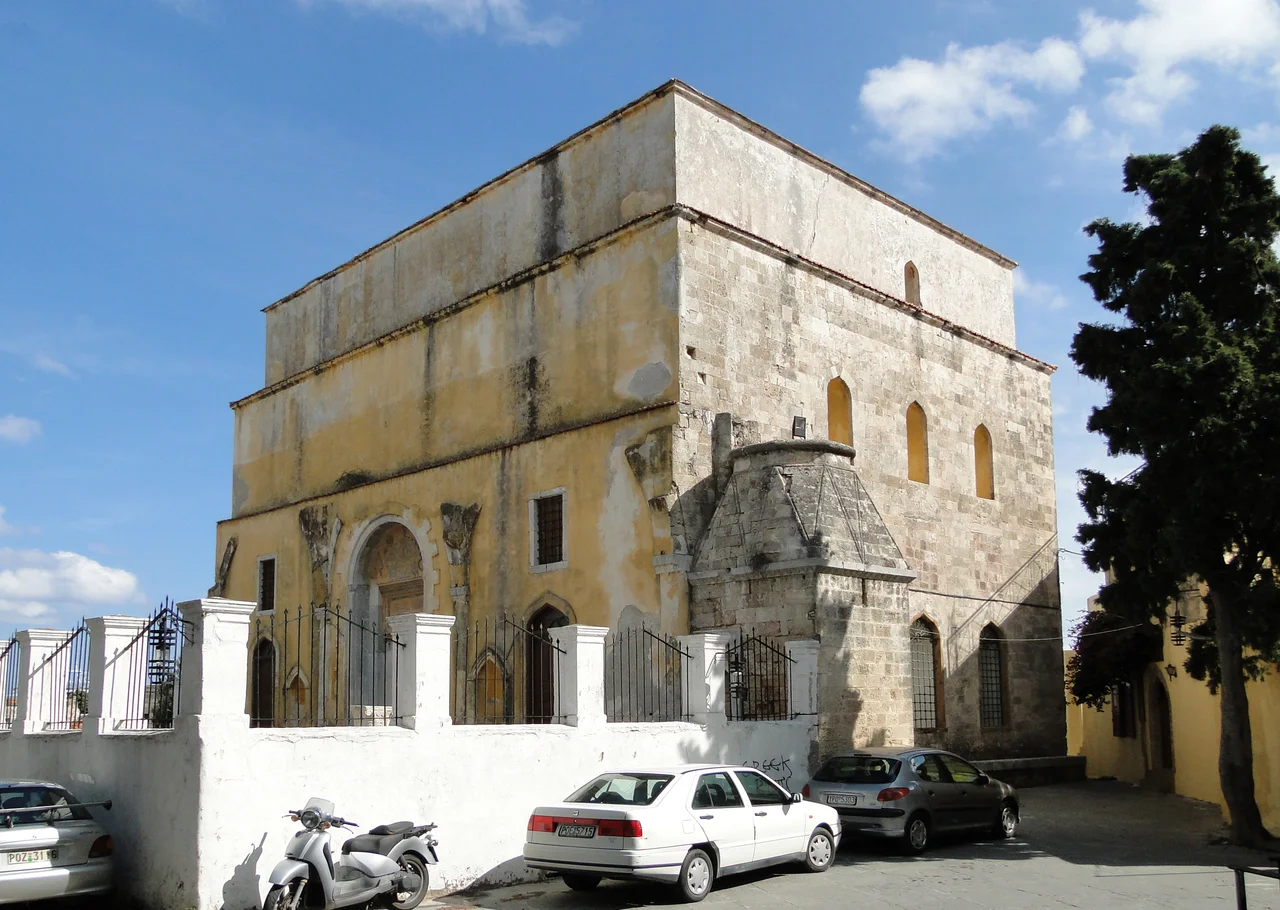
Built in 1764 or 1765 by order of Sultan Mustafa III, the Mustafa Pasha Mosque stands in Arionos Square, in the medieval old town of Rhodes, next to a Turkish bathhouse the same sultan also commissioned. The square is small, quiet most afternoons, paved in worn stone. The mosque's facade is painted a vivid yellow that catches the late afternoon sun and glows. Its minaret was demolished in 1973 and has not been rebuilt. Its great marble portico is also gone, dismantled at some point in the 20th century. What remains is a rectangular building roughly fourteen meters across, topped by a central dome flanked by two unusual rectangular vaults, the only example of vaulted construction in any Ottoman mosque on Rhodes.
Many flags
Rhodes has been many things. A Hellenistic kingdom whose Colossus once welcomed ships at the harbor mouth. A Roman province. A Byzantine theme. The headquarters of the Knights Hospitaller, who lost it to Suleiman the Magnificent's siege in 1522 after a six-month defense. Ottoman territory then for nearly four centuries, during which mosques replaced or stood beside churches throughout the old town. Italian from 1912, when Italy seized the Dodecanese during the Italo-Turkish War and held the islands through World War II. Greek from 1947, when the postwar settlement transferred them to Athens. The Mustafa Pasha Mosque has stood through all of this since the 1760s, used continuously for prayer until the 1940s, when the Muslim population of Rhodes, which had been substantial under Ottoman rule, dwindled through emigration to Turkey and the disruptions of the war.
The architecture
Inside, the central dome covers the mihrab, the prayer niche oriented toward Mecca, and rests on a square plan. To either side, the rectangular vaults running east to west fill the corners that a single dome would have left awkward; this solution to the geometry of square room into round dome is conventional in Ottoman architecture, but the use of true rectangular vaults rather than pendentives or smaller domes is rare. Rhodes has many Ottoman mosques. None of the others do this. Two smaller, shallow domes nest between the vaults. The vault roofs are sheathed in lead strips. The mihrab itself is shallow, less than a quarter circle deep, and crowned by an arch shaped like a crescent moon. Two cylindrical columns frame it, each set on a rectangular base and topped with Corinthian capitals borrowed in spirit from the older classical tradition the eastern Aegean has always carried in its bones.
The minbar
The minbar, the stepped pulpit from which the imam delivered Friday sermons, is among the largest surviving marble minbars on the island. Pieces of grey marble assembled with care. An ornamental top decorated with Arabic calligraphy. Beneath the calligraphy runs an inscription in stone of the Shahada, the Islamic declaration of faith: there is no god but God, and Muhammad is His messenger. The minbar has stood here for two and a half centuries. It has heard sermons in Ottoman Turkish, watched the call to prayer fall silent in the 1940s, and now sits patient through the wedding ceremonies that take place in the building several times a year. Since 1977, the local Muslim community of Rhodes, descendants of Ottoman families who chose to remain when the island became Greek, has used the former mosque as its wedding office.
Care and continuity
Both the mosque and the octagonal stone fountain in its courtyard were registered as protected monuments by the Greek Ministry of Culture in 1948, the year after the Dodecanese officially joined Greece. The yellow facade and the lead roof were renovated in the mid-2010s. The minaret has not been rebuilt; whether it ever will is a question that touches on the politics of a small religious minority within a Greek Orthodox state, and on the practical question of who would pay for it. For now, the building is preserved without being fully restored, in active partial use, neither shut museum nor functioning mosque, but something more particular. A square in old Rhodes where a yellow building still belongs to the people whose ancestors built it, and still hosts the moments that mark new families joining the community.
From the Air
36.443 N, 28.225 E. The mosque is in the old walled town of Rhodes city, on the northeastern tip of Rhodes island, in the southern Aegean. Best viewed at 1,500-3,000 ft AGL where the medieval star-shaped fortifications of the Knights Hospitaller are unmistakable. Diagoras Airport (LGRP) is 14 km southwest. Approach often comes in over the channel between Rhodes and Turkish Anatolia, which is just 18 km east. Strong meltemi winds June-September; check for sea haze in summer.
Nearby Stories
- Temple of Athena Lindia 23 km away
- Bodrum Castle 45 km away
- Battle of Rhodes (1912) 51 km away
- Bodrum 84 km away
- Antalya Museum 166 km away
- Antalya 175 km away
- Toplou Monastery 179 km away
- Agios Neophytos Monastery 361 km away