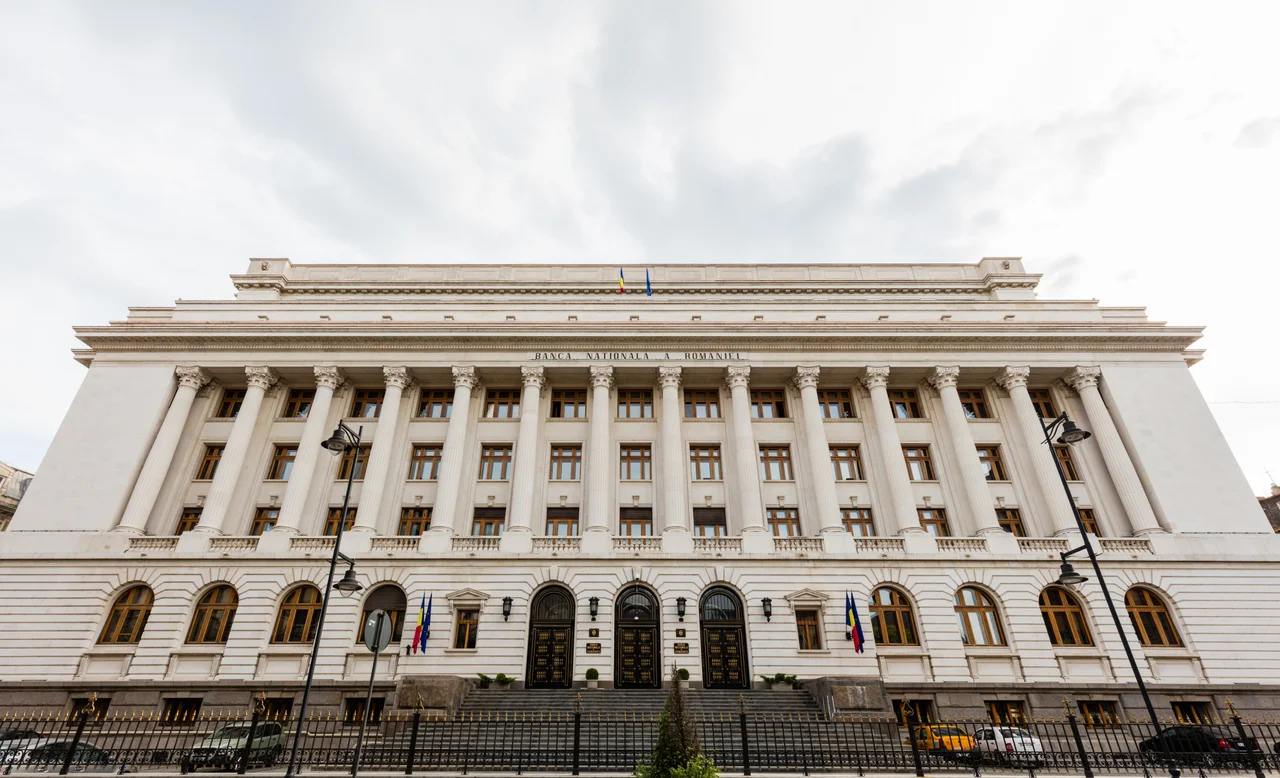

National Bank of Romania
Romania is still owed its gold. In 1916, with the German army advancing, the National Bank of Romania loaded its reserves onto trains and sent them east to Moscow for safekeeping. The Russian government accepted the deposit, signed the receipts, and locked the gold in vaults of the Kremlin. A year later the Tsar fell, and the new Bolshevik regime quietly decided that the deposit was no longer a deposit. More than a century later, with one minor exception, none of the gold has been returned. The headquarters that sent it sits on Lipscani Street in old Bucharest, two adjoining palaces of granite and Corinthian columns, still doing the work of a central bank under different masters.
Founding the Lei
The National Bank of Romania, BNR in Romanian abbreviation, was established in April 1880, only two years after Romania gained full independence from the Ottoman Empire. The bank's first governor was Ion Campineanu. The figure most associated with the institution's founding, however, was Eugeniu Carada, who organized and led the bank but pointedly refused the title of Governor, preferring to operate as director of operations. Carada became something of a legend in Romanian financial history, a quiet technocrat in an era of louder politicians. The bank's mandate was straightforward: issue the Romanian leu as legal tender, set monetary policy, hold currency reserves, manage the exchange rate. Today, as a member of the European System of Central Banks, the BNR also sits on the boards of the European Banking Authority and several other EU financial regulators, a Romanian voice in the rooms where European monetary policy is shaped.
The Old Palace
On 26 February 1882, the French architects Cassien Bernard and Albert Galleron were assigned to design the bank's headquarters. They produced an eclectic late 19th-century building with neoclassical elements, on a site previously occupied by an inn built by the 17th-century Wallachian prince Serban Cantacuzino, who ruled from 1678 to 1688. Construction proceeded between July 1884, when the foundation stone was laid, and June 1890, under the supervision of Romanian architect-engineer Nicolae Cerchez assisted by E. Baicoianu. The result is one of the most imposing bank buildings in Romania, fronting on Lipscani Street, the historic commercial heart of Bucharest. Today it is protected as a historic and artistic monument. The interior includes vaulted halls in marble, frescoes by Eugen Voinescu and Mihail Stefanescu, and the kind of gilded heaviness that signaled fiscal seriousness in the late 19th century.
The Romanian Treasure
When German, Austro-Hungarian, Bulgarian, and Ottoman forces invaded Romania in 1916, the government retreated to Iasi in Moldavia and made a fateful decision: send the country's gold reserves and other valuables to Moscow for safekeeping under wartime alliance with Russia. Two shipments left Romania in December 1916 and August 1917, totaling roughly 91 metric tons of gold, jewelry from the royal family, archives, paintings, manuscripts, and the contents of museums. By the time the second shipment arrived, the Russian Provisional Government was collapsing. After the Bolshevik Revolution, the new Soviet authorities froze the deposit. In 1935 they returned a small portion, including the Pietroasele Treasure, a 4th-century Gothic gold hoard now displayed at the National Museum of Romanian History in Bucharest, along with some manuscripts. The bulk of the gold has never come back. Romanian governments have raised the issue with successive Russian governments for more than a century. The conversations continue, without conclusion.
The Strange Robbery
On 28 July 1959, a group of six Jewish Romanians, all members of the Romanian Communist Party apparatus, were charged with stealing 1,600,000 lei, about 250,000 US dollars at the time, from an armored car of the National Bank of Romania. The case, known as the Ioanid Gang affair, was at the time called the most famous bank robbery in the Eastern bloc. Three of the six were executed. The trouble with the case is that it does not quite make sense. The lei stolen could not have been exchanged for hard currency anywhere in the world, since the Romanian leu was not convertible. The official accusation, that the conspirators planned to donate the money to Zionist organizations to fund Jewish emigration to Israel, made no economic sense given the currency involved. Most historians now believe the trial was a Stalinist-style show trial, possibly tied to internal Communist Party purges of Jewish members in the late 1950s. Whether the robbery actually took place at all remains in dispute. The accused, denied any meaningful chance to defend themselves, are remembered as victims of a regime that needed both criminals and Jews on demand.
From the Air
National Bank of Romania: 44.4326 N, 26.0994 E, on Lipscani Street in old Bucharest, in the historic commercial district just south of Revolution Square and west of the Old Princely Court. Best viewed below 3000 feet. Identifiable as a large stone palatial building with a heavy classical facade, in the dense old city street grid. Henri Coanda International (LROP) is about 10 nm north. The Dambovita River runs through central Bucharest just south of the bank. Class C airspace; coordinate with Bucharest approach for low-level flight over the city center.
Nearby Stories
- National Transport Museum, Bulgaria 34 km away
- Slanic Mine 68 km away
- Sinaia 79 km away
- Great Basilica, Pliska 87 km away
- Sinaia Monastery 108 km away
- Holy Forty Martyrs Church, Veliko Tarnovo 115 km away
- Shumen Fortress 126 km away
- Danube Delta 227 km away