
National College of Art and Design
In 1746 a young painter named Robert West rented rooms on George's Lane in Dublin and started teaching figure drawing. The Dublin Society - later the Royal Dublin Society - was impressed enough to start subsidising his students. Two hundred and eighty years later, that drawing school has not closed. It has changed names eight times, moved across the city, weathered the Act of Union, the Famine, the Easter Rising, two world wars, government closures, riotous student protests, and a 1980 relocation to an old whiskey distillery in the Liberties - but the institution that became the National College of Art and Design has trained Irish artists in an unbroken line since the year of the second Jacobite rebellion.
The Drawing School
Robert West was Master of the Figure School in those first decades; James Marrin ran the Landscape and Ornamental School; Thomas Ivory later headed the Architectural School. Throughout the eighteenth century the school had a status almost unique in the British Isles - it was the only state-supported art school in either Great Britain or Ireland, funded by an annual grant from the Dublin Parliament to the Dublin Society. In 1767 the operation moved to the Society's new premises in Grafton Street, where the drawing rooms looked out across what is now the most expensive shopping street in Ireland. In 1796 the school moved again, to Hawkins Street. In 1811 a fourth discipline was added - the School of Modelling, headed by the great Irish neoclassical sculptor Edward Smyth (whose carved heads of the rivers of Ireland still decorate the keystones of Dublin's Custom House and Four Courts). In 1815 the Society moved its books and casts to Leinster House on Kildare Street, where in 1827 the permanent drawing schools were finally built. They would remain in the basement of Leinster House and its surrounding buildings - sharing the address with the National Library, the National Museum, and what would eventually become the Dail itself - for the next 155 years.
London Takes Over
After the 1800 Act of Union, the school's funding shifted from the Dublin Parliament to Westminster. In 1849 the Board of Trade in London took direct control of the school as a school of industrial design. In 1854 it passed to the new Department of Science and Art at South Kensington in London, and was made to conform to the London syllabus, which prioritised ornamental design for industry above fine art training. In 1877 the British government bought the school outright from the Royal Dublin Society and renamed it the Dublin Metropolitan School of Art. By the early twentieth century, with control devolved back to a Dublin office under Horace Plunkett's Department of Agriculture and Technical Instruction, the school had become an internationally significant centre for craft, particularly stained glass. The crafts teacher A. E. Child trained a generation of stained-glass artists whose work would define early twentieth-century Irish ecclesiastical decoration: Harry Clarke, Michael Healy, Wilhelmina Geddes. William Orpen taught life drawing. The Dublin Metropolitan School in those years was punching wildly above its weight.
Becoming National
In 1924 the Department of Education of the new independent Irish state took over the Metropolitan School. In 1936 it was renamed the National College of Art, with professorships of Design, Painting and Sculpture; weaving and ceramics were added later. By the 1960s the institution was in deep institutional trouble. Adverse reports piled up. The old quarrel between Modernism and traditional academic discipline, which had been settled elsewhere in Europe decades before, had not been settled in Dublin. The college was periodically closed by the government as student disturbances continued. Out of the crisis came the National College of Art and Design Act of 1971, which re-established the college under a new governing board (An Bord) and granted it freedom to run its own academic affairs. On 1 May 1972 the National College of Art and Design - in Irish, Colaiste Naisiunta Elaine is Deartha - officially came into being. In 1975 a faculty structure was adopted: Faculty of Fine Art, Faculty of Design, Faculty of History of Art and Design, Faculty of Education. Degrees followed. A new chapter was beginning.
The Distillery on Thomas Street
The Dail next door at Leinster House needed more space. The college needed more space. In 1980 the College purchased the old Powers Distillery premises at 100 Thomas Street in the Liberties - a six-acre nineteenth-century industrial complex of stone warehouses, vat-houses, and engine rooms. The Department of Visual Communication moved in first; the rest of the college followed over the following years. The largest of the original distillery buildings is the five-storey Granary, crowned with a cupola whose weather vane is dated 1817. The Counting House, designed by C. W. Caroe around 1876, now houses the college administration. The Clock Building holds the National Irish Visual Arts Library. The student cafe occupies what was once the Powers staff canteen, in the vaulted basement of the Counting House. Three of the original giant copper pot stills, once enclosed inside the distillery, now stand on the periphery of Red Square in the open air. Engine House No. 5, which once housed a 250-horsepower beam engine, still stands. The smell of fermenting grain is gone. The smell of oil paint and clay has replaced it.
Next Door to Pugin
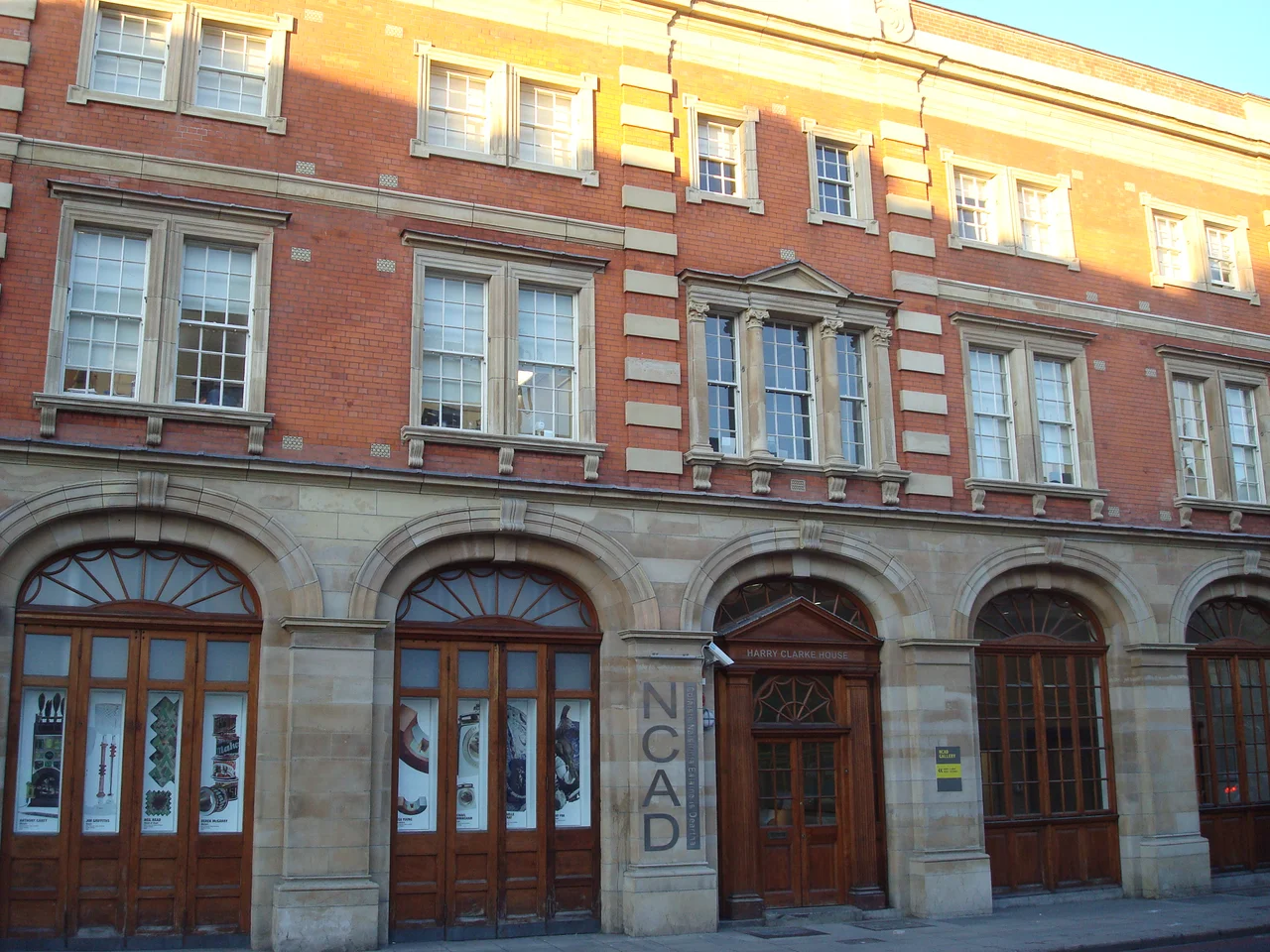
The campus stands immediately next to the Church of St Augustine and St John on Thomas Street - the great Gothic Revival church begun in 1862 by Edward Welby Pugin (son of the more famous A. W. N. Pugin of the Houses of Parliament). Inside the church, fittingly, are stained-glass windows by NCAD alumni Michael Healy and Harry Clarke - light filtered through coloured glass made a few hundred yards away by men who learned their craft on the same site. In 1998 the college acquired the old Thomas Street Fire Station (Dublin's first motorised fire station, designed by Charles J. McCarthy in 1911), renamed it Harry Clarke House in honour of its most famous alumnus, and turned it into lecture theatres. The modernist NCAD Gallery, designed by Murray O'Laoire, opened in 2009 between Harry Clarke House and the Counting House. The college now offers BA degrees in everything from Ceramics and Glass to Interaction Design, joined the National University of Ireland in 2000, and switched its affiliation to University College Dublin in 2011. About 950 full-time students from over forty countries pass through it. The drawing school that Robert West founded in a rented room in 1746 is still operating, somewhere on the grounds, in some form, in 2026.
From the Air
NCAD's Thomas Street campus is located at approximately 53.3428 degrees N, 6.2789 degrees W, in the Liberties area west of Dublin city centre, between Thomas Street and Meath Street. From the air the precinct shows as the cluster of nineteenth-century industrial buildings (the old Powers Distillery) adjacent to the prominent Gothic spire of the Church of St Augustine and St John. Dublin Airport (EIDW) lies about 10 km north-east; Weston (EIWT) sits west. The Liffey just to the north provides the most useful navigation line.
Nearby Stories
- Wicklow Mountains 12 km away
- Mornington 14 km away
- German submarine U-1051 16 km away
- Abbey of Kells 18 km away
- Irish Military Intelligence Service 20 km away
- HMS Manners (K568) 37 km away
- Templemore 42 km away
- Irish Sea Bridge 43 km away