
National Gallery
Most European national galleries began as confiscated palace walls. The Louvre was the French royal collection nationalised in 1793; the Uffizi was the Medici inheritance opened to Florentines in 1789; the Hermitage was Catherine the Great's hoard. London came late to the idea and refused the obvious source. The British Royal Collection still belongs, two centuries later, to the sovereign personally. So in 1824 the British government did something stranger: it bought 38 paintings, in cash, from the heirs of a Russian-born marine insurance underwriter called John Julius Angerstein, and called the result a national gallery. Angerstein's old townhouse at 100 Pall Mall served as the first home. There was no royal collection inside. There was no palace. There was a handful of pictures, free admission, and a determination that anyone could walk in.
Buying a Founding Collection
Britain had nearly bought a national collection three times before. In 1777 the descendants of Sir Robert Walpole put his pictures up for sale. The MP John Wilkes argued in Parliament for the government to buy this 'invaluable treasure' and house it in a gallery built in the British Museum's garden. Nothing happened, and Catherine the Great bought the lot for St Petersburg. In 1798 the Orleans collection arrived in London for sale; George III and William Pitt the Younger both wanted it; nothing happened, although twenty-five of those paintings would later trickle into the National Gallery anyway, one of them carrying the accession number NG1. In 1799 the dealer Noel Desenfans tried to give Britain the ready-made collection he and Sir Francis Bourgeois had assembled for the King of Poland - until the Third Partition of Poland in 1795 abolished the kingdom. The offer was refused. Bourgeois left the pictures to his old school. The result, in 1814, was the Dulwich Picture Gallery, Britain's first purpose-built public art museum - which opened a full decade before the National Gallery.
Trafalgar Square
Construction of the Trafalgar Square building began in 1832 to a design by William Wilkins, on the northern half of the old Royal Mews. The location was political. It sat between the wealthy West End and the poorer streets to the east; Parliament's commission of 1857 declared that 'the existence of the pictures is not the end purpose of the collection, but the means only to give the people an ennobling enjoyment.' The building itself was almost universally hated. The site was only one room deep because a workhouse and a barracks stood directly behind it. Columns demolished from Carlton House were forced into the elevation. Sculptures originally intended for John Nash's Marble Arch, abandoned when Nash ran out of money, were grafted onto the facade. William IV called it 'a nasty little pokey hole.' Thackeray called it 'a little gin shop of a building.' Augustus Pugin put it on the cover of Contrasts (1836) as a specimen of architectural degeneracy. The gallery opened to the public on 9 April 1838 and has been expanded around the original facade ever since.
Eastlake and the Italian Hunt
The early gallery was run by trustees with conservative taste and a hopeless purchase grant. Between 1847 and 1850 no acquisitions were made at all. In 1851 a critical House of Commons report demanded a single director with real authority. Sir Charles Lock Eastlake got the job in 1855, and he transformed the place. Eastlake's taste was for the early Italian Renaissance and the Northern Renaissance - the so-called 'primitives,' artists like Piero della Francesca and Paolo Uccello whom the gallery's existing trustees had ignored. He toured the continent every year buying paintings: 148 abroad and 46 in Britain across his eleven years as director. Uccello's three-panel Battle of San Romano arrived under Eastlake. So did Piero's Baptism of Christ. He collected privately too, picking up works he knew the trustees would never buy, and his widow Elizabeth bequeathed his collection to the gallery on his death. Two-thirds of the National Gallery's pictures today came as private gifts. Eastlake set that pattern.
The Manod Quarry
On 1 September 1939 the paintings began moving out of London. The first hiding places - Penrhyn Castle and the university colleges of Bangor and Aberystwyth in Wales - were not secure enough. When the Battle of France began in 1940, the cabinet discussed shipping the collection to Canada. Churchill refused. 'Bury them in caves or in cellars,' he telegrammed director Kenneth Clark, 'but not a picture shall leave these islands.' A slate quarry at Manod, near Blaenau Ffestiniog in North Wales, was requisitioned. The Manod tunnels held the collection at a constant temperature and humidity, conditions the gallery's conservators had long suspected mattered but had never been able to prove. The data they collected at Manod led directly to the first air-conditioned gallery, opened in 1949. Meanwhile, with the walls in Trafalgar Square empty, the gallery hosted lunchtime piano recitals by Myra Hess and a 'Picture of the Month' programme, in which a single masterpiece was retrieved from Wales and displayed for Londoners. The art critic Herbert Read called the wartime gallery 'a defiant outpost of culture right in the middle of a bombed and shattered metropolis.' The paintings came home in 1945.
The Sainsbury Wing and What's Inside
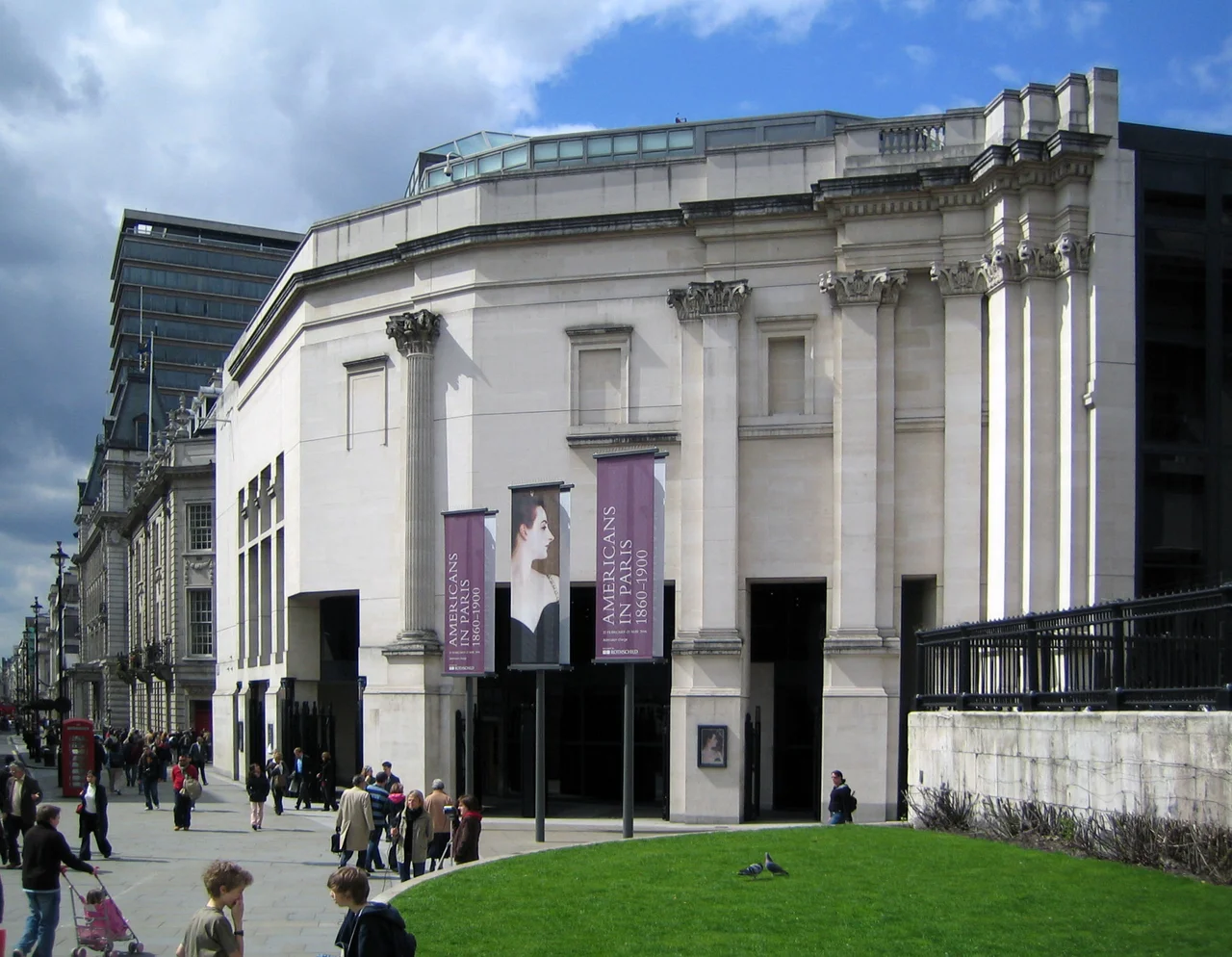
In 1982 a competition was held for an extension on the bomb-damaged Hampton's site to the west. The winning design by Ahrends, Burton and Koralek included a tower. The Prince of Wales famously called the proposal 'a monstrous carbuncle on the face of a much-loved and elegant friend' - a phrase that has since become the standard British insult for any unwelcome modern building - and the design was dropped. A donation of nearly £50 million from Lord Sainsbury and his brothers allowed a new closed competition; the postmodernists Robert Venturi and Denise Scott Brown won, and the Sainsbury Wing opened in 1991. Its toplit galleries draw on John Soane's Dulwich Picture Gallery and the church interiors of Brunelleschi. False perspective in the long central axis ends, fittingly, on an altarpiece by Cima. The collection on these walls now includes Jan van Eyck's Arnolfini Portrait, Piero della Francesca's Baptism, Holbein's Ambassadors, Velazquez's Rokeby Venus, Caravaggio's Supper at Emmaus, Rembrandt's Belshazzar's Feast, Turner's The Fighting Temeraire, and Van Gogh's Sunflowers. In 2024 the gallery celebrated its bicentenary. In September 2025 it announced Project Domani: a £375 million expansion behind the Sainsbury Wing, and a policy change ending the 1900 cut-off so that twentieth-century paintings can return. Admission to the main collection has been free since 1824. Sir Denis Mahon's bequest stipulated that it must stay that way. The building is still ugly, the corridors are still crowded, and the Renaissance is still on free public display.
From the Air
The National Gallery occupies the north side of Trafalgar Square at 51.5089° N, 0.1283° W. From the air the colonnaded front faces south across the square toward Whitehall, with Nelson's Column directly in front. The Sainsbury Wing extension sits to the west; the National Portrait Gallery wraps around the building's eastern flank. London Heliport (EGLW) is the closest helipad; London City (EGLC) east, Heathrow (EGLL) west. Central London is Class A airspace and restricted. From the ground, the easiest landing-on-feet route is from Trafalgar Square itself; entry from the new Getty Entrance at ground level avoids the historic main staircase. The collection comprises more than 2,300 paintings from the mid-13th century to 1900, with Project Domani set to extend the date range into the modern era in the early 2030s.
Nearby Stories
- Stevenage 5.7 km away
- Malling Abbey 5.7 km away
- 1952 Farnborough Airshow Crash 7.7 km away
- Ingatestone Hall 8.2 km away
- Hellfire Caves 9.1 km away
- The Carrington Event: The Solar Storm That Could Happen Again 9.8 km away
- Bletchley Park 16 km away
- Castle Hedingham 23 km away