.jpg)
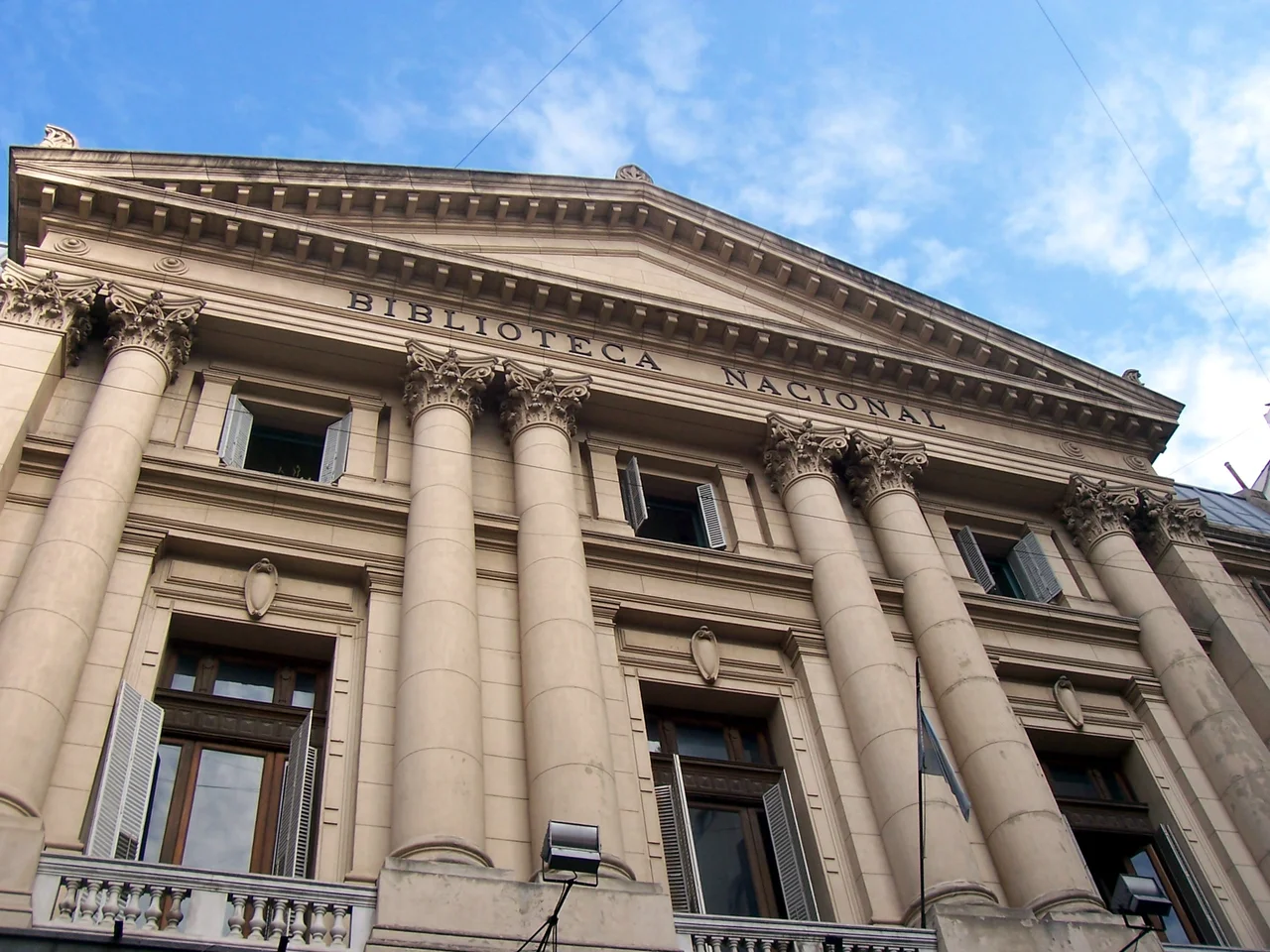
National Library of Argentina
In 1955, Argentina made Jorge Luis Borges director of its National Library. Surrounded by nearly a million books, he was, by then, almost entirely blind. He could barely make out the titles on the spines. He called it the splendid irony of God, who, he wrote, granted him books and blindness at one touch. It was not even the first time the institution had been led by a blind man, and it would not, by then, have surprised anyone who knew its strange and tangled history. The library that holds the soul of Argentine letters has always seemed to attract such fates.
A Library for a Revolution
The library was born in September 1810, in the same revolutionary heat that created the country, founded by decree only months after the May Revolution overthrew Spanish rule in Buenos Aires. Its first director was Mariano Moreno, a fierce young intellectual of that revolution and one of independence's sharpest minds, the man whose writings had helped light the fuse. For Moreno, a public library was not a luxury but a weapon: part of a deliberate program to forge citizens, to make the case that an educated people could govern themselves and build an autonomous country. The institution began as the Public Library of Buenos Aires and only formally became the National Library of Argentina in 1884, when the city became the nation's capital and the library redefined its mission to match. Moreno himself would not see it grow; he died at sea in 1811, not yet thirty-five, on a diplomatic voyage to Britain.
The Blind Directors
The library has a habit of being run by men losing their sight. Paul Groussac, the formidable French-born scholar who directed it for some forty years, built a rigorous cataloging system and founded its most prestigious journals, then went blind himself before dying in 1929. Decades earlier the writer-director José Mármol had also lost his vision. And then came Borges, the third in this uncanny line. When Borges later wrote his Poem of the Gifts about the coincidence, he was not inventing a literary conceit. He was simply describing the history of the building he had been given to run, a place where the keepers of the books kept going dark.
Houses for the Words
The collection has lived in several homes, each with its own quirk. It began in an old eighteenth-century Jesuit mansion on the Manzana de las Luces, the colonial Block of Enlightenment, at the corner of Moreno and Perú streets. Its founding shelves were stocked with books seized from the royalist Bishop Orellana and donated by the Cabildo, the colonial college, and Belgrano, the patriotic library of a revolution. In 1901 it moved to a building on Mexico Street, in the Monserrat ward, that had been designed for the national lottery, so that early visitors, climbing a grand staircase still decorated with lottery ornaments, must have wondered what kind of library they had entered. Across these years Groussac's forty-year tenure swelled the holdings with great private collections: tens of thousands of volumes from jurists, historians, and scholars, including some 18,600 from the legal expert Amancio Alcorta, and papers reaching back to the very founding of Buenos Aires.
Concrete and Memory
The library's present home is a startling thing: a vast brutalist structure raised on massive concrete legs, designed in 1961 by Clorindo Testa with Francisco Bullrich and Alicia Cazzaniga. It stands on charged ground. This was the site of the Unzué Palace, the residence where Juan and Eva Perón lived and where Evita died in 1952. The palace was demolished in 1958 for political reasons, and a library rose in its place. Bureaucratic indifference dragged the project out for decades; construction did not begin until 1971, and the new building was not inaugurated until 1992. Borges, who had run the old library and given it his legend, died in 1986, six years before the new one finally opened its doors.
From the Air
The National Library of Argentina stands in Recoleta at 34.58°S, 58.40°W, its bold concrete form raised on pillars above a public park near Plaza Rubén Darío. From the air, the brutalist building is one of the most recognizable structures in the district, hovering over green space close to the riverside Avenida del Libertador and the parks of Recoleta. Aeroparque Jorge Newbery (ICAO: SABE) lies roughly 3 km north along the Río de la Plata, placing the library beneath many flight paths; Ministro Pistarini / Ezeiza International (ICAO: SAEZ) is about 35 km southwest. A viewing altitude of 1,500–2,500 ft on a clear day best reveals the library's stark geometry against the surrounding parkland. Morning river haze can soften the view from the northeast.
Nearby Stories
- Ezeiza Massacre 1.9 km away
- Luján, Buenos Aires 5.1 km away
- Curutchet House 13 km away
- Colonia del Sacramento 17 km away
- Martín García Island 28 km away
- Atucha Nuclear Power Plant 37 km away
- Lobos 43 km away
- Cry of Asencio 87 km away