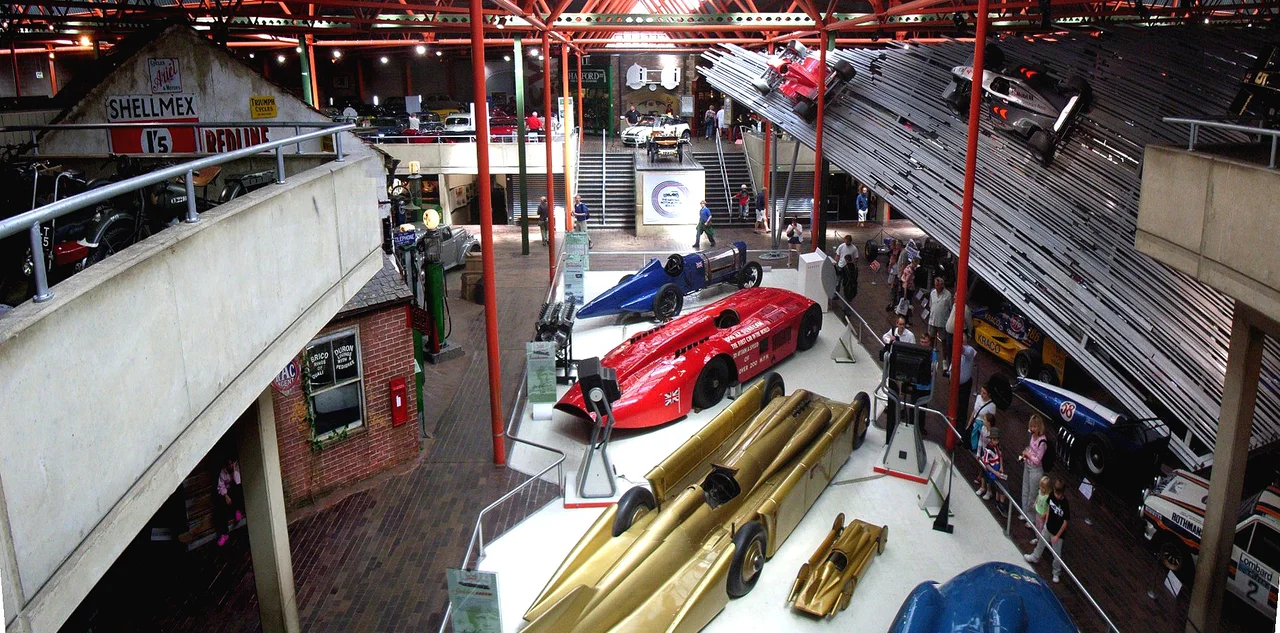

National Motor Museum, Beaulieu
It began as a memorial. In 1952, Edward Douglas-Scott-Montagu, the 3rd Baron Montagu of Beaulieu, opened the front hall of his ancestral house to the public, set out five cars and some automobilia, and called it a museum. The tribute was for his father - the 2nd Baron Montagu - who had driven a motor car into the yard of the Houses of Parliament before anyone else, and who had taught the future King Edward VII to drive in the 1890s. The five cars outgrew the front hall almost immediately. By 1959, attendance had crossed 290,000 a year. By 1964, half a million. The tribute had become an institution.
From Front Hall to Purpose-Built
By the early 1960s, Lord Montagu and his trustees realised the wooden sheds behind Palace House could not keep up. A design committee chaired by the architect Sir Hugh Casson commissioned Leonard Manasseh's practice; the building was largely the work of his partner Ian Baker. The new museum opened on 4 July 1972, in a ceremony performed by the Duke of Kent, with more than 300 exhibits ranged across a purpose-built hall in the parkland around Palace House. The status changed at the same time. What had been a private collection became a charitable trust, with the new name - the National Motor Museum - meant to declare Britain's ambition to have a museum 'worthy of the great achievements of its motor industry'.
Record-Breakers Under One Roof
Walk through the galleries and the range is startling. Earliest motor carriages share floor space with World Land Speed record cars: the Bluebird CN7, the Golden Arrow, the Sunbeam 350hp and the colossal Sunbeam 1000hp, the first car to break 200 mph. A recreated 1930s garage holds tools and ephemera. 'Streets Ahead' walks you past shop fronts and cars from the 1950s to the 1970s. The Grand Prix Greats gallery covers Formula 1 history; Road, Race and Rally focuses on hill-climbing and rallying machines. The collection covers motorcycles too, and there is even a monorail - opened with the museum in 1972 - that loops you over the exhibits at gallery-roof height.
On-Screen Cars and a Whispered Secret
The 'On Screen Cars' gallery is where the museum lets itself have fun. Del Boy's three-wheeled Reliant Regal from 'Only Fools and Horses'. Mr. Bean's lime-green Mini. Doctor Who's roadster, Bessie. The Jaguar XKR Convertible from 'Die Another Day' lives in the permanent collection. The 'World of Top Gear' exhibit ran from June 2009 to November 2024, drawing more than five million visitors before closing to make way for 'We had one of those.' But the most quietly compelling object is small: a collection of Rolls-Royce Spirit of Ecstasy mascots, including the original. Charles Sykes sculpted it for the 2nd Baron Montagu's Silver Ghost in the form of Eleanor Thornton - the model, and the Baron's secretary, with whom he was conducting an affair. Sykes posed her with a finger to her lips. He called the figurine 'The Whisper'.
An Estate, Not Just a Museum
The Motor Museum is one ticket among several on the Beaulieu estate. Walk down the path and Palace House waits, the Montagu family home built into the gatehouse of a 13th-century Cistercian abbey. The partial ruins of Beaulieu Abbey, dissolved by Henry VIII, are still on the grounds; the domus is used for functions, and the refectory still serves as the parish church. The Secret Army Exhibition tells the story of the Special Operations Executive, which trained agents in this very estate during the Second World War, sending them into occupied Europe from a place hidden in the New Forest. In Spring 2026 a new gallery, 'Driven: Britain's Motoring Story,' is set to open, funded in part by the National Lottery Heritage Fund.
From the Air
The National Motor Museum sits inside the Beaulieu Estate in the New Forest at 50.82 N, 1.45 W. The nearest airfields are Bournemouth (EGHH), 14 nm southwest, and Southampton (EGHI), 9 nm northeast. From 1,500 to 2,500 feet, look for the broad estuary of the Beaulieu River winding down to the Solent, with Palace House and the abbey ruins set in parkland just inland. The New Forest's heaths stretch north and west. The Isle of Wight rises across the Solent to the southeast.
Nearby Stories
- Clavell Tower 2.5 km away
- Longleat Safari and Adventure Park 11 km away
- Siege of Basing House 13 km away
- Shaftesbury Abbey 14 km away
- Woodhenge 15 km away
- Fishbourne Roman Palace 18 km away
- Swanage Lifeboat Station 26 km away
- D-Day: The Longest Day 164 km away