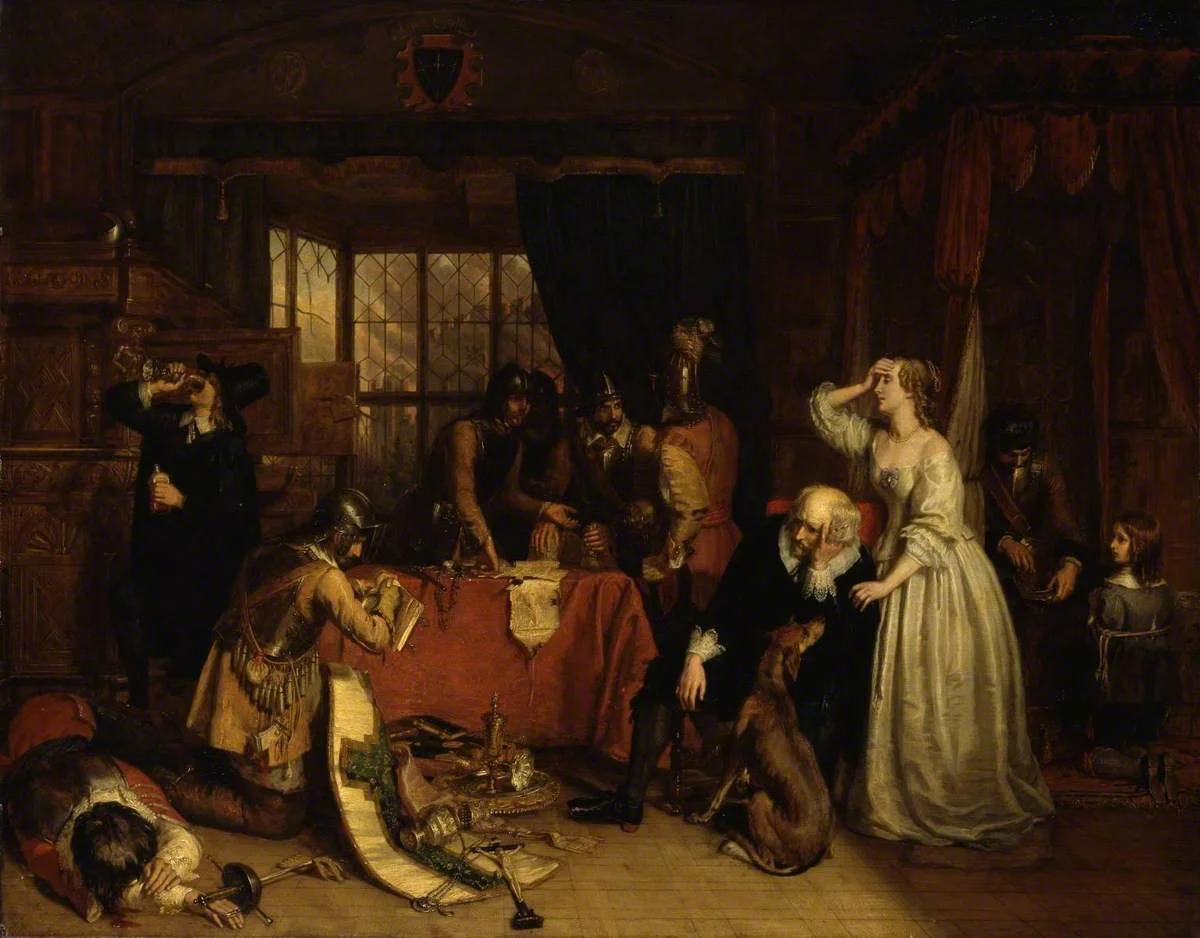
_-_The_Plundering_of_Basing_House_-_N00612_-_Tate.jpg)
Siege of Basing House
John Paulet, fifth Marquess of Winchester, had a motto written on the window glass of his house: Aymez Loyaute. Love loyalty. He believed it literally enough that he held Basing House against three sieges across two years of civil war, sheltering Inigo Jones and the actor William Robbins and the engraver Wenceslaus Hollar within his walls, until Oliver Cromwell himself arrived with a 63-pounder cannon and reduced Loyalty House to gaunt and blackened walls in a single morning.
A Princely Residence
The first Marquess of Winchester, Sir William Paulet, had served four Tudor monarchs and converted Basing House from a medieval castle into something his descendants called a princely residence. By 1643 it covered fourteen and a half acres - gardens, courtyards, entrenchments, a four-turreted gatehouse looking north, brick ramparts lined with earth, and a deep dry ditch. It commanded the road from London through Salisbury to the west, which was reason enough for the King to want it held, and for Parliament to want it taken. Inside, the fifth Marquess hoped at first that "integrity and privacy might have here preserved his peace." He was wrong. By the summer of 1643 the house was a Royalist garrison, with 100 musketeers sent by Charles I to stiffen the defence.
Waller's Failure
Sir William Waller arrived on 6 November 1643 at the head of seven thousand horse and foot. He attacked three times in nine days. The first storm was broken by wind and rain. The second was undone by a Westminster regiment that refused to obey orders. The third collapsed when the London trained bands, ordered forward, shouted "Home! home!" and deserted in a body. Inside the house, only two of the garrison had been killed. Waller withdrew to Farnham, humiliated. He wrote afterward to his old friend Lord Hopton, now on the opposite side, with rueful honesty about the war they were both caught in - the kind of letter that reminds you these were neighbours fighting neighbours.
Starvation by Inches
The winter passed quietly. In June 1644 Colonel Richard Norton closed in again, this time to starve the place out. The garrison divided itself into three watches under Major Cufaude, Major Langley, and Lieutenant-Colonel Rawdon, the last excused from night duty on account of his age. They made sallies, burnt the besiegers' positions, took prisoners, lost men. By September the house was nearly out of food. A relief column was promised, then delayed, and on 11 September the news arrived that help was on its way. The man bringing it was Colonel Henry Gage, riding from Oxford with an orange sash on his back - the colour Parliamentary officers wore - in the hope that, glimpsed from a distance, his column might be mistaken for the enemy's. The deception worked. He cut his way through the lines, resupplied the garrison, took the church back from the besiegers, and slipped out again the following night.
Loyalty House
Waller returned, reinvested the house, and pressed the siege through October. By the first of November the garrison's bread, corn, and beer were exhausted, and officers were skipping one meal a day. Disease was eating Waller's army faster than his army was eating the garrison. By mid-November he had 700 men left of the 2,000 he had started with. He burned his huts and retreated toward Odiham, and Gage arrived five days later with a thousand horsemen, each carrying a sack of corn over his saddle and a coil of match around his waist. The garrison held through the winter, the spring, the summer. They had survived two sieges. They believed they could survive a third.
Cromwell Arrives
What changed was Naseby. Cromwell's New Model cavalry had broken the King at Naseby in June 1645, and through the autumn his forces gathered the kingdom in like a closing hand. On 8 October Cromwell arrived at Basing with five demi-cannons and a 63-pounder. He summoned the garrison to surrender on 11 October. They refused. By the evening of 13 October two wide breaches had been opened in the walls. At two in the morning Cromwell resolved to storm at six. He spent the rest of the night in prayer, persuaded he was God's champion against what he called "a nest of Romanists." At dawn his soldiers were loosed upon the doomed house. The defenders, perhaps four hundred against several times that number, could not hold the breaches. Six of the ten priests in the house were killed during the assault; the other four were saved for the gallows. The daughter of an Anglican clergyman, hearing her wounded father reviled, snapped back at the soldier abusing him and was struck on the head and killed. The Marquess himself survived only because a Parliamentary colonel he had once treated kindly as a prisoner now protected him in turn.
The Fire
Inigo Jones, then seventy-two, was carried out wrapped in a blanket because the looters had stripped him of every stitch. The architect of the Banqueting House had become a refugee in his own clothes. While soldiers and country people sorted plate, jewels, tapestry, and a hundred ladies' gowns into heaps on the lawn, fire took the building, and within hours of victory the great house was a ruin. Hugh Peters, Cromwell's chaplain, pressed the broken Marquess to admit that the King's cause was hopeless. "If the King," he replied, "had no more ground in England but Basing House, I would adventure as I did, and so maintain it to the uttermost. Basing House is called Loyalty." The next day, on Cromwell's recommendation, the House of Commons resolved that the place be "totally slighted and demolished," and that anyone who wanted to cart away the stones could have them free for their pains. They did. The site of Loyalty House is now an outline in the grass on the edge of Basingstoke.
From the Air
The ruins of Basing House lie just east of Basingstoke at 51.269°N, 1.052°W, beside the M3 and the Reading-Basingstoke railway. Visible from low altitude on approach to Farnborough (EGLF) or Southampton (EGHI). The most obvious landmark in the area is the Basingstoke ringway; the old village of Old Basing is to the east, and Basing Church - still bearing musket-shot marks from the siege - is adjacent to the ruin.
Nearby Stories
- Ealing Abbey 3.4 km away
- SeaCity Museum 7.6 km away
- The Carrington Event: The Solar Storm That Could Happen Again 13 km away
- Mansion House, Hurstpierpoint 13 km away
- Fishbourne Roman Palace 16 km away
- Hellfire Caves 17 km away
- Hungerford Massacre 21 km away
- Museum of the Great Western Railway 28 km away