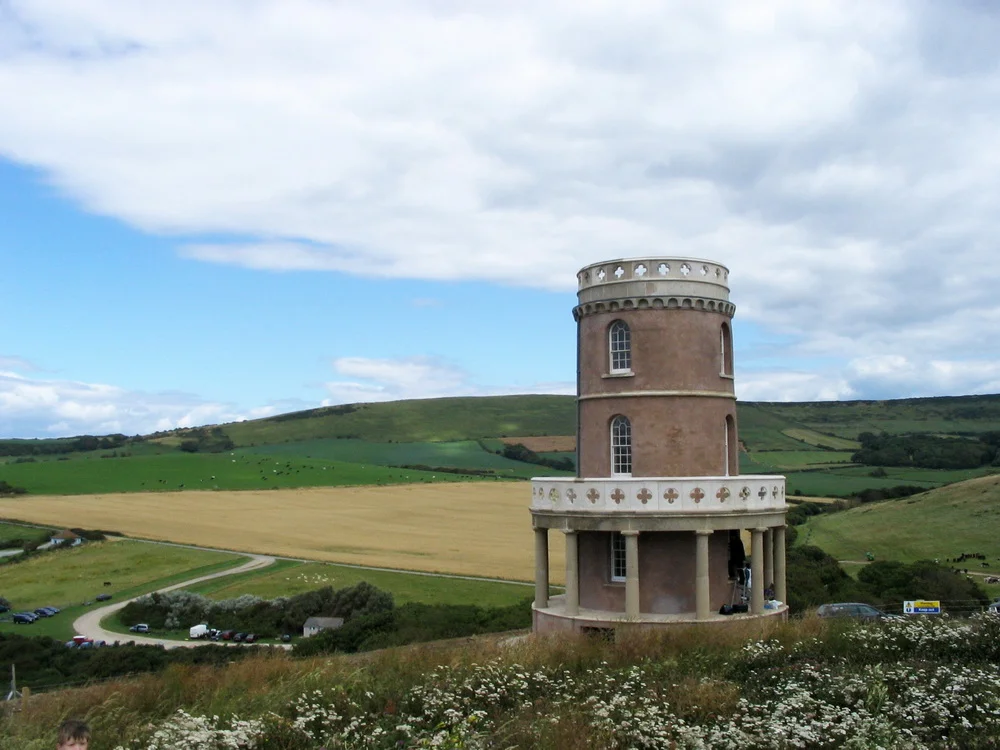

Clavell Tower
Engineers numbered each of the 16,272 stones with a marker and a camera before lifting them off the cliff. The Reverend John Richards Clavell had not anticipated this when he raised his Tuscan folly above Hen Cliff in about 1830 - he was simply a country clergyman with a freshly inherited estate, a love of observatories, and an enviable view. But the same chalk-grey cliffs that gave the tower its 330-foot perch above Kimmeridge Bay were dissolving beneath it. By 2006, the sea had crept close enough that the only way to save the building was to take it apart and walk it inland.
A Clergyman's Indulgence
John Richards inherited the Smedmore estate in 1817 and, in keeping with the genteel custom of the day, added Clavell to his name. Folly-building was already a polite Georgian habit - a way for landed gentlemen to perform learning and leisure on the skyline of their own land - and the new Reverend Clavell took to it with enthusiasm. His tower stood thirty-five feet high, four storeys tall, ringed at the ground by a Tuscan colonnade and capped with a stone parapet. The upper floors were timber and could only be reached by ladder, but fireplaces on the ground floor suggest the Reverend meant to use the place year-round. Whether observatory or summerhouse, it was a building designed for one purpose above all: to give a man somewhere extraordinary to stand and look out at the sea.
Hardy's Hill
Thomas Hardy walked these cliffs with Eliza Nicholls, his first love, and Clavell Tower became one of their places. He later used an illustration of it in his Wessex Poems, fixing the building in literary geography long after the romance had faded. The Dorset coast that Hardy made famous is full of these layered intimacies - lovers' walks remembered as poems, poems remembered as landscapes. The local coastguards eventually claimed the tower as a lookout, watching the Channel through Reverend Clavell's windows until the 1930s, when a fire gutted the interior. The roofless, blackened shell that remained spent decades as a haunting silhouette on the headland, the kind of ruin that invites stories.
The Black Tower
P. D. James found the desolate building so unnerving she made it the centrepiece of her 1975 detective novel The Black Tower, sending Adam Dalgliesh to a sinister Dorset clifftop to investigate a death. Anglia Television filmed the adaptation here in 1985 with Roy Marsden as Dalgliesh, and the same year the tower appeared in The Style Council's music video for Boy Who Cried Wolf - Paul Weller picking out his lyrics against the grey Jurassic Coast. By then the building had outlived its first purpose three times over: as folly, as coastguard post, as gothic ruin. It was about to be asked to do something stranger still.
A Tower in Motion
By the early 2000s, the cliff edge was within metres of the foundations. The Landmark Trust, which acquired the tower in 2002, decided the only way to keep it was to move it. Work began on 5 September 2006. Each of the tower's 16,272 stones was numbered, photographed, and lifted away. Engineers laid out a new foundation 25 metres inland, then reassembled the puzzle. Around 298 new carved stones replaced ones too damaged to reuse. The job consumed roughly a mile and a half of pipes and cables, ten tons of render, 1,344 bags of lime, and a hundred tons of sand. The final stone went back on 25 February 2008 in a traditional topping-out ceremony - a Georgian folly successfully transplanted, the way you might move an ancient tree.
A Room With Every View
The tower today sleeps two, which is the kind of detail that sounds like a joke until you stand inside it. The top-floor living room offers a 360-degree view of the surrounding coast and countryside, and rental income from the holiday let pays for the maintenance of the building it occupies. Antony Gormley once chose it for one of five sculptures marking the Landmark Trust's 50th anniversary - until the figure toppled into the sea in September 2015, a reminder of what the tower itself had narrowly escaped. The cliffs below continue to retreat. The Reverend Clavell's observatory has bought itself another century, perhaps two, by walking away from the edge it once leaned over.
From the Air
50.6069°N, 2.13°W on the eastern flank of Kimmeridge Bay, Isle of Purbeck. The tower sits atop Hen Cliff at roughly 330 feet AMSL. Nearest aviation reference is Bournemouth (EGHH) about 22 nm east-northeast. Best viewing 1,500-3,000 ft AGL on a clear southerly approach along the Jurassic Coast. The tower's pale Tuscan silhouette is unmistakable against the dark Kimmeridge shale below.
Nearby Stories
- Needles Lighthouse 18 km away
- Lyme Bay Canoeing Disaster 19 km away
- HMS Formidable (1898) 19 km away
- National Motor Museum, Beaulieu 22 km away
- Sherborne Castle 22 km away
- Muchelney Abbey 24 km away
- German Submarine U-672 29 km away
- Battle of Cherbourg (1864) 58 km away