;_B-II-m-A-19856.JPG)
National Museum of Art of Romania
The bullet holes are still there if you know where to look. In December 1989, when the Romanian Revolution raged through Revolution Square, gunfire raked the Royal Palace, shattering windows and tearing through galleries that held some of Europe's finest paintings. The museum staff hid what they could. When the smoke cleared and Nicolae Ceausescu lay dead, the National Museum of Art of Romania began the long work of rebuilding itself, room by room, painting by painting, until it could open its doors again on a country that no longer existed.
The Palace Before the Republic
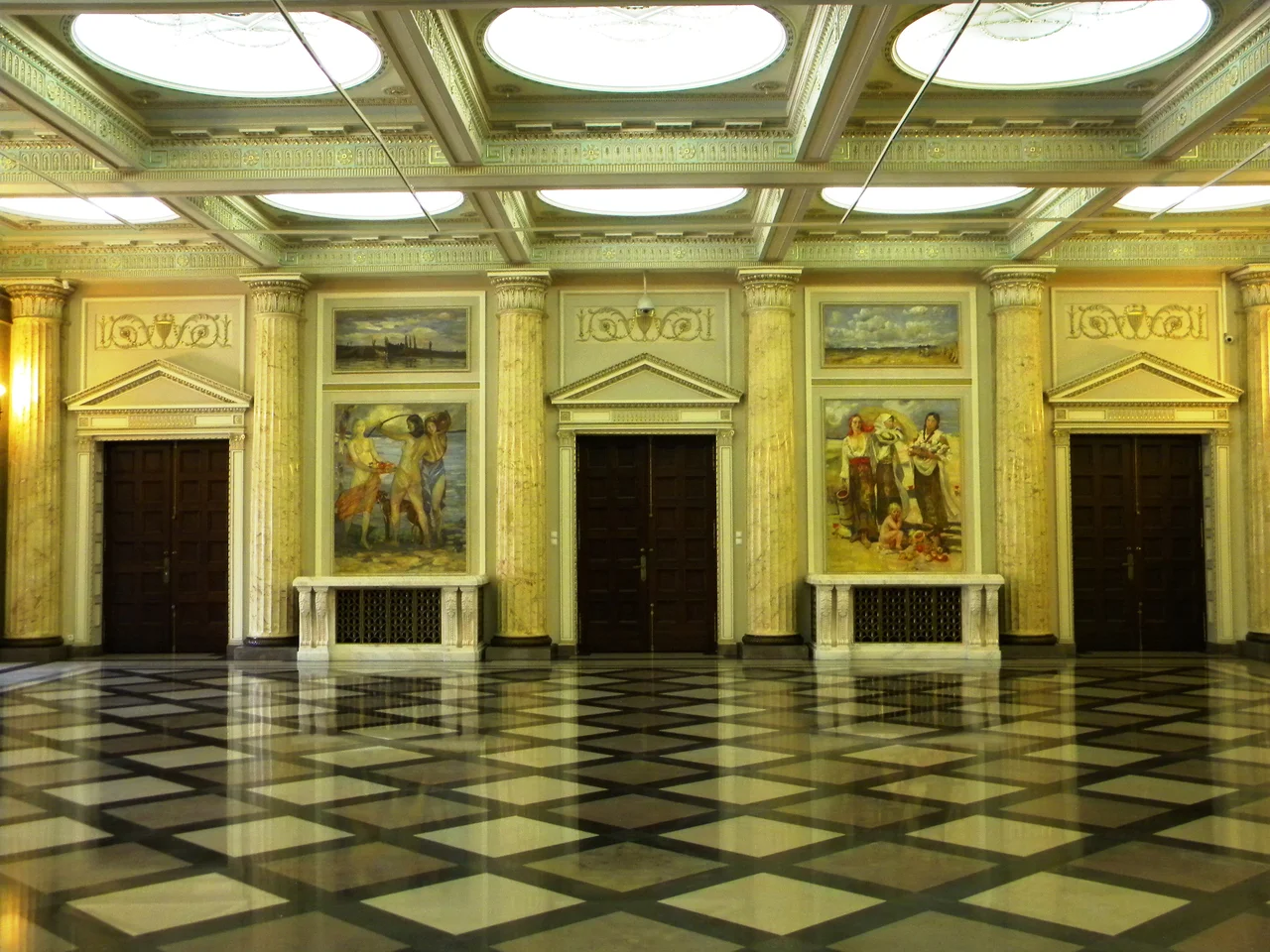
Long before it became a museum, this building was home to Romania's kings. The Royal Palace took its modern form by 1937, replacing earlier structures on the same site, and served as the residence of Carol I, Ferdinand, Carol II, and the boy-king Michael, who would be Romania's last monarch. Carol I was an obsessive collector with a discerning eye, and over decades he assembled 214 paintings that included works by El Greco, Rembrandt, Rubens, and Bruegel the Elder. When the Communists abolished the monarchy in 1947 and exiled Michael, the royal collection became state property. The palace itself was converted into a museum, opening to a public that could now see, on the walls of the king's former rooms, the paintings the king had once hung in private.
December 1989
Revolution Square earned its name in front of these windows. On 21 December 1989, Ceausescu addressed a hostile crowd from the balcony of the Communist Party Central Committee building across the way. By the next day, he had fled by helicopter from its roof. In the chaos that followed, fighting consumed the square. The museum took heavy damage. Paintings were pierced by bullets, ceilings collapsed, water from broken pipes ran through the European galleries. For nearly a decade afterward, much of the collection sat in storage while restorers worked through the wreckage. Part of the museum reopened in 2000. The medieval art galleries, the most heavily damaged, did not reopen until 2002.
The Salvaged Saints
The medieval collection that visitors see today exists because of an earlier act of rescue. During Ceausescu's systematization campaign of the 1980s, dozens of historic Bucharest churches and monasteries were demolished or buried inside concrete bunkers. Curators, sometimes working against direct orders, removed icons, frescoes, and altar pieces and hid them. After 1989, those salvaged works became the heart of the medieval gallery. Standing in front of a 16th-century icon that survived the bulldozers, you can feel the double weight of what it depicts and what it nearly was. The monastery it came from no longer exists. The painting does.
The Old Masters' Rooms
The European Gallery is a quietly extraordinary collection for a city most travelers never associate with Western art. Antonello da Messina's small Crucifixion has the eerie precision that made the Sicilian master one of the great innovators of the early Renaissance. Jacopo Amigoni's portrait of Farinelli captures the celebrity castrato singer in pearl-grey silk, mid-pose, mid-smile. Lucas Cranach the Elder's Venus and Amor, painted in 1520, reads like a sly Northern reply to Italian classicism. There is an El Greco Marriage of the Virgin from 1614, a Hans Memling donor portrait from 1490, a Tintoretto Annunciation, a Hans von Aachen Three Graces. Carol I bought them with the eye of a man building a national institution rather than a private trophy room.
The Romanian Wing
On the upper floors, the Romanian collection traces a national art beginning to find its own voice in the 19th century. Theodor Aman, Nicolae Grigorescu, and Stefan Luchian translated the landscapes and peasants of the Danube plains into a recognizably Romanian idiom. Then comes Constantin Brancusi, whose smooth, abstracted bronzes and stone forms broke from everything that came before and helped invent modernism itself. Sculptures by Brancusi and Dimitrie Paciurea anchor the modern rooms. Surrealist Victor Brauner, who left Romania for Paris and joined Andre Breton's circle, hangs nearby. Together they tell the story of a country that produced, at the edge of Europe, artists who remade what European art could be.
From the Air
The museum sits at 44.4398 N, 26.0960 E in central Bucharest, atop Revolution Square (Piata Revolutiei) just north of the historic core. From above, look for the long Royal Palace facade fronting Calea Victoriei, with the round Romanian Athenaeum a block north and the former Communist Party Central Committee building (now an Interior Ministry annex) directly across the square. Bucharest Henri Coanda International (LROP) lies 17 km north-northwest; Bucharest Baneasa (LRBS) is 9 km north. Recommended viewing altitude 800 to 2,000 ft AGL with good visibility.
Nearby Stories
- National Transport Museum, Bulgaria 34 km away
- Slanic Mine 68 km away
- Sinaia 79 km away
- Great Basilica, Pliska 87 km away
- Sinaia Monastery 108 km away
- Holy Forty Martyrs Church, Veliko Tarnovo 115 km away
- Shumen Fortress 126 km away
- Danube Delta 227 km away