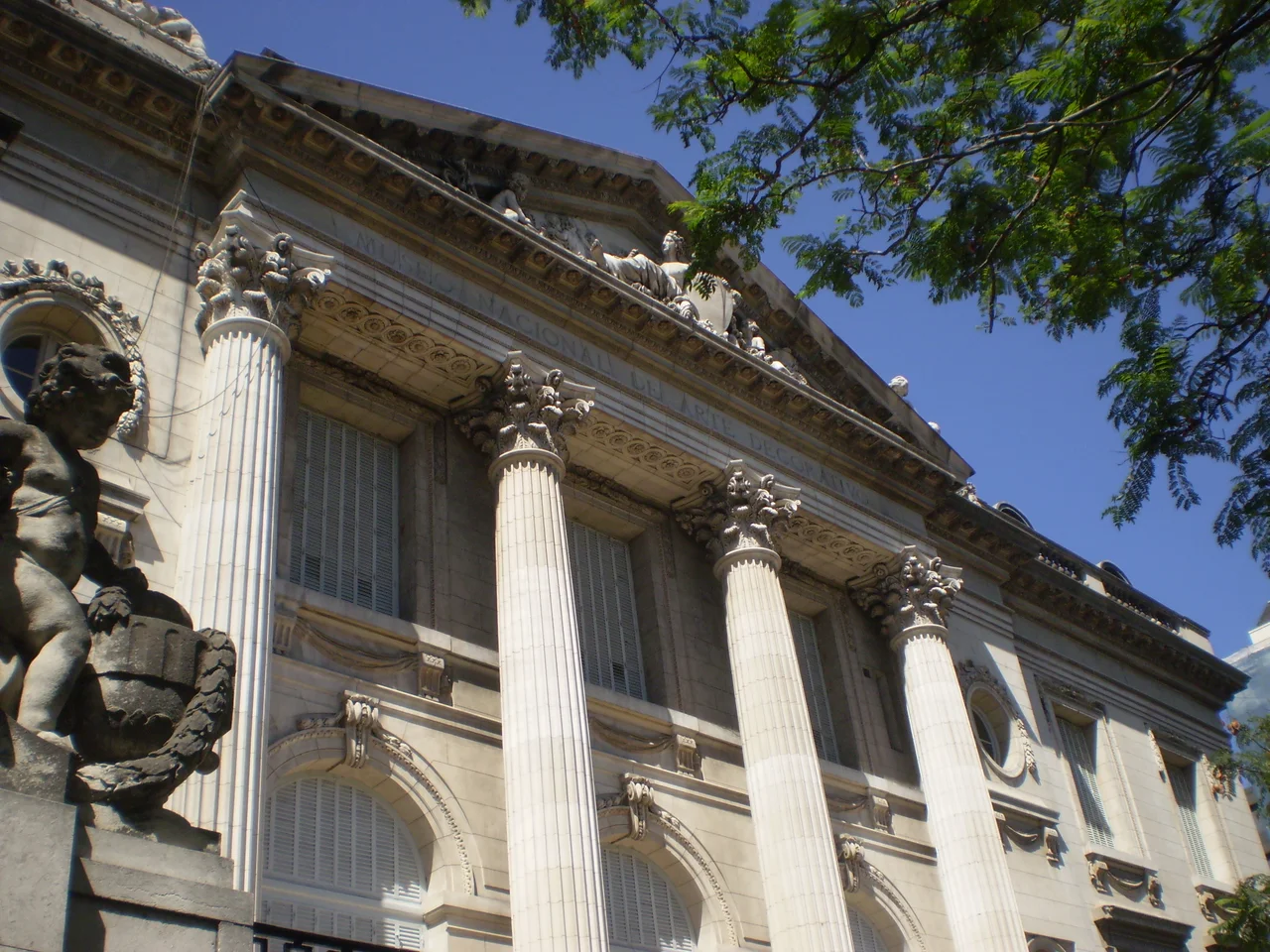

National Museum of Decorative Arts, Buenos Aires
Matías Errázuriz built this palace for a retirement he would spend with his wife. They had married in 1897, he the son of Chilean émigrés and she, Josefina de Alvear, the granddaughter of an independence hero. He served as Argentina's ambassador to France, fell in love with the architecture of old Europe, and resolved to bring it home. He hired a celebrated Parisian architect, imported the marble and the mirrors and the woodwork from across the Atlantic, and filled the rooms with antiques and masterpieces. Then, in 1935, Josefina died. The grieving widower gave the whole magnificent house to the people of Argentina, and it became a museum.
A Piece of Paris on the Pampa
The couple commissioned the French architect René Sergent in 1911, the designer whose work would set the standard for Buenos Aires's grandest mansions. The First World War slowed everything, so the palace was not finished until around 1916, with the couple spending two more years filling the rooms with art and antiques. Sergent worked from Paris, dispatching plans and a team of specialist decorators across the ocean: H. Nelson, G. Hoentschel, and the Carlhian firm dressed the rooms, while the renowned Achille Duchêne laid out the gardens. The materials themselves crossed the Atlantic, wooden panels, mirrors, marble, frames, even the latches, with European artisans summoned to finish the stucco. The sober Neoclassical façade borrows from the eighteenth-century court architecture of Louis XV's France, in particular the work of Jacques-Ange Gabriel, all gigantic Corinthian columns and balanced proportion. So admired was the result that the Bosch family promptly commissioned a similar palace nearby, the building that now houses the residence of the United States ambassador.
Rooms Like Movements in Music
Inside, each room plays a different note from the European past. The double-height Great Hall conjures a Tudor English manor, its star-patterned floor inlaid in maple and walnut, five great chandeliers hung from hidden iron beams. The dining room reaches for Versailles, modeling itself on the palace's Hercules Room, with Carrara marble and the swagger of the Baroque. The ballroom dissolves into Rococo curves and mirror-panels that hide the true edges of the space. There is even an Art Déco boudoir painted by the Catalan master Josep Maria Sert. To move through the house is to travel several centuries of French and European taste in the span of an afternoon.
El Greco by the River Plate
The collection the Errázuriz family assembled, now grown to more than 4,000 objects across a dozen halls, would honor any museum in Europe. On the walls hangs El Greco's Jesus Bearing the Cross Uphill, its elongated Christ glowing in the Spanish master's strange light, alongside a Fragonard, a Manet portrait, and a Corot view of Rome. In marble stands a Roman Minerva and Rodin's tender Eternal Spring. From the East came Chinese vases and jade carvings from the Qianlong era. The house also holds what is said to be the most important public collection of portrait miniatures in the Americas, tiny painted faces from four centuries gazing out from a single room.
The Gift and What It Means
When Josefina died in 1935, Matías followed his children's advice and bequeathed the mansion to the state. On 18 December 1937, under Law 12351, Argentina bought the residence and its collections, and the National Museum of Decorative Arts was born. It is hard not to read the gesture as a kind of memorial, a man unable to live in the dream house he had built for a marriage that was over, handing it instead to his country. The couple's own faces remain in the building, captured in portraits by Joaquín Sorolla and Giovanni Boldini, so that visitors still meet the people who imagined the place. Today its gardens hold the Café Croque Madame, the Argentine Academy of Letters has met under its roof since 1944, and choral concerts still echo through twelve halls designed for a vanished world of diplomats' dinners and grand receptions.
From the Air
The National Museum of Decorative Arts, the former Errázuriz Alvear Palace, stands in Recoleta at 34.58°S, 58.40°W, fronting the grand Avenida del Libertador near the parks that run beside the Río de la Plata. From the air, look for the long green ribbon of Libertador's parkland and the palatial mansions lining it, with the Recoleta and Palermo green spaces spreading north. Aeroparque Jorge Newbery (ICAO: SABE) lies only about 3 km north along the river, so this elegant stretch passes close beneath many arrivals; Ministro Pistarini / Ezeiza International (ICAO: SAEZ) is roughly 35 km southwest. A viewing altitude of 1,500–2,500 ft on a clear day shows the palace district and its gardens against the dense city beyond. Riverbank fog can reduce visibility on calm mornings.
Nearby Stories
- Ezeiza Massacre 1.9 km away
- Luján, Buenos Aires 5.1 km away
- Curutchet House 13 km away
- Colonia del Sacramento 17 km away
- Martín García Island 28 km away
- Atucha Nuclear Power Plant 37 km away
- Lobos 43 km away
- Cry of Asencio 87 km away