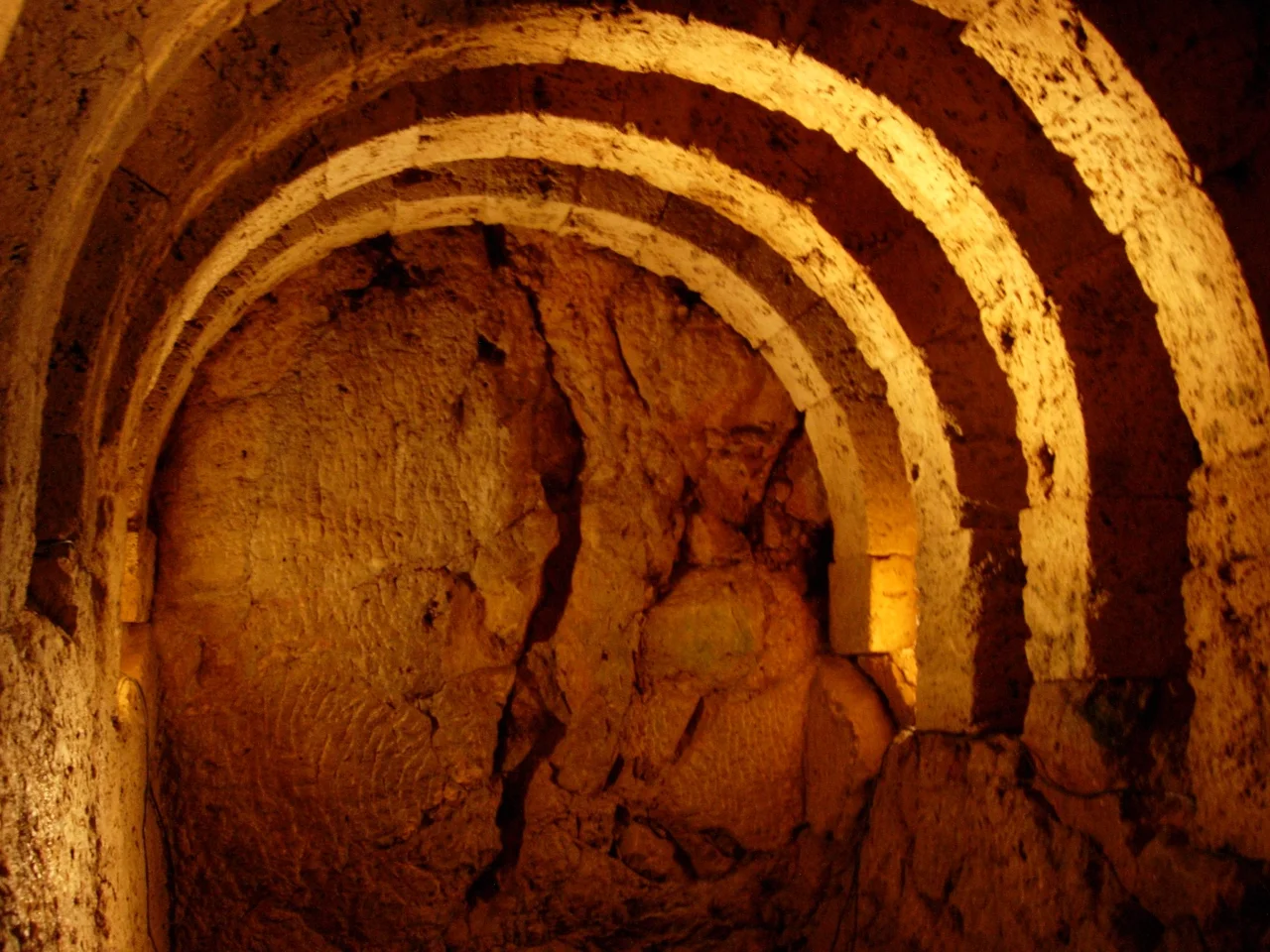

Necromanteion of Acheron
Three rivers meet near the low hill at Mesopotamos in Epirus: the Acheron, the Pyriphlegethon, and the Cocytus. Ancient Greeks interpreted their names as "joyless," "flaming with fire," and "lament" — and believed these dark waters flowed through the kingdom of Hades before surfacing here. Where the rivers converged, the Thesprotians, the local Epirot tribe, built a sanctuary unlike any other in the ancient world: the Necromanteion, the Oracle of the Dead, where pilgrims came not to seek prophecy from a god but to speak with those they had lost.
The Place Where the Veil Thinned
The word Necromanteion means, literally, oracle of the dead. Other sanctuaries in the ancient world housed oracles of the dead — at Cape Taenaron, at Cumae, at Herakleia on the Black Sea coast — but the Necromanteion of Ephyra was regarded as the most important of them all. The Thesprotians of Epirus were its guardians, and for centuries the faithful made the journey to this river confluence in the belief that here, and perhaps only here, communication with the dead was genuinely possible.
Homer placed the entrance to the underworld in this region, and in the Odyssey it is here that Odysseus descends to consult the shades of the dead — his katabasis, the journey downward. Herodotus, writing in the 5th century BC, records that Periander, the tyrant of Corinth, sent envoys to the Necromanteion to question the ghost of his wife Melissa. The literary tradition confirmed what the local people already believed: this was the threshold.
Ritual at the Threshold
The rites described by ancient sources were elaborate and deliberately disorienting. Pilgrims seeking to speak with the dead did not simply arrive and ask. The preparation unfolded over days. Celebrants gathered in the ziggurat-like temple and consumed a ritual meal of broad beans, pork, barley bread, oysters, and a narcotic compound. After a cleansing ceremony and the sacrifice of sheep, they descended through a chthonic labyrinth — a series of meandering corridors, dark and deliberately confusing, passing through a number of iron gates, leaving offerings as they went.
At the heart of the sanctuary, questions were posed and prayers were chanted. Then the priest would appear to rise from the floor and move through the air — theatrical cranes embedded in the architecture achieved the illusion of flight. Whether the pilgrims believed what they witnessed as literal contact with the dead, or understood it as ritual performance, they came back across the ancient world to repeat it. The sanctuary served real human grief: the need to say what was left unsaid, to ask the question that only the dead could answer.
What Archaeology Found
A site at Mesopotamos in Epirus was first identified as the Necromanteion in 1958, and excavations by Greek archaeologist Sotirios Dakaris produced objects that seemed to confirm the identification. The site is now questioned, however. The ruins date to no earlier than the late 4th century BC — considerably more recent than Homer's description. More tellingly, the topography does not fit ancient accounts: the hill commands the surrounding landscape in ways that do not match descriptions of a low, hidden sanctuary.
Among the finds were household ceramics, agricultural tools, weaponry including Roman pila, and — most unexpectedly — 21 bronze modioli, the distinctive washers from at least seven different catapults. Dakaris had originally identified these components as parts of the theatrical cranes used to simulate the priest's flight. Later analysis concluded they were catapult hardware. The site appears to have been a fortified farmhouse of the type common in the Hellenistic period. The Romans destroyed it in 167 BC.
The identification remains uncertain and debated. What is clear is that whoever and whatever occupied the site, the rivers still converge there. The Acheron still runs dark and cold through its reeds. The place that Homer named, that Herodotus cited, that Periander's envoys sought — it was somewhere in this landscape. The landscape itself has not changed.
Living Myth on a Dark River
The Acheron today is a shallow, reed-lined river running through the flat Fanari plain before reaching the Ionian Sea. In summer, visitors come to kayak its lower reaches — an experience that feels, in good light, entirely benign. But in winter the plain floods and the light turns grey, and the rivers that the Greeks named for grief and fire earn their reputations.
Modern visitors to the excavated site at Mesopotamos find low stone walls and corridor foundations — the labyrinth stripped down to its bones. There is no theatrical machinery, no iron gates, no narcotics. What remains is the question the pilgrims came to ask, which is the same question people have always carried to the threshold of the irreversible: what do you say to someone who is gone, when you finally get the chance?
From the Air
The Necromanteion site sits at approximately 39.24°N, 20.53°E, in the Fanari plain southeast of the Acheron River mouth. Flying from Aktion National Airport (LGPZ, approximately 30 km to the southeast), approach from the south at 2,000–4,000 feet. The Acheron River is clearly visible as it crosses the agricultural plain, flanked by reeds and willows. The site at Mesopotamos occupies a low hill just east of the river. The Ionian coast and the broad Amvrakikos Gulf open to the south. Aim for 3,000 feet AGL for the best view of the river confluence.
Nearby Stories
- Battle of Olpae 9.5 km away
- Achilleion (Corfu) 12 km away
- Battle of Nicopolis (1798) 14 km away
- Corfu 38 km away
- Vikos Gorge 45 km away
- Battle of Karpenisi 49 km away
- Meteora: The Monasteries Built on Impossible Pillars 50 km away
- Hellenic Trench 136 km away