.jpg)
Nelson's Column
The admiral stands seventeen feet tall on top of a column more than ten times his height, and yet the figure that gazes south toward Westminster is, in life, a slight man of barely five feet four. The proportions are not accidental. Trafalgar Square was raised to celebrate something larger than the man who won it for Britain. On 21 October 1805, Horatio Nelson defeated the combined French and Spanish fleets off Cape Trafalgar, broke Napoleon's hopes of crossing the Channel, and was killed by a French sniper in the moment of his victory. The monument that now dominates central London was Britain's answer to that bargain - a price paid, and a debt commemorated.
A Column by Public Subscription
In February 1838, more than thirty years after Trafalgar, 121 peers and Members of Parliament finally formed a committee to raise a proper memorial. The government offered a site in front of the newly completed National Gallery. A design competition was announced with a budget between £20,000 and £30,000. The deadline came and went, and the contest had to be re-run after complaints about its organisation. William Railton's design won twice: a Corinthian column flanked by sculpted lions, with steps rising between them to the pedestal. The original plan called for 203 feet of height, but engineers reduced this to roughly 170 feet over stability concerns. Construction by Grissell and Peto crept forward through 1840 to 1843. By 1844 the committee had run out of money, having raised barely £20,485 of public subscriptions, and the Office of Woods and Forests took over. The last of the four bronze reliefs was not installed until May 1854 - nearly half a century after the battle it commemorated.
Stone from Dartmoor, Bronze from French Guns
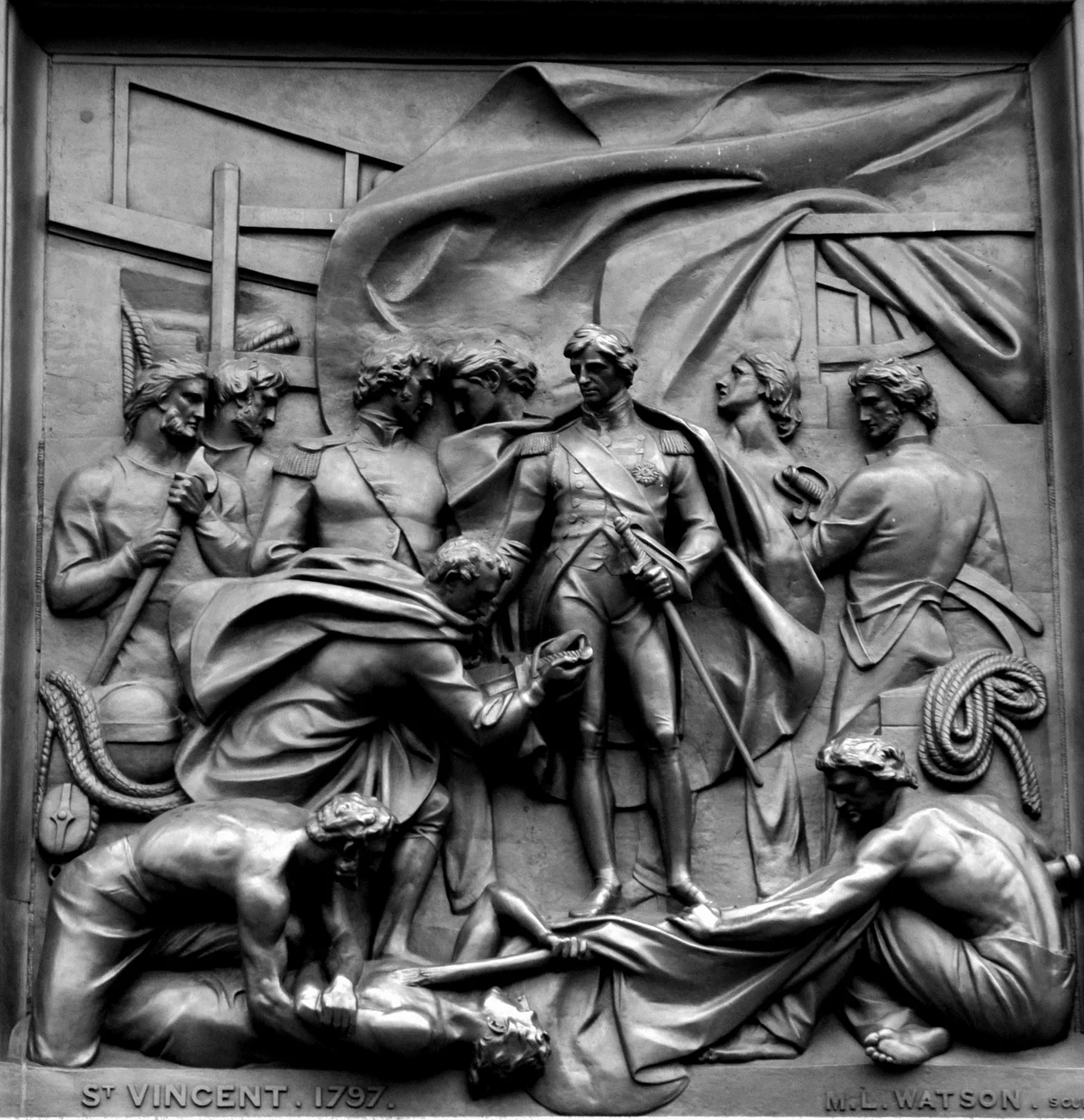
The materials of the column carry their own story. The shaft is solid granite from the Foggintor quarries on Dartmoor. The statue at the top was carved from three pieces of Craigleith sandstone donated by the Duke of Buccleuch from his own quarry near Edinburgh. The Corinthian capital is bronze - cast from cannon salvaged from the wreck of HMS Royal George at the Woolwich Arsenal foundry, with some pieces weighing as much as 900 pounds and fixed to the stone with great metal belts. The four eighteen-foot relief panels around the pedestal were cast from captured French guns, depicting Nelson's victories at Cape St. Vincent, the Nile, Copenhagen, and his death at Trafalgar. Even the metal that decorates the column was a kind of trophy - enemy ordnance melted down and remade into images of British triumph. When laser surveys were taken before the 2006 refurbishment, engineers discovered something curious: the monument was about 14 feet shorter than the 185 feet everyone had been quoting for over a century.
The Lions That Took Twenty Years
The four Barbary lions at the base were not added until 1867 - a quarter century after the column itself was finished. The path to them was strange. The sculptor John Graham Lough was chosen first and turned the commission down. Thomas Milnes received it next, carving four sandstone lions each individualised to represent Peace, War, Vigilance, and Determination. They were rejected. The mill owner Sir Titus Salt bought them instead and installed them at his workers' village of Saltaire, where they still stand. The job finally went to Sir Edwin Landseer, Queen Victoria's favourite painter, who collaborated with Carlo Marochetti. Landseer requested casts of a lion from Turin which did not arrive until 1860, so he sketched lions at London Zoo in the meantime. Eventually the corpse of a lion was sent to him to work from. The body began to decompose before he finished, which accounts for the famous anatomical oddities of the bronzes: the paws are based on those of a cat, and the lions' backs are concave rather than convex. Landseer was paid £6,000 for his work, Marochetti £11,000.
Looking South Forever
For all its solidity, the column has rarely been left in peace. If Hitler's Operation Sea Lion had succeeded, the German leader planned to dismantle the monument and ship it to Berlin as a trophy of conquest. The smog of London nearly accomplished its own slower demolition - the column was sandblasted clean in 1968 and steam-cleaned again during the £420,000 refurbishment of 2006, which Zurich Financial Services paid for in exchange for advertising on the scaffolding. Protestors have made it their stage. In March 1988 climbers scaled it for Greenpeace, campaigning against acid rain. In 1992 they returned to protest the Earth Summit, and in 1995 Simon Nadin free-climbed it to highlight the plight of the Canadian Inuit, grading the route E6 6b. In 2003 the stunt performer Gary Connery parachuted from the top in protest against Chinese policy in Tibet. In December 2015 Disney paid £24,000 to light the column to resemble a giant lightsaber, promoting Star Wars: The Force Awakens. In April 2016 activists fitted Nelson himself with a breathing mask to highlight London's air pollution. The admiral, who died of a French musket ball at thirty miles per hour of wind and a clean line of sight, has continued to attract dramatic gestures from far below.
Looking South Forever
Like the column erected to him in Montreal almost forty years earlier, Nelson at Trafalgar Square stands with his back to the waves - facing south toward Westminster and the workings of British government rather than out across the empire he fought to defend. The position has its own logic: Nelson, after all, is now part of the city he protected, watching over Parliament instead of the sea. Around him the Square has accumulated its rituals - protests, victory celebrations, the annual lighting of the Norwegian Christmas tree, the cleaning of lions worn smooth by generations of climbing children. The four reliefs at his feet show his battles in cast French bronze. The lions guard his base in slightly-wrong proportions. And the admiral himself, three times his living size, keeps watch over a country that built him this column because they could not give him back his life.
From the Air
Nelson's Column stands at 51.5078N, 0.1279W in central London's Trafalgar Square. Coordinates place it midway between the Houses of Parliament to the south and the British Museum to the north. Recommended viewing altitude is 1,500-2,500 feet AGL for a clear view of the square, the National Gallery on its north side, and the four bronze fountains. Nearest major airport is London City (EGLC) approximately 7 nm east; London Heathrow (EGLL) lies about 14 nm west. The City of London Class A airspace and the London Heliport (EGLW) are nearby - expect heavy controlled airspace restrictions. Visibility over central London is often reduced by haze; best photographic light comes early morning or late afternoon.
Nearby Stories
- Stevenage 5.7 km away
- Malling Abbey 5.7 km away
- 1952 Farnborough Airshow Crash 7.7 km away
- Ingatestone Hall 8.2 km away
- Hellfire Caves 9.1 km away
- The Carrington Event: The Solar Storm That Could Happen Again 9.8 km away
- Bletchley Park 16 km away
- Castle Hedingham 23 km away