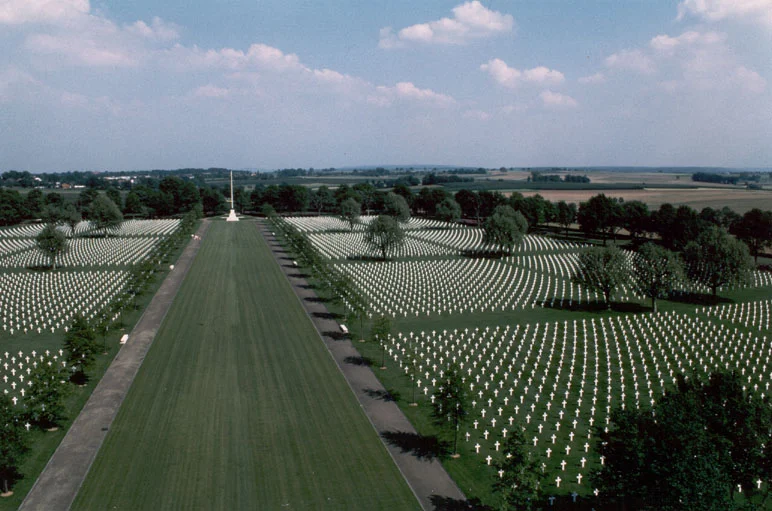

Netherlands American Cemetery
In 1945, when the war had just ended and the cemetery at Margraten was still raw earth and wooden crosses, an official in the village made a suggestion. What if each grave were adopted? A local family, or a single person, would take responsibility for visiting that one grave, learning the name on it, leaving flowers on the anniversaries. Eighty years later, every American grave at Margraten still has an adopter. There are 8,301 burials. There are 1,722 names on the Tablets of the Missing. There is a waiting list. The adoptions are passed down through families. Children inherit the grave their grandparents adopted, and they bring their own children to it.
The Winter of 1944
The cemetery was created in November 1944 under Lieutenant Colonel Joseph Shomon of the 611th Graves Registration Company, as the Ninth United States Army pushed into the southern Netherlands. The agricultural land at Margraten, 10 kilometres east of Maastricht on the old Roman road to Aachen, was chosen because it sat at a logistical crossroads and because no American soldier was to remain buried on enemy ground. The first ground was broken by the men of the 960th Quartermaster Service Company, a largely African American unit. The winter was historically cold and wet. The standard grave was 6 feet deep, 6 feet long, 2 and a half feet wide. The men used picks and shovels. Each body was wrapped in a mattress cover with the dog tag placed in the mouth for identification. The first three hundred dead were buried during Thanksgiving 1944. Through the rest of the winter, frozen ground had to be hacked open, and graves flooded as fast as they could be dug.
A Dramatic Spring
Spring 1945 brought thawed ground and, because of the Battle of the Bulge, a vast acceleration in the number of bodies arriving. The American military asked the village of Margraten for help. The response of the village began a relationship between the Limburg countryside and the dead in its soil that has now lasted four generations. The cemetery was ceremonially opened on Memorial Day 1946. Twenty trucks arrived loaded with flowers from sixty surrounding villages. By 1949 the work of reburial was complete: many of the dead had been sent home at their families' request, others moved to permanent cemeteries elsewhere, and the German burials had been moved to Ysselsteyn. What remained were the more than 8,000 Americans whose families had chosen to leave them where they fell.
The Adoption Program
The adoption idea took hold immediately. Within months of the war's end, every grave had a Dutch or Belgian adopter. Adopters were asked to do something simple but persistent: visit, bring flowers, write to the family if they could find them, remember. Many wrote letters back to American mothers and fathers and widows for decades. Many tracked down nieces and grandchildren and brought them across the Atlantic to see graves they had inherited care of. The program continues today, administered by the Foundation for Adopting Graves American Cemetery Margraten. Adoptions pass from grandparent to parent to child. When an adoption lapses, the next person on the waiting list takes it up. There is always a waiting list.
Faces of Margraten
In 2014 a project called The Faces of Margraten set out to gather a photograph of every person buried or memorialised at the cemetery. The idea was to display the photos beside the headstones on alternate Memorial Days, so that visitors would see not just stones but human faces, twenty-year-olds and twenty-five-year-olds, the people the stones represented. By 2020 the photo library contained 7,500 faces. Around the same time, the Black Liberators project, led by historians Mieke Kirkels and Sebastiaan Vonk, began researching the 172 African American soldiers buried at Margraten and the broader role of Black American troops in the liberation of the Netherlands. Many of those soldiers, like the men of the 960th Quartermaster who dug the first graves, had served in segregated units in a still-segregated army. The first sergeant of those 960th gravediggers, Jefferson Wiggins, returned to the Netherlands in 2009 as a retired Connecticut educator and spoke at a community celebration in Maastricht. He said that when the war ended, American soldiers like him went home. The dead stayed. The people of the Netherlands had taken on the task of remembering them.
A Quiet Curve of Stones
Walking the cemetery today is an unhurried experience. From the entrance, the Court of Honor opens onto a long reflecting pool. On either side, walls hold the names of the 1,722 missing; a small bronze rosette beside a name means the person has since been identified and is no longer missing. At the base of the chapel tower stands a statue by Joseph Kiselewski of a grieving mother. The Tablets of the Missing and three engraved operations maps describe the campaigns that fed the cemetery: the breakout from Normandy, the push through Belgium, the Battle of the Bulge, the crossing into Germany. Beyond the chapel, the burial area opens out into sixteen plots, the headstones laid in long curves rather than rigid rows. The names include Robert G. Cole, Maurice Rose (the highest-ranking American killed by enemy fire in the European Theater), and Willy F. James Jr., one of seven African American soldiers awarded the Medal of Honor for service in the Second World War. On almost every grave, in almost every season, there are flowers. They were brought by someone whose family agreed, eighty years ago, to remember this person.
From the Air
Located at 50.82 N, 5.81 E, in the village of Margraten, 10 km east of Maastricht in the southernmost Netherlands. The cemetery covers 65.5 acres on the historic Roman road between Maastricht and Aachen (the modern N278 becoming the B1 across the German border). Maastricht Aachen Airport (EHBK) lies about 8 NM north. The reflecting pool and curved rows of white headstones are visible from low approaches in clear weather.
Nearby Stories
- Siege of Julich (1621-1622) 4.6 km away
- Wessem-Nederweert Canal 6.7 km away
- Monchengladbach 9 km away
- County of Duras 10 km away
- SCK CEN 15 km away
- Belgium 56 km away
- Marcinelle Mining Disaster 100 km away
- Marmoutier Abbey 228 km away