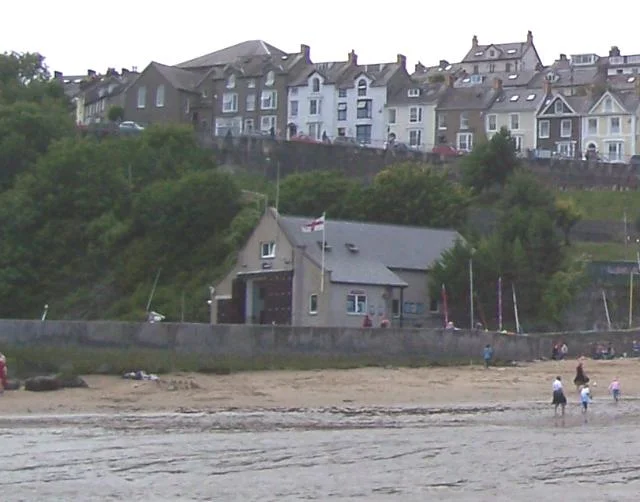

New Quay Lifeboat Station
Six wrecks in a single night. That was the toll the Royal Charter Storm extracted from the coast around New Quay on the night of 25 October 1859, when winds reached hurricane force across the Irish Sea and bodies washed up along the Ceredigion shore. The Inspecting Commander of the Coastguard had seen enough. He petitioned the Royal National Lifeboat Institution for a station here, and in 1864 a small boathouse was built on New Quay's town beach at a cost of £130. From that day forward, when the weather turned and the bay churned white, the men of New Quay would not stand on the pier and watch.
The Public Holiday
When New Quay's second lifeboat, Frank and Marion, arrived in 1886, the town declared a public holiday for her naming. The 37-foot self-righter, built by Forrest and Son of Limehouse for £374, was a gift from a Dr and Mrs Smart of Kent who had never set foot in Cardiganshire. Such was the lifeboat service in Victorian Britain: paid for by strangers, manned by neighbours, named after the dead and the loved ones of the dead. Coxswain Evans had been at the helm for twenty-five years already and would retire in 1905. His successor, David Davies, would carry on. The Frank and Marion launched seven times in her recorded service. Nineteen lives saved. In lifeboat accounting, that is the number that matters.
Forty-One Years Under Oar and Sail
From 1907 to 1948, New Quay's boat was the William Cantrell Ashley - the longest-serving lifeboat the station ever had, and the very last pulling-and-sailing lifeboat the RNLI ever operated. She came south by train from London to Fishguard, then sailed home around the Pembrokeshire headlands by the same fifteen crewmen who had delivered her predecessor in the other direction. In August 1917, she set out for two boys fishing in a small boat as the weather deteriorated; on the way she diverted to a foundering vessel with two adult fishermen aboard. All four came home. In February 1946, she stood by a broken-down submarine for more than twenty-four hours in severe weather, helping to take off the crew. Two years later she was retired and given to the new Outward Bound school at Aberdovey, where she taught generations of teenagers what salt water tasted like.
The Youngest Coxswain in Britain
In 1965, Winston Evans took the helm of the New Quay lifeboat at the age of twenty-six - the youngest coxswain in Britain. His father, Arden Evans, had held the same job; between father and son the Evans family served forty years at the wheel. The following year Winston won the RNLI Bronze Medal for a rescue in Cardigan Bay, and in 1985 the British Empire Medal arrived from Buckingham Palace. He retired in 1994 after twenty-nine years. The man who succeeded him, Daniel Potter, was a great-nephew of Frederick Shayler, who had been coxswain through the 1920s and 30s. New Quay's lifeboat history reads like a parish register: the same surnames recurring across generations, the sea cycling through families. In Winston's early years almost everyone in the crew was a fisherman. By the time he stepped down, they came from every walk of life - postmen, builders, retirees, the boat answered to anyone willing to drop everything when the maroons fired.
Today's Boats
The station operates two lifeboats today, both bought through donations and bequests. The all-weather boat, 13-48 Roy Barker V, arrived in 2023 - a Shannon-class hull capable of self-righting and powered by waterjets rather than propellers, making her safer to launch into shallow surf. The inshore boat, the D-class Will Morgan, came on station in February 2024 with funding raised by the local community. In 2014 the station marked 150 years of service. The 1992 boathouse that now houses both boats sits below Glanmor Terrace, its slipway pointing into Cardigan Bay - the same bay that took six ships in one night and built this station in answer.
From the Air
New Quay sits at 52.21 degrees north, 4.36 degrees west, on the Ceredigion coast roughly 20 miles south of Aberystwyth. From the air the lifeboat station appears as a substantial slate-roofed building just below Glanmor Terrace, with a sloped slipway dropping to the inner harbour. The harbour itself curls in a J-shape behind a stone pier. Cruising the Cardigan Bay coast at 2,000 to 3,000 feet AGL on a clear day offers stunning views of the bay, with bottlenose dolphins occasionally visible in the water. Nearest airports: Aberporth airfield (EGFA) about 12 miles south, Haverfordwest (EGFE) 50 miles south, and Caernarfon (EGCK) 60 miles north. The MoD Aberporth Range Danger Area covers much of Cardigan Bay; check NOTAMs.
Nearby Stories
- Strata Florida Abbey 2.9 km away
- Machynlleth 3.8 km away
- Fishguard Lifeboat Station 4.7 km away
- Cantre'r Gwaelod 9.8 km away
- Gwili Railway 17 km away
- RAF Towyn 20 km away
- HMS Tyler 33 km away
- Brecon Cathedral 34 km away