.jpg)
Newington Green Unitarian Church
Mary Wollstonecraft was twenty-five, broke, and running a school for girls when she first walked into the brick chapel on Newington Green. The year was 1784, and the minister inside - the political radical Richard Price - was about to do something that would change history through his protege. He listened to her. The chapel itself looked unimpressive: a plain rectangular brick building with a hipped tile roof, financed in 1708 with £300 from a goldsmith named Edward Harrison. The pews were modest, the architecture restrained, the congregation small. Yet the conversations happening here would help give Britain its first feminist treatise, fuel arguments about the French Revolution, and welcome American founders like Benjamin Franklin and Thomas Jefferson. Today a banner outside proclaims it the birthplace of feminism. The building lives up to the claim more than its plain walls suggest.
A Refuge for the Excluded
The chapel exists because seventeenth-century England did not want it to. After the Restoration of Charles II in 1660, a series of laws known as the Clarendon Code made life difficult for anyone who would not conform to the Church of England. The Act of Uniformity drove around 2,000 clergymen out of the established church in the Great Ejection of 1662. Public office was restricted to Anglicans. Religious meetings of more than five people were forbidden. Nonconformist ministers could not live within five miles of a parish from which they had been banned. After the Act of Toleration in 1689 loosened some restrictions, Dissenters - barred from Oxford and Cambridge - founded their own academies, which were often more rigorous than the universities. Newington Green, then a farming village a few miles from London, became one such gathering place. By 1708 a permanent chapel could finally be built. The community that gathered around it included Quakers, Anglicans, and the Unitarians who would shape the church's identity - people united less by doctrine than by a willingness to question.
Richard Price and the Visitors from America
Dr Richard Price arrived in 1758 and lived next door, at No. 54 the Green, in a brick terrace dating from 1658 - still the oldest surviving brick terrace in London. From this small house Price reshaped Anglo-American political thought. He was a polymath who wrote on probability, life insurance, and finance, was inducted into the Royal Society, and corresponded freely with thinkers across the Atlantic. His visitors included Benjamin Franklin, Thomas Jefferson, Thomas Paine, John and Abigail Adams, Prime Minister William Pitt, philosophers David Hume and Adam Smith, and the mathematician Thomas Bayes of Bayes' theorem fame. When the American colonies revolted, Price publicly defended the revolution. When the French Revolution began, he preached "A Discourse on the Love of Our Country" on the 101st anniversary of the Glorious Revolution, sparking the Revolution Controversy. Edmund Burke's furious reply, Reflections on the Revolution in France, attacked Price by name. Two of Price's friends - Thomas Paine and a young schoolmistress named Mary Wollstonecraft - rushed into the pamphlet war to defend him.
How a Schoolmistress Became a Philosopher
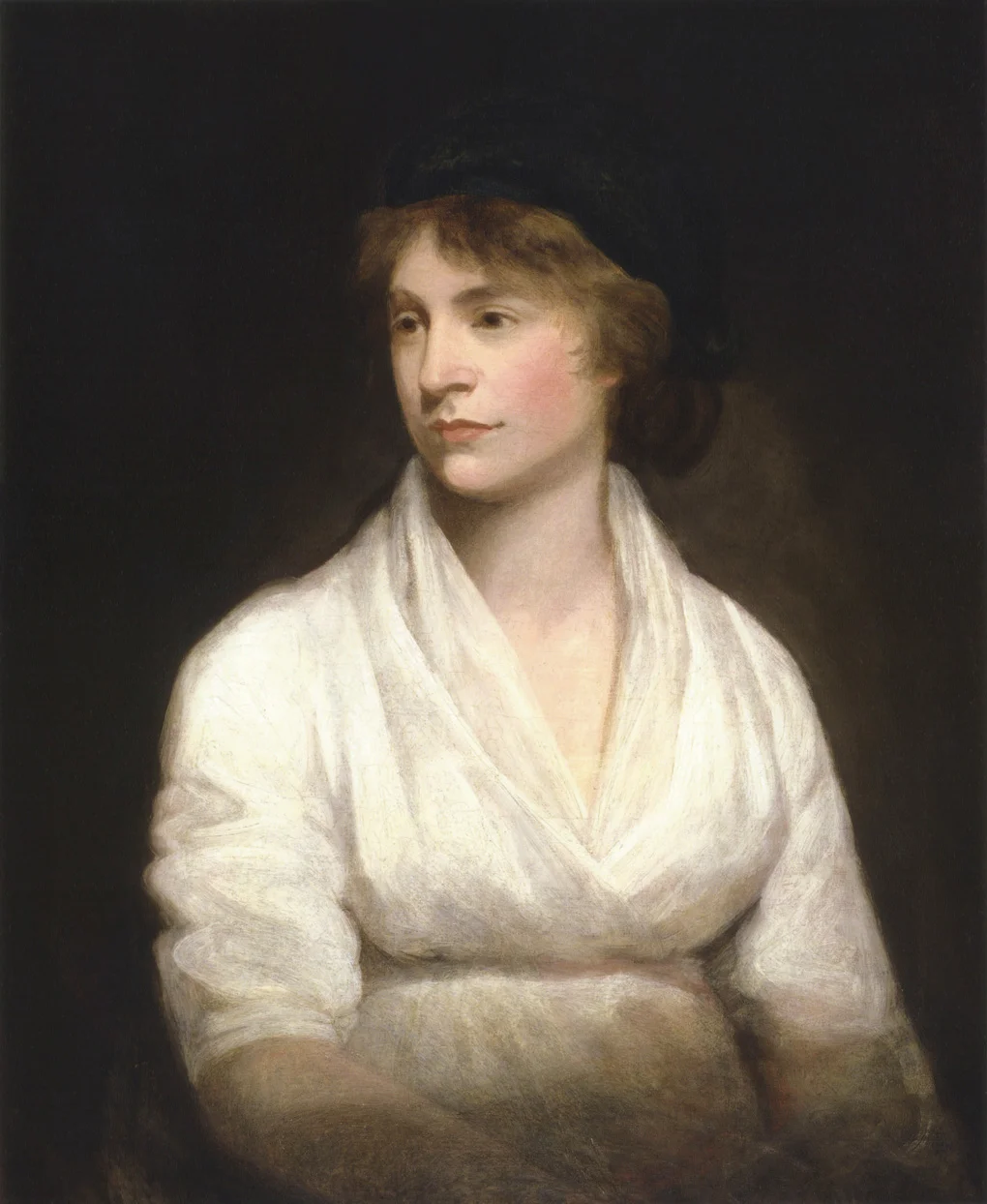
Wollstonecraft was a lifelong Anglican when she moved her struggling school for girls from Islington to Newington Green in 1784. A wealthy widow named Mrs Burgh found her a house and helped fill it with twenty pupils. The Unitarians of the chapel did not try to convert her. They welcomed her instead into their habit of logical inquiry and individual conscience. Price became her mentor, introducing her to the radical publisher Joseph Johnson, who guided her career. Her first book, Thoughts on the Education of Daughters, came out of this circle. So did the deeper work that followed. When Burke attacked Price, Wollstonecraft answered with A Vindication of the Rights of Men. Two years later, in 1792, she extended the same Rational Dissenting logic to half of humanity in A Vindication of the Rights of Woman. Her biographer Claire Tomalin has argued that Wollstonecraft transferred the Dissenters' arguments - that an excluded class develops character defects because of its exclusion, not because of innate inferiority - to women. A mural inside the church now commemorates her. The banner outside, declaring this the birthplace of feminism, is bold, but the case is not weak.
Decline, Wars, and Slow Recovery
Legal victories did not preserve the church. By 1813, when the Doctrine of the Trinity Act formally legalised Unitarian worship, the great battles for Dissenter rights were largely won, and a strange exhaustion set in. The congregation dropped, at one point, to nine subscribers. Yet new causes arrived. Mid-century ministers set up Sunday schools for poor children, a Domestic Mission Society to visit the poor at home, a savings club, and a library. The church campaigned for the removal of civil disabilities from Jewish citizens in 1847 and for Dissenters' access to Oxford and Cambridge. By the 1880s subscribers numbered around eighty and the Sunday school was educating up to 200 children. World War I brought a different kind of loss: about fifteen members of the congregation and Sunday school were killed. The building itself was badly damaged by a landmine during World War II, but services continued in the schoolhouse without missing a Sunday. The community held on through the lean decades that followed.
Still Speaking
The church has refused to be a museum. In 2002 a young Irish pastor named Cathal Courtney revitalised the congregation; he later led a silent vigil before the Iraq War march. His successor, Andrew Pakula - an American with an MIT doctorate in biology who came to ministry via a career in biotechnology - took over in 2006. In March 2008 the church became the first religious establishment in Britain to refuse to perform any weddings until same-sex couples could marry too. A £1.73 million National Lottery Heritage Fund grant completed a major renovation in 2020. The annual Richard Price Memorial Lecture, revived in 2003, has featured Will Self, Evan Davis, Susie Orbach, and Terry Eagleton. The chapel has held a flower communion, hosted Ottoman classical music for the local Turkish community, and continues to be where small, stubborn arguments about how to live become large ones. Wollstonecraft's mural still watches the pews. The building is still plain. The conversation it shelters is still loud enough to be heard.
From the Air
Newington Green Unitarian Church sits at 51.5535N, 0.0830W in north London, on the boundary between the boroughs of Hackney and Islington. Recommended viewing altitude is 1,000-2,000 feet AGL to see the green itself and the surrounding terrace of brick houses, including No. 54 the Green - London's oldest surviving brick terrace, dating from 1658. The site is about 3 nm north of central London. Nearest airport is London City (EGLC) approximately 4 nm south-east; Heathrow (EGLL) lies about 17 nm west-south-west. London's Class A airspace covers the area - controlled access only. Stoke Newington's Victorian Gothic church spire is a useful landmark to the north.
Nearby Stories
- Stevenage 5.7 km away
- Malling Abbey 5.7 km away
- 1952 Farnborough Airshow Crash 7.7 km away
- Ingatestone Hall 8.2 km away
- Hellfire Caves 9.1 km away
- The Carrington Event: The Solar Storm That Could Happen Again 9.8 km away
- Bletchley Park 16 km away
- Castle Hedingham 23 km away