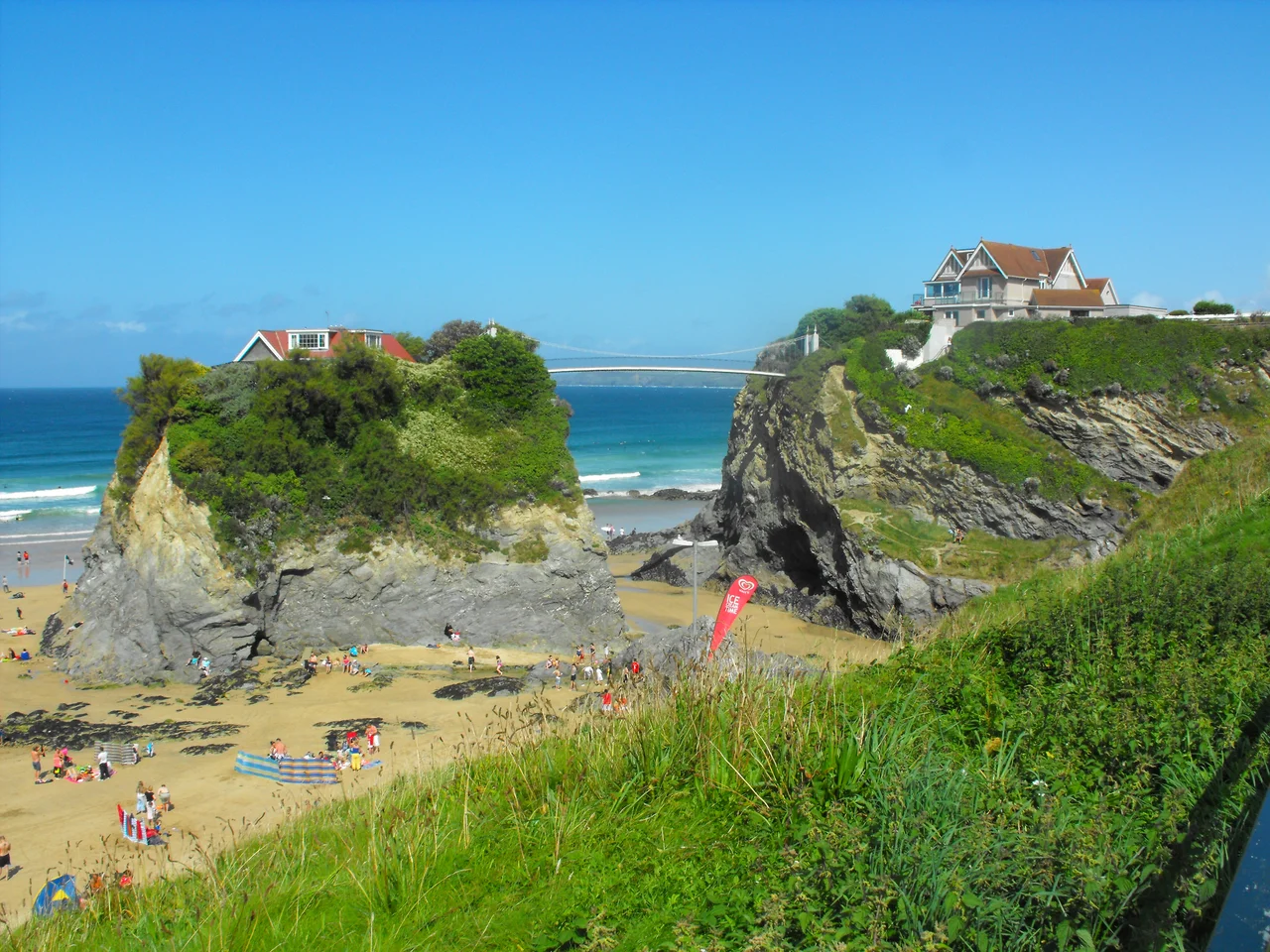

Newquay
On 9 January 2023 a converted Boeing 747 named Cosmic Girl rolled down the runway at Newquay Airport, banked west over Fistral Beach and the Atlantic, and dropped a small rocket called LauncherOne from beneath its left wing. The first orbital launch ever attempted from western Europe lifted off, climbed, and then suffered an anomaly in the second stage. The payload satellites did not reach orbit. But Newquay had become, in that moment, a kind of place that no other British seaside resort had ever been: an actual spaceport. A medieval pilchard-fishing village that 200 years ago grew rich on shoals of silver fish, then on Victorian holiday-makers, then on world-class Atlantic surf, was now also trying to grow rich on satellites.
Hevva, Hevva
For most of its history Newquay lived and died on pilchards. The Huer's Hut still stands on the headland west of the harbour. The huer was the lookout whose job was to spot the approach of pilchard shoals from the cliffs above town, and his cry was "hevva, hevva," probably a corruption of an older Cornish word for shoal. He would direct the seine-boats below by waving leafy boughs above his head, like a man signalling to ships in a coded semaphore. The word huer has the same root as the hue in hue and cry. The current hut dates from the late 18th or early 19th century, although a plaque claims 14th-century origins and the local lore says it may have once served as both hermitage and lighthouse. By 1571 a fish market was operating in what is now Central Square. Richard Carew's Survey of Cornwall, published in 1602, called the place "newe Kaye," describing how the locals had tried to make a quay there but had run out of money.
Bishops, Quays, and the Railway
The name Newquay comes from a 1439 indulgence issued by Edmund Lacey, Bishop of Exeter, raising funds for a new quay. The appeal did not succeed. The harbour stayed undeveloped, with short wooden piers, until 1615, when Thomas Stuer, Lord of the Manor, got permission to build a single stone pier. By 1832 the London-based entrepreneur Richard Lomax had bought the Manor of Towan Blystra, which included the village. He began work on the north and south quays but died in 1837 before they were finished. The decisive change came in 1872, when the Cornwall Minerals Railway acquired the harbour, extended it with a middle jetty, and connected the town to the rest of England. Passenger trains arrived in June 1876. Within years the cliffs were being colonised by hotels: the Great Western opened in 1879, the Atlantic in 1892, the Victoria in 1899, the Headland in 1900. Most were built first as wealthy seasonal houses along Narrowcliff and then converted as the tourist trade boomed.
Fistral
Newquay's modern reputation rests on Fistral Beach. The western edge of the town meets the Atlantic in a wide, west-facing bay that gathers Atlantic swell better than almost anywhere else on the British coast. Surfers found it in the 1960s and have not let go since. The 2021 census put Newquay's parish population at 23,626. The Office for National Statistics built-up area is 24,545. In summer, holiday accommodation pushes the daytime population past 100,000. The Boardmasters music festival, held on cliffs above Fistral and at Watergate Bay, brings 50,000 visitors in a single August weekend. The Run to the Sun, which began in 1987 with Volkswagen camper vans and Beetles rolling onto Fistral Beach, ran for almost three decades. Cornwall Pride moved here from Truro in 2017. The South West Coast Path passes through the town. The Newquay Discovery Trail, fourteen slate discs sunk into pavements by sculptor Peter Martin, weaves through the centre starting at the Killacourt.
Spaceport on the North Coast
Newquay's airport occupies the old RAF St Mawgan site, transferred from the Ministry of Defence to Cornwall Airport Limited in December 2008. By 2017 it was reportedly the fastest-growing airport in the UK. In April 2012 the Aerohub enterprise zone for aerospace businesses was created on the site. In July 2018 a partnership with Virgin Orbit was announced for what became Spaceport Cornwall. The construction of a 5.6 million pound Centre for Space Technologies alongside the spaceport was formally launched in February 2022 by then-Business Secretary Kwasi Kwarteng. The 9 January 2023 LauncherOne flight was, despite its second-stage failure, the first orbital launch attempt from European soil. The town that learned to read the colour of pilchard shoals from a cliff-top hut is now trying to read launch windows and weather minima for low-Earth orbit. The harbour still exists. Fishing boats still tie up beside the middle jetty Cornwall Minerals built in 1872. But the long arc of Newquay's economic life keeps reinventing what an Atlantic-facing town can be.
From the Air
Newquay sits at 50.41 N, 5.07 W on the north Cornish coast, with Fistral Bay on the west and the River Gannel forming its southern boundary. Cornwall Airport Newquay (EGHQ, ICAO; NQY, IATA) lies 3.5 miles northeast of the town centre at the former RAF St Mawgan site, the principal airport for Cornwall and also home to Spaceport Cornwall. The airport's runway is large enough to handle Boeing 747 operations, which is how the 2023 Virgin Orbit launch was carried out from a 747 carrier. Best viewed 1,500 to 3,000 feet AGL.
Nearby Stories
- Brane Barrow 0.7 km away
- Polperro 4.9 km away
- Goonhilly Satellite Earth Station 8.2 km away
- Launceston Castle 15 km away
- Pendeen Lighthouse 22 km away
- St Materiana's Church, Tintagel 24 km away
- Battle of Plymouth (1652) 30 km away
- SM U-27 123 km away