
Nicopolis
In 29 BC, two years after the naval battle that made him master of the Roman world, Octavian stood on a promontory in Epirus and founded a city. He called it Nicopolis: the City of Victory. The choice of location was deliberate and theatrical — this was the shore from which he had watched Antony and Cleopatra's fleet burn, and the new city was both a monument to that fact and a working capital designed to outlast the memory of the men he had defeated. It did outlast them, for eight centuries, until its ruins were old enough to serve as a battlefield for soldiers who had never heard of Actium.
The Shape of a New City
Octavian's planners laid Nicopolis out on a Roman orthogonal grid, covering approximately 375 acres on the isthmus of the Preveza peninsula, with the sea on both sides. Within five years of its founding, the city had a theatre, a stadium, a gymnasium, an odeon, and the beginnings of an aqueduct. The water came from the Louros River, 50 km away, carried to the city's nymphaeum — a great fountain complex — by an engineering system recent research assigns to Hadrian's reign in the 2nd century AD.
The stadium deserves particular attention. Built just after the city's foundation, it held at least 10,000 spectators and was the venue for the Actian Games — the quadrennial festival Octavian instituted in honor of Apollo Actius, his patron god. Athletes and spectators arriving from across the Mediterranean would have entered through apsidal archways on the western side and found themselves in an arena with two curved ends in the Roman amphitheatre style. The adjacent theatre and gymnasium formed a sacred grove complex north of the city walls, a precinct where sport, culture, and divine honor were deliberately combined.
To populate his new city, Octavian required the inhabitants of nearby settlements — Kassopaia, Ambracia, parts of Acarnania — to relocate to Nicopolis. The city was free and autonomous, linked to Rome by treaty, minting its own copper coins from its founding until 268 AD.
The Hill Above the City
North of Nicopolis, on the hill where his own tent had stood before the Battle of Actium, Octavian built a monument and sanctuary to Apollo. This was not merely a temple: he adorned it with the bronze rams of captured galleys from Antony's fleet — physical trophies, weapons converted into architectural decoration, the material evidence of what had happened in the bay below.
Herod the Great, client king of Judea and generous benefactor of public works across the eastern Mediterranean, contributed to Nicopolis's development. Germanicus, nephew of Augustus, celebrated his second consulship there in 18 AD. In 66 AD, Emperor Nero visited for the Actian Games and — in the way of Roman emperors at Panhellenic contests — was awarded the crown in the chariot race.
Around 94 AD, Emperor Domitian expelled philosophers from Rome. Among the exiles was Epictetus of Hierapolis, the Stoic philosopher, who came to Nicopolis and founded a school. His student Arrian attended lectures there during the reign of Trajan; Arrian's notes are how Epictetus's teachings survived at all. Epictetus died in Nicopolis around AD 135. The city that began as a victory monument had become a center of philosophy.
Capital of an Empire, Corner by Corner
Around 110 AD, Emperor Trajan created the province of Epirus, carving it from Macedonia and Achaia. Nicopolis became the seat of the procurator Augusti — the emperor's personal representative, responsible for tax collection across a territory that included Acarnania and the Ionian Islands. When Hadrian visited in 128 with his wife Vibia Sabina, the city gave them divine honors: altars equated Hadrian with Zeus Dodonaios and Sabina with Artemis Kelkaia, a manifestation of the goddess unknown anywhere else in the Greek world.
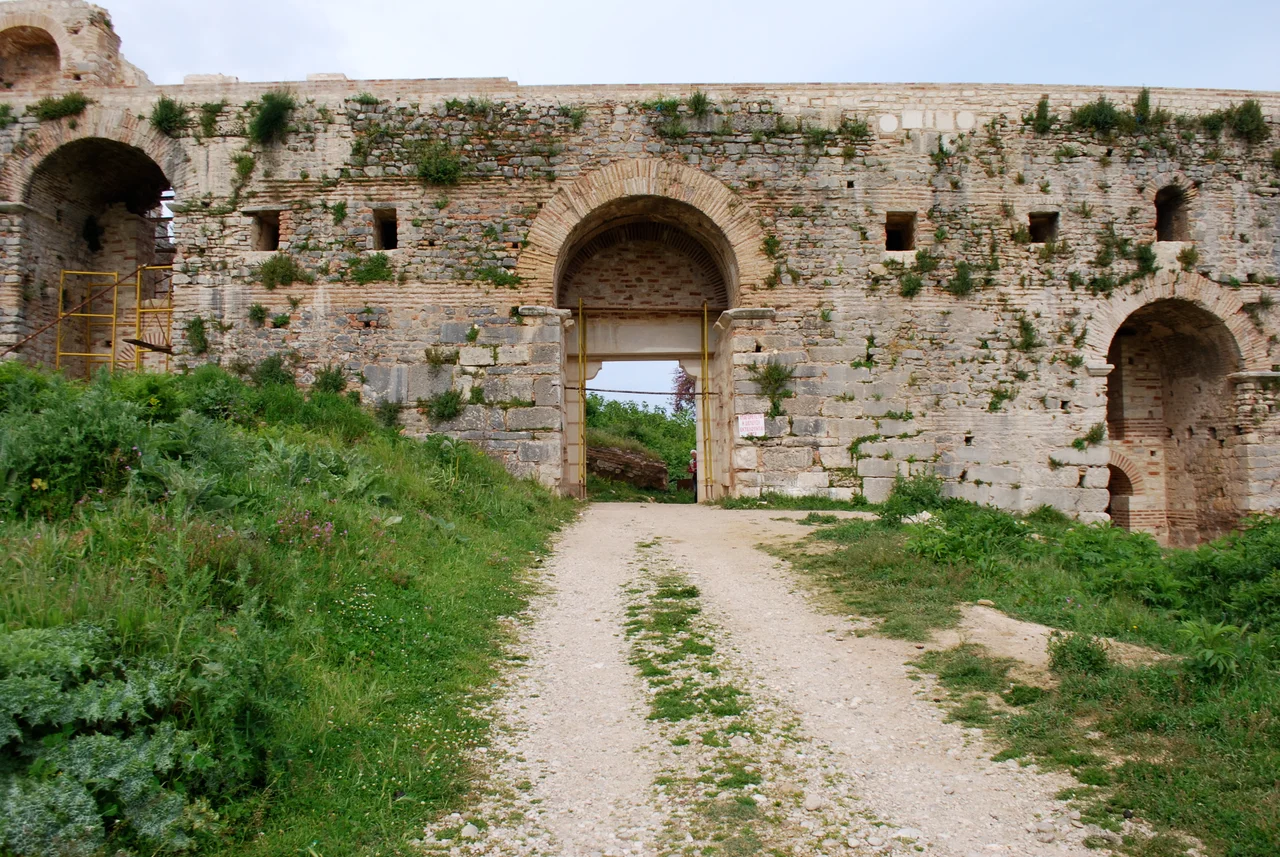
Diocletian's reforms in 293 reorganized the map again. The province became Epirus Vetus, and Nicopolis remained its capital. The city survived the Gothic and Herulian invasions of 268 by hurriedly repairing its fortifications — neighboring settlements were less fortunate. In 474, Vandal raiders did take the city and carried off prisoners who were ransomed back. That shock apparently reduced the inhabited area to one-sixth of what it had been: the population retreated into a fortified northeast sector, and Justinian rebuilt the walls around this smaller core in the 6th century.
Basilicas and Bishops
Christianity came slowly to Nicopolis, then thoroughly. The Apostle Paul spent the winter of 65-66 AD in the city and invited his co-worker Titus to join him from Crete — a Christian community existed there within a generation of the Crucifixion. But Christianity did not predominate in the region until the late 4th century; Julian the Apostate still found enough pagans to revive the Actian Games during his reign.
After Julian's death, the faith spread rapidly across Epirus. From around 460 AD, a series of six basilicas went up in and around Nicopolis. Their mosaic floors were produced by a local workshop that operated until the 550s, and its influence extended beyond the city throughout eastern Illyricum. Basilica B, the largest, served as the metropolitan bishop's main church; an inscription records that Bishop Alcison added to its southern annex around 500 AD. Nicopolis became one of the senior sees of Illyricum — the records of the Ecumenical Councils list it after Thessalonica and Corinth among the hierarchically most significant bishops of the region.
The last known bishop of Nicopolis, Anastasius, attended the Ecumenical Council of 787. Soon after, the metropolitan see moved to Naupactus. The city had been shrinking for a century, and by sometime after the 8th century it ceased to exist as a functioning urban center.
What Remains at the Edge of the Gulf
The ruins of Nicopolis — now called Palaea Preveza, or Old Preveza — lie about 5 km north of the modern town, strung along the isthmus between the Gulf of Arta and the Ionian Sea. Walking the site today means moving through time in discontinuous layers. The theatre retains 77 rows of seats; the odeon is still legible in its architecture; long sections of the Byzantine city wall — built over earlier Roman foundations — stand several meters high. The Monument of Augustus on the hill to the north has been excavated, revealing the stone cuttings where the bronze ship rams once sat.
Fragments of aqueduct survive across the region in multiple forms of construction, some of them substantial enough to photograph. The stadium, gymnasium, thermae, and nymphaeum are all present in various states of preservation. Beneath the scrub and the centuries, the orthogonal grid Octavian's engineers laid out is still partially readable in the ground.
The nearby Archaeological Museum of Nicopolis holds the material record: the last surviving bronze ship ram from Actium, portraits of Augustus and Agrippa, mosaic floors from the basilicas, and the accumulated everyday objects of eight centuries of urban life. Together, the site and the museum make Nicopolis one of the most substantially preserved Roman provincial capitals in the eastern Mediterranean — a City of Victory that outlasted the empire that built it.
From the Air
Nicopolis sits at approximately 39.009°N, 20.734°E, on the narrow isthmus of the Preveza peninsula in northwestern Greece. From altitude, the site is immediately recognizable: the peninsula is defined by the Ambracian Gulf (Gulf of Arta) to the east and the Ionian Sea to the west, narrowing to a thin neck before expanding into the Preveza headland. The Byzantine walls and the Roman theatre are visible from 1,000–2,000 m in clear weather. Aktion National Airport (LGPZ) lies directly across the gulf mouth, approximately 5 km east-southeast. The Actium monument hill, site of Octavian's tent before the battle and his victory monument afterward, is visible as a distinct rise north of the main ruins. Approach from the south over the Ambracian Gulf for the clearest view of the entire site.
Nearby Stories
- 2015 Lefkada Earthquake 2.9 km away
- Cichyrus 4.9 km away
- Battle of Olpae 5.1 km away
- Stratos 19 km away
- Achilleion (Corfu) 42 km away
- Lake Plastiras 58 km away
- Corfu 75 km away
- Hellenic Trench 97 km away