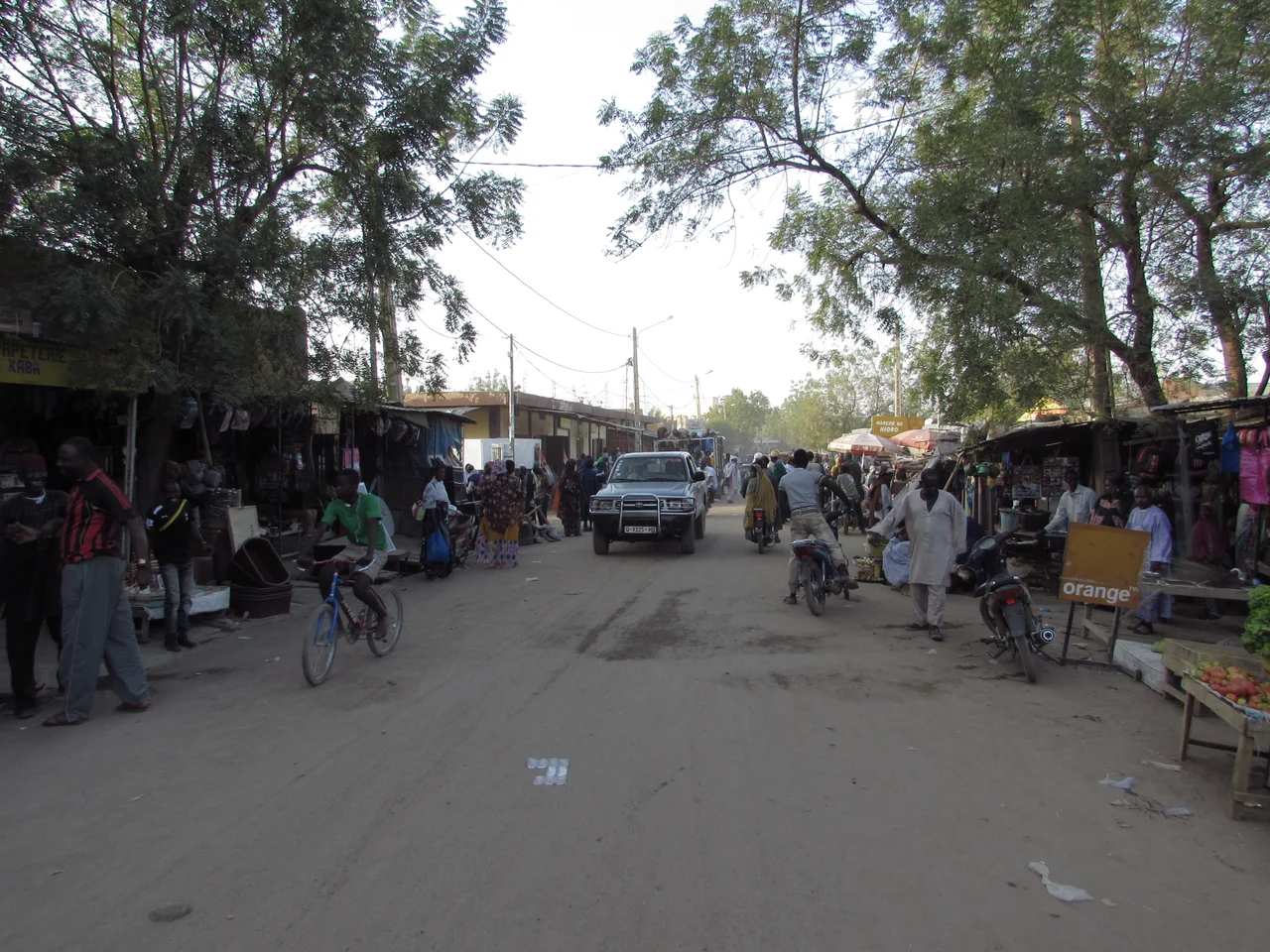

Nioro du Sahel
Roughly 240 kilometers up the road from Kayes, where the savannah thins toward the true Sahel, sits a town that has been a capital, a battlefield, and a holy place by turns. Nioro du Sahel was founded, tradition holds, around 1240 - and across nearly eight centuries it has reinvented itself again and again. Today some 69,000 people live here, but Nioro's reach extends far beyond its size, because each year thousands more arrive on pilgrimage, seeking the blessing of one of the most influential spiritual lineages in the entire West African Sahel.
Capital of Kaarta
Nioro reached its first great height in the eighteenth century as the capital of Kaarta, a kingdom of the Bambara people. Sitting on the routes that linked the upper Senegal to the broader Sudan, the town grew rich as a trading center - a place where caravans, languages, and goods converged on the dry plains. Power in the Sahel was never settled for long, but for a stretch of the 1700s Nioro was a seat of one, the political and commercial anchor of a kingdom that controlled a swath of what is now western Mali. The mud-walled town on the savannah was, in its day, a capital worth conquering.
Conquest and Last Stand
In the early 1850s the conqueror came. El Hadj Umar Tall, founder of the Toucouleur Empire, invaded Kaarta and forced its conversion to Islam, raising a great mosque at Nioro in 1854 as a mark of the new order. The town passed into his empire - and then, a generation later, became its refuge. When the French took the Toucouleur capital of Segou in 1890, Umar Tall's son Ahmadu Tall fled to Nioro to make a stand. His army was led by an exile from elsewhere, the Wolof king Alboury Ndiaye, driven from his own kingdom and now defending another man's last city. In January 1891 the colonial army arrived, and the defense failed. Nioro fell, and with it the empire's final hope in the west.
The Holy City of the Sahel
Out of conquest grew something colonial guns could not touch. Early in the twentieth century, Shaykh Ahmadou Hamahoullah - a sharif of Nioro - founded the Hamawiyya, a branch of the Tijaniyya Sufi order that drew followers from across French West Africa and unsettled the colonial authorities enough that they exiled him repeatedly. The brotherhood endured, and Nioro became its headquarters. Today the lineage is led by Mohamed Ould Cheikh Hamallah, known across Mali as Chérif Bouyé - so influential that his blessing is courted by politicians from distant Bamako. Pilgrims pour into Nioro each year to pay homage and seek favor, and the town that was once a kingdom's capital and then an empire's grave has become, in the end, a place people travel hundreds of kilometers simply to pray.
From the Air
Nioro du Sahel lies at 15.18°N, 9.55°W in northwestern Mali's Kayes Region, near the Mauritanian frontier where Sudanian savannah gives way to true Sahel. The town has its own modest airfield, Nioro Airport, serving the immediate region; the nearest major fields are Kayes Dag Dag (GAKY) about 240 km to the southwest and Bamako-Sénou International (GABS) far to the south. From the air, Nioro reads as a compact town set in flat, sparse savannah scored by seasonal watercourses, with the great mosque a recognizable landmark. Sahelian skies are usually clear but often dust-hazed; visibility is sharpest in the cool months before the harmattan blows.
Nearby Stories
- Koniakary Tata 86 km away
- Boucle du Baoulé National Park 99 km away
- Ghana Empire 124 km away
- Koumbi Saleh 140 km away
- Gouina Falls 164 km away
- Bafing National Park 177 km away
- Aoudaghost 219 km away
- Aoukar 248 km away