.jpg)
Nobatia
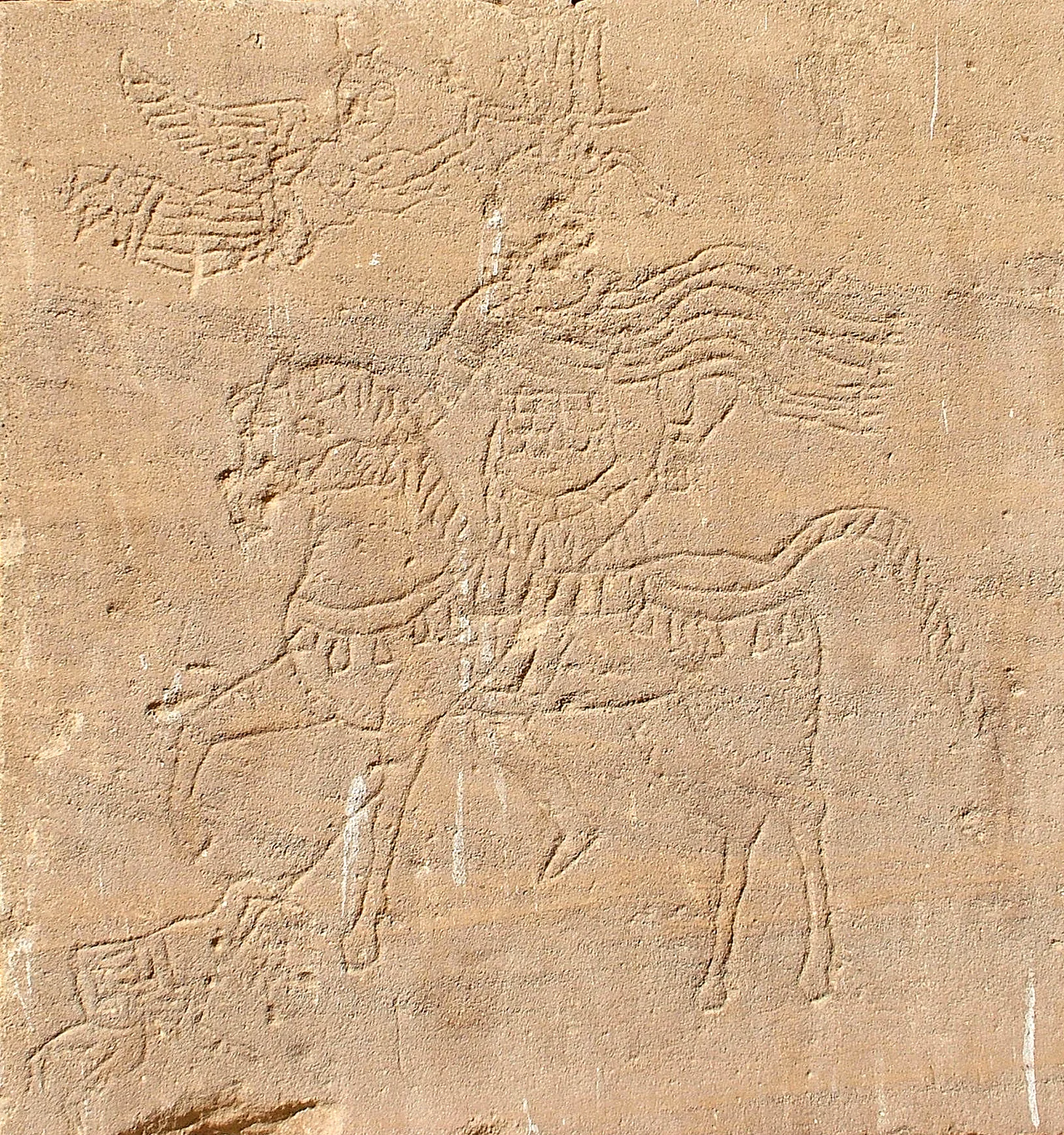
The wall painting at Kalabsha shows a king on horseback driving a lance into his enemy. The figure crowning him is Nike, the Greek goddess of victory. The king is Silko, Basiliskos of the Nobatae -- a title that still carries Greek roots in an African kingdom that was beginning to call itself something new. Silko's inscription claims he drove the Blemmyes into the Eastern Desert, securing the territory his people had been invited into by the Roman emperor Diocletian in 297 CE and had spent two centuries consolidating. Nobatia would convert to Christianity around 543, expand into the gap left by the collapse of Kush, and last until its larger southern neighbor Makuria absorbed it sometime before 707. For roughly three centuries, it was an independent Christian African state between the First and Third Cataracts of the Nile.
Arriving from the Western Desert
The Nobatae came from the Western Desert, part of the long migration of peoples who had moved across the Sahara as it dried. Diocletian invited them into Lower Nubia in 297 CE as frontier allies, partly to help Rome pull back from territory it no longer wanted to garrison directly, partly to use them against the Blemmyes, a rival population that was harassing the Roman border at Aswan. By around 400 CE, the Nobatae had established a recognizable kingdom. Archaeologists identify early Nobatia with the Ballana culture, whose royal tumuli at Ballana and Qustul produced some of the richest tombs in Nubian archaeology -- crowns, weapons, silver-and-bronze harnesses, and the body of a king buried with horses, attendants, and regalia that combined Egyptian, Meroitic, and local elements. Royal burials this opulent tell you what kind of polity the Nobatae had become by the fifth century: wealthy enough to spend lavishly on a single funeral, organized enough to mobilize craftspeople and long-distance traders, confident enough to invent their own iconography.
From Isis to Christ
For most of Nobatia's early history, the royal cult was the Isis worship of Philae -- a Ptolemaic-era holy site where Nubian pilgrims continued to travel long after Egypt itself had turned away from the old gods. The temple at Philae was finally closed between 535 and 538 CE, when the Byzantine emperor Justinian banned Nubian access to the island. Whether Nobatia's conversion to Christianity in 543 was a consequence of that ban or merely coincided with it, it was a dramatic shift. Miaphysite missionaries sent by the empress Theodora reached Nobatia first; the Chalcedonian missionaries Justinian had sent arrived too late. Across the kingdom, ancient Egyptian temples were converted into churches. At Dendur, a Coptic inscription commemorates the conversion during the reign of King Eirpanome. At Kalabsha, a bishop named Paul oversaw the repurposing. At Amada and Wadi es-Sebua the Egyptian reliefs were whitewashed over and painted with Christian saints. Christ himself appears on the ceiling of the converted Temple of Abu Oda near Gebel Adda. The Nobatian elite became Christian quickly. The villages took generations.
The Archers of Nubia
Military archaeology from Nobatia reveals a sophisticated combat culture. The Nobatian bow was initially a slightly reflexed longbow, the type Kushite mercenaries had used since the Middle Kingdom. During the Meroitic or post-Meroitic period, this was replaced by a reflex composite bow about one meter long, originally designed for horseback use. Arrows were roughly 50 centimeters long, sometimes barbed, sometimes poisoned. Quivers were made from the tanned hides of long-necked animals like goats or gazelles, elaborately decorated and possibly worn on the front rather than on the back. Nobatian archers wore protective bracelets -- silver for nobility, rawhide for the poor -- and thumb rings of three to four centimeters. That thumb-ring draw technique is the same used by Persian and Chinese archers. Across the width of the ancient world, an elite method of loosing an arrow had emerged independently or through transmission, and Nubian archers were practitioners of the highest rank. At Qasr Ibrim, archaeologists even found two crossbow darts -- the only crossbow evidence documented in ancient Nubia.
Swords and Scale
The Nobatian melee weapon was distinctive: a short sword with a straight hollow-ground blade sharpened on one edge only, designed to hack rather than thrust. Lances, some with large blades, and halberds were also in use -- though the large-bladed lances and halberds may have been ceremonial rather than battlefield weapons. Body armor survived in fragmentary pieces: thick hide from royal tombs at Qustul, a well-preserved oxhide breastplate from Qasr Ibrim, a reptile-hide breastplate (possibly crocodile) from Gebel Adda. A Qustul fragment consists of layered tanned leather studded with lead rosettes. This was not the iron-and-bronze panoply of a Mediterranean legion. It was something different -- African, tropical-materials-based, effective enough that Muslim Arab chroniclers still wrote about Nubian archers two centuries after Nobatia itself had vanished into Makuria.
The Merger and the Long Echo
Sometime before 707 CE, Makuria annexed Nobatia. The circumstances are not known. It probably happened before the Arab Muslim conquest of Egypt in 642, because Arab historians describe only one Christian state in Nubia by that point. The Nobadian royal family's fate is lost to the record. What survived was the regional identity: Nobatia remained a distinct administrative unit within the unified Makurian kingdom, governed by an eparch who was also titled Domestikos of Pakhoras. Originally appointed, this office seems to have become dynastic in later centuries. Their records have been recovered from Qasr Ibrim, depicting figures with substantial power. Arab histories called the region al-Maris. A 1463 document still mentions an eparch named Teedderre, which means the institution persisted in recognizable form for nearly a thousand years after Nobatia had formally merged into its larger neighbor. A kingdom that had been founded by desert migrants and painted its saints over Egyptian reliefs retained its identity long after the throne was gone.
From the Air
Nobatia's core region was Lower Nubia between the First and Second Cataracts of the Nile, roughly 22.20 degrees north, 31.47 degrees east. The center Faras/Pakhoras is now submerged beneath Lake Nasser / Lake Nubia. Best viewed at 15,000 to 25,000 feet to appreciate the reservoir and the surrounding desert. Nearest airports: Abu Simbel (HEBL), Aswan International (HEBA), and Wadi Halfa (HSSW) to the south across the Sudan border. The Temples of Kalabsha, Dendur, and Amada -- some of which have been relocated to higher ground -- remain visible landmarks in the area. Extreme desert heat and occasional dust storms year-round.
Nearby Stories
- Buhen 20 km away
- Qasr Ibrim 57 km away
- Kulb 105 km away
- Kulubnarti 135 km away
- Temple of Dendur 139 km away
- Bi'r Tawīl 180 km away
- Bir Tawil 184 km away
- Kharga Oasis 308 km away