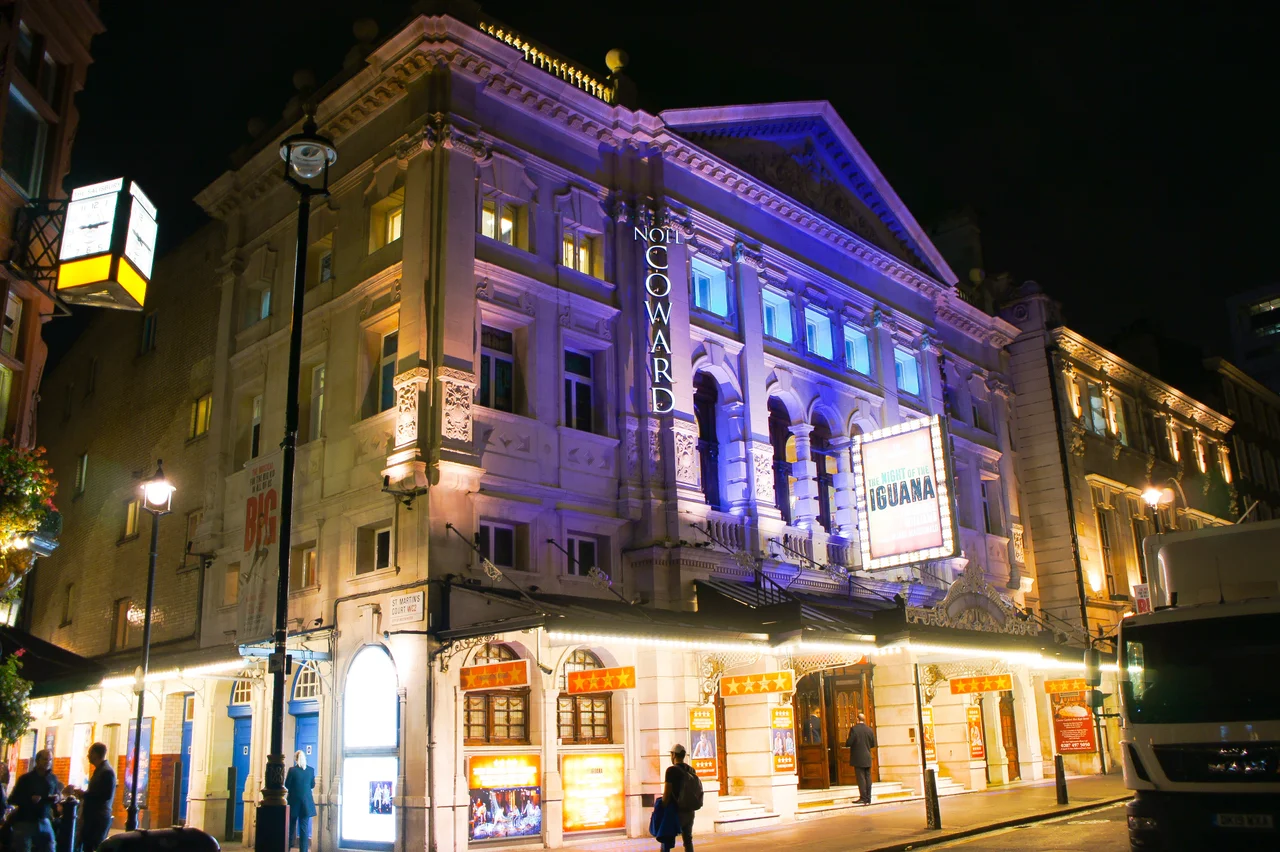

Noël Coward Theatre
In 1901, the actor-manager Sir Charles Wyndham had a problem. Two years earlier, to build his namesake theatre on Charing Cross Road, he had been forced to buy more land than he needed. Now negotiations to sell off the surplus had collapsed. Wyndham did what actor-managers do when handed unexpected real estate: he built another theatre on it. The new venue rose behind Wyndham's, fronting St Martin's Lane. While it was under construction, everyone called it the new theatre. The name stuck. The New Theatre opened on 12 March 1903 with a revival of Rosemary starring Wyndham himself, and across the next century its narrow stage would host Noël Coward's first play, John Gielgud's early Shakespeare, the longest-running West End musical to date, and a young Daniel Radcliffe long after he had hung up his wand.
Sprague's Thirtieth Theatre
The architect was W.G.R. Sprague, the prolific designer of West End playhouses for whom this would be his thirtieth theatre. He gave the building a classical exterior - described by one contemporary report as "of the free classic order, at once dignified and effective" - and an interior in deep Rococo: gilded plasterwork, painted panels, a sweeping curve of balconies. The early seasons established the New as a serious house. Fred Terry and Julia Neilson played a six-month annual residency from 1905 to 1913, performing The Scarlet Pimpernel repeatedly. Mrs Patrick Campbell appeared in early seasons. In 1911 Terry presented As You Like It and Romeo and Juliet to introduce his daughter Phyllis to the stage. Dion Boucicault Jr took over as manager in 1915 with a revival of Peter Pan, restaged each Christmas through 1919. The young Noël Coward arrived in 1920 with his first staged play, I'll Leave It to You - it ran for thirty-seven performances. Coward did not yet know the building would one day carry his name.
Wartime Refuge of Olivier and Richardson
By 1925 the theatre had become a home for serious drama. Margaret Kennedy's The Constant Nymph ran for 587 performances, starring first Coward and then a very young John Gielgud as Lewis Dodd. Edith Evans, Michael Redgrave, Leslie Banks, Laurence Olivier, and Judith Anderson all played Shakespeare on this stage in 1937. The building's most extraordinary chapter came in wartime. The managing director made the New available to the Old Vic and Sadler's Wells companies, whose own homes had been bombed. From 1944 a reconstituted Old Vic took possession, starring Ralph Richardson, Olivier, and Sybil Thorndike. That single season offered Peer Gynt, Arms and the Man, Richard III, and Uncle Vanya - a repertory so dense that it has been credited with rebuilding British classical theatre after the war. The 1945 season added the Henry IV plays and a celebrated double bill of Oedipus and The Critic. In September 1946 came King Lear and Cyrano de Bergerac. Between Old Vic visits, Robert Morley and Wendy Hiller played The First Gentleman for 654 performances. The building had become, briefly, the centre of British stage acting.
The Year Oliver! Arrived
In June 1960 Lionel Bart's musical Oliver!, based on Dickens, opened at the New Theatre. It ran until September 1966 - 2,618 performances. The Times reported that it had broken the previous West End records held by My Fair Lady (2,282) and Salad Days (2,283). The shadow of that run defined what kind of theatre this could be: not just a place for serious drama, but a barn capable of hosting the longest-staying crowd in town. The decade that followed brought stranger experiments. Roy Dotrice played multiple roles in the comedy World War 2. Paul Scofield starred in John Osborne's The Hotel in Amsterdam. The controversial Soldiers by Rolf Hochhuth opened in December 1968. A revival of Oliver! returned to the same stage from 1977 to 1980. In 1973 the theatre had been renamed the Albery in tribute to Sir Bronson Albery, who had presided as manager for many years. The walls remembered him, but the building's biggest changes were still to come.
Becoming the Noël Coward
In September 2005 Delfont-Mackintosh Ltd took over the theatre. A major refurbishment followed in 2006, and on 1 June that year the building reopened with a third name - the Noël Coward Theatre - honouring the playwright whose first play had been performed here eighty-six years earlier. The European premiere of Avenue Q opened on 28 June 2006 and ran nearly three years. Calendar Girls followed, then Enron, then Deathtrap with Simon Russell Beale and Jonathan Groff, then Million Dollar Quartet. In December 2012 the Michael Grandage Company began a remarkable resident season: Privates on Parade with Russell Beale; Peter and Alice with Judi Dench and Ben Whishaw; The Cripple of Inishmaan with Daniel Radcliffe; A Midsummer Night's Dream with Sheridan Smith and David Walliams; Henry V with Jude Law. Photograph 51 followed in 2015 with Nicole Kidman. The lineup that came after read like a casting call for the early 2020s: Imelda Staunton, Vanessa Redgrave, Gillian Anderson, Aidan Turner, Mark Gatiss, Ian McKellen, Steve Coogan, Paul Mescal.
The Building That Refuses to Settle
In 2026 the theatre is hosting Kip Williams's Dracula, with Cynthia Erivo in the lead. Before her, Olly Alexander and Stephen Fry played Wilde's The Importance of Being Earnest. Before them, Paul Mescal made his West End debut as Stanley Kowalski in A Streetcar Named Desire. The building that began as Sir Charles Wyndham's surplus real estate has hosted Coward's debut, Gielgud's early career, the rebirth of classical British acting under Olivier, the longest-running West End musical of its day, and a steady parade of A-list returns to the stage. It is a Grade II listed structure. The Sprague exterior is largely as it was. The Rococo interior, restored in 2006, glitters again above the seats. St Martin's Lane outside is narrow, busy, and unimpressed - exactly the sort of London street a great theatre belongs on.
From the Air
The Noël Coward Theatre is at 51.5111N, 0.1274W in the West End of London, on St Martin's Lane just north of Trafalgar Square. Recommended viewing altitude is 1,500-2,000 feet AGL for a clear look at the Theatreland district - the Wyndham's, Duke of York's, and London Coliseum are all within a few hundred yards. The site is in central London Class A airspace - heavily restricted. Nearest airport is London City (EGLC) approximately 6 nm east; Heathrow (EGLL) lies about 14 nm west. Charing Cross station and the National Gallery are useful landmarks just to the south.
Nearby Stories
- Stevenage 5.7 km away
- Malling Abbey 5.7 km away
- 1952 Farnborough Airshow Crash 7.7 km away
- Ingatestone Hall 8.2 km away
- Hellfire Caves 9.1 km away
- The Carrington Event: The Solar Storm That Could Happen Again 9.8 km away
- Bletchley Park 16 km away
- Castle Hedingham 23 km away