
North Carolina Transportation Museum
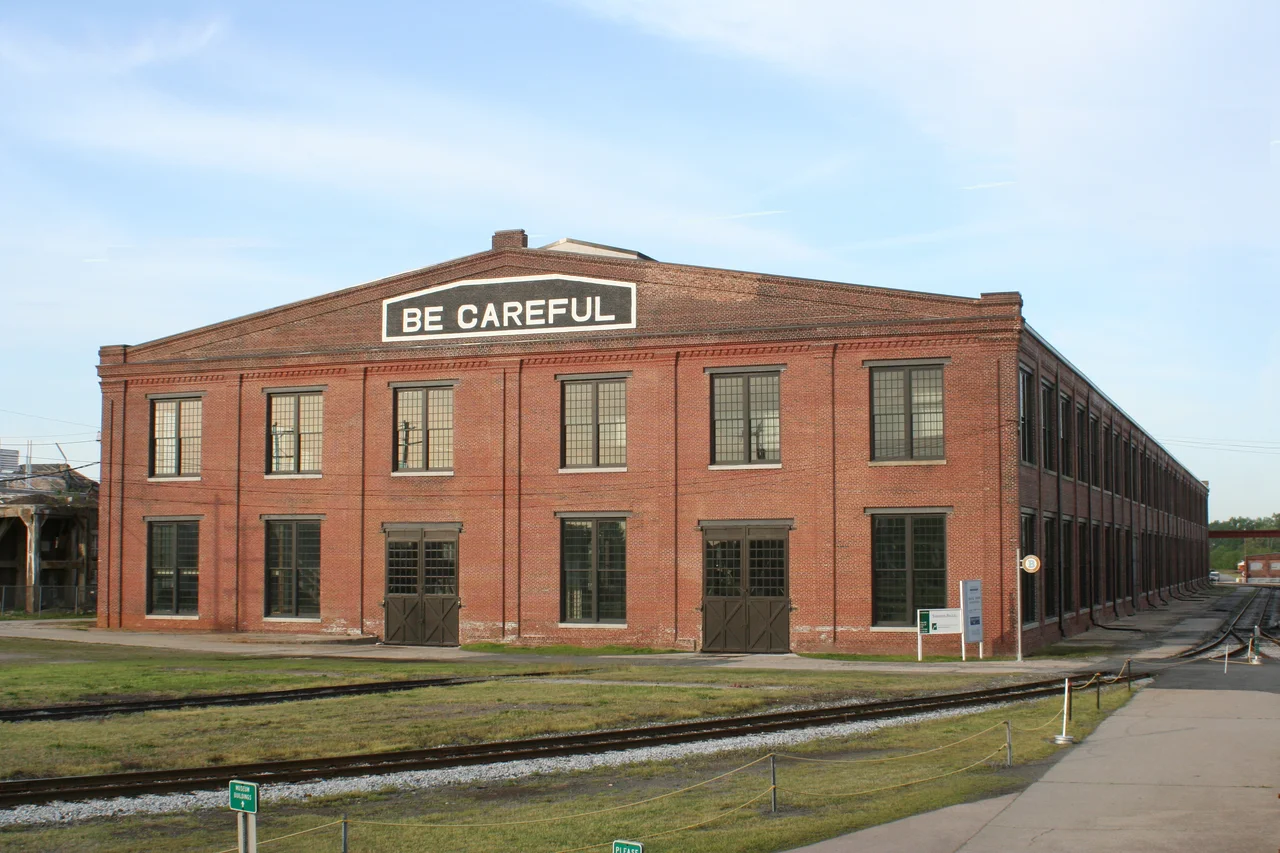
The Back Shop building is two football fields long and stands almost three stories high - a structure built when American railroads still ran on steam and the men who repaired the engines numbered three thousand strong. Today it houses part of the largest collection of rail relics in the Carolinas, in a museum that grew on land Southern Railway donated to the state of North Carolina in 1977, four acres at first, then another fifty-three the next year. The Spencer Shops were where Southern Railway repaired its steam locomotives from 1896 until 1953, and the bones of that industrial operation - the 37-stall roundhouse, the Back Shop, the Flue Shop - now hold restored locomotives, vintage cars, aviation exhibits, and one Pullman car whose history is darker than the rest.
Three Thousand Men Repaired Trains Here
In the first half of the twentieth century, roughly three thousand people worked at the Spencer Shops, employed to keep Southern Railway's steam locomotives running. The shops were the largest steam locomotive repair facility on the entire Southern Railway system, sprawling across acres of brick and steel structures designed for an industrial scale that has largely disappeared from American memory. When diesel locomotives replaced steam after World War II, the shops gradually fell silent. Southern Railway eventually deeded the property to the state, and what had been a working industrial complex became a museum in 1977. The first major exhibit, called People, Places and Time, opened in 1983. Restoration has been a slow accumulation of decades of volunteer labor: the Bob Julian Roundhouse renovated in 1996, the relocated Barber Junction depot moved thirty miles to become the visitor center, the Back Shop opened to the public in 2009 and fully opened in 2017.
Walking the Roundhouse
The Bob Julian Roundhouse, built in 1924, has thirty-seven stalls arranged around a central turntable - the same configuration steam-era crews used to swing locomotives onto repair tracks. Today visitors walk among massive engines and rail cars displayed open-air in the first sixteen stalls. The enclosed Elmer Lam gallery in stalls seventeen through twenty pivots to aviation, with a full-size replica Wright Flyer hung overhead and exhibits on Piedmont Airlines, the regional carrier that started in nearby Winston-Salem before becoming a major American airline. Stalls twenty-one through thirty-two house the active restoration shop, where volunteers work on locomotives and rail cars and sometimes machine the parts they need by hand. The remaining stalls hold additional exhibits. A trip around the turntable is a trip through a century of American transportation.
The 1211 and the Jim Crow Laws
Southern Railway Car No. 1211 was built by Pullman in 1917 as car No. 1563, and later divided by an interior wall to comply with Jim Crow laws - separate compartments for white and Black passengers traveling in different sections of the same car. The Southern partitioned the car around 1939 at Hayne Shops and rebuilt it more heavily in 1953, when it received a welded body, the long sealed windows that became standard on mid-century streamliners, and its current number, 1211. The plan now is to restore the 1211 to its 1940s and 1950s appearance, with the Jim Crow division intact - not to celebrate segregation but to document it honestly. The National Park Service added the car to the National Register of Historic Places in April 2022, recognizing both the engineering history and the social history embedded in a single piece of rolling stock. Two other private cars at the museum tell different stories: The Doris, owned by James B. Duke of the American Tobacco Company and named for his daughter, and The Loretto, built in 1902 for steel magnate Charles Schwab and trimmed in stained glass and gold-leaf carvings.
Streamliners, Steam, and the No. 611
In 2014, the museum hosted Streamliners at Spencer, a four-day photographic event that gathered notable 1930s through 1950s locomotives around the Bob Julian Roundhouse turntable. The Norfolk and Western 611, a Class J streamlined steam locomotive owned by the Virginia Museum of Transportation, came to Spencer for that event and then stayed for restoration work that returned it to operating condition. From 2016 and 2017, the 611 pulled public excursions out of Spencer to Lynchburg, Asheville, Charlotte, and Greensboro - hauling passengers behind one of the last great American steam engines along tracks the Southern Railway built. The museum's own roster runs heavily to diesel: Norfolk and Western GP9 No. 620, Southern GP30 No. 2601, Southern FP7 No. 6133, Southern E8A No. 6900, Atlantic Coast Line E3 No. 501. None of those are steam, but visiting engines from coal companies in Indiana and from the Tennessee Valley Railroad Museum bring steam back to the site on special weekends.
Bumper to Bumper and Be Careful
The Flue Shop, where workers once manufactured the boiler flues for steam engines, now houses the Bumper to Bumper exhibit: several Model Ts, a Model A, a 1907 Ford Model R that predates the Model T, a 1935 Highway Patrol car, a Divco milk truck, a Lincoln Continental. The most striking element of the exhibit may not be the cars themselves but the words BE CAREFUL standing some three feet tall and visible from nearly anywhere on the north end of the site - a safety message that doubled as a workplace mantra during the shops' active years and now serves as a kind of accidental art installation. The museum draws about 80,000 visitors annually. For a town of fewer than 4,000 people, Spencer punches well above its weight on the strength of what one railroad chose to leave behind.
From the Air
The North Carolina Transportation Museum sits at 35.69 N, 80.44 W in Spencer, just east of Salisbury along the Norfolk Southern main line that follows the Yadkin River corridor. From the air, look for the long Back Shop building running parallel to the tracks and the distinctive circular footprint of the Bob Julian Roundhouse. Mid-Carolina Regional Airport (KRUQ) is just south. Charlotte/Douglas (KCLT) lies about 30 miles southwest. Recommended viewing altitude 2,000 to 3,500 feet AGL.
Nearby Stories
- Greensboro, North Carolina 4.1 km away
- 2025 North Carolina Cessna Citation II Crash 7.2 km away
- R. J. Reynolds Memorial Auditorium 9.5 km away
- Battle of Cowan's Ford 12 km away
- North Wilkesboro Speedway 23 km away
- Concord, North Carolina 27 km away
- Tobacco Road 30 km away
- Carthage Nursing Home Shooting 40 km away