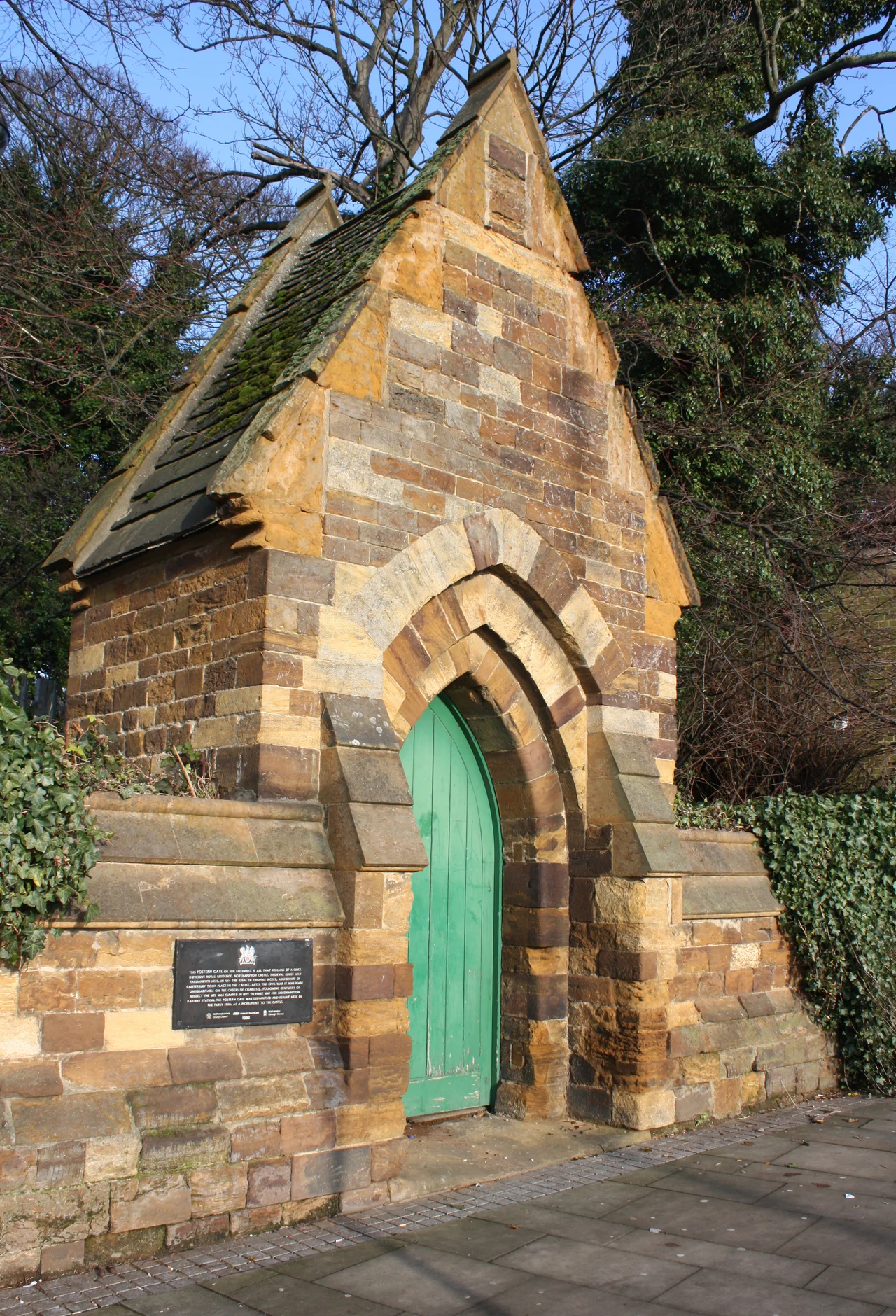

Northampton Castle
The Victorians, when they wanted something done, did not look kindly on twelfth-century masonry. In 1879 the London and North Western Railway needed somewhere to put a new station for the Northampton loop line, and what stood in the way was one of the most important Norman castles in England. The railway company bought what was left of Northampton Castle and tore it down. The keep mound was scraped flat for sidings. A single archway, the postern gate, was dismantled, carted aside, and rebuilt into a wall a short walk from where the platforms now sit. That arch and a strip of earth bank beside St Andrew's Road are all that survive above ground of a fortress that once held Thomas Becket on trial, sheltered the rebellious barons against King John, and saw a king of England's son crowned.
The first earl's stronghold
Simon de Senlis, first Earl of Northampton, began building the castle around 1084, a generation after the Norman Conquest. It was substantial enough that its absence from the Domesday Book of 1086 is telling: the building was still going up. Once finished, it sat outside the western gate of the walled town, defended on three sides by deep ditches and on the fourth by a branch of the River Nene. The keep was large, the bailey extensive, the gates protected by earth bulwarks that would later mount artillery. By the reign of Henry II it had passed into royal hands, becoming one of a string of fortresses the Crown used to hold the Midlands. Parliament met within its walls more than once. Royal tournaments thundered through its outer ward. For two centuries it was, without exaggeration, one of the most important places in the kingdom.
The trial of Becket
In October 1164 Thomas Becket, Archbishop of Canterbury, was summoned to Northampton Castle to answer charges of contempt of royal authority. The dispute with Henry II had become incendiary, a quarrel between church courts and royal courts that would end, six years later, with Becket's murder at Canterbury. At Northampton the council went badly for him from the start. Becket pleaded illness for the first sessions, then arrived carrying a heavy cross. Henry's attendants tried to provoke him into striking the king's officers; the archbishop, sensing what was coming, slipped out at night dressed as a Cistercian monk and rode for the coast. He sailed to France and stayed in exile for six years. The room where he was tried, the staircase he descended, the postern through which he likely escaped: none of it is here anymore. The story is, and the postern arch standing by the railway station is the only physical witness left.
Slighted, then sold
The castle came through the medieval centuries reasonably intact, though by the fifteenth century it was being rented out as a property; in 1452 Robert Caldecote took it on a twenty-year lease at five pounds a year. During the English Civil War the Parliamentarians held it. After the Restoration in 1662, Charles II, taking a long view on payback, ordered the town walls and castle defences slighted, that is, deliberately damaged so they could never again be used to resist a royal army. From then on the surviving buildings served as a court and a gaol, gradually crumbling. By the late seventeenth century the castle was in the hands of one Robert Haselrig. Parts were still standing into the nineteenth century, when fashion and finance both turned against them. Excavations during station rebuilding in 1961 revealed a defensive ditch ninety feet wide and thirty feet deep with a bank eighty feet wide and twenty feet high, the kind of statistics that quietly admit what was lost.
Prince Arthur and the playwright
Shakespeare staged Prince Arthur's death at Northampton Castle in King John, Act IV Scene III. The young prince, John's nephew and a rival claimant, leaps from the castle wall in a desperate escape attempt and dies on the stones below. Real history is murkier. Arthur of Brittany was last documented as a sixteen-year-old captive at Rouen in April 1203, after which he disappears, rumoured to have been killed on John's orders. He was almost certainly not in Northampton when he died, but Shakespeare needed an English castle for the scene and Northampton was famous enough to carry the weight. Becket and the lost prince became its shadow biographies, the names that stick to a place even after every stone of the place is gone.
What remains, and what was added
Stand by Northampton railway station today and you can find the postern gate set into a wall, a low pointed arch with the wrong dimensions for its surroundings, like a sentence in old English left mid-paragraph. Castle Park, the green space immediately to the north, marks the rough outline of the bailey. In July 2025 a set of heritage poles was installed in the park to trace the perimeter of the lost fortress, part of a new trail telling the castle's story to visitors who would otherwise never know there had been one. The Friends of Northampton Castle have campaigned for years to give the site more visible recognition. They have not yet rebuilt the castle, which would be impossible, but they have done the next best thing: they have made the ground remember.
From the Air
Coordinates 52.237°N, 0.905°W, immediately west of Northampton town centre alongside the railway station. Recommended viewing altitude 2,000-3,000 ft AGL. Visual landmarks: the rectangular shed of Northampton railway station, the small green space of Castle Park immediately north, and the loop of the River Nene curving west and south of the site. The town's distinctive National Lift Tower stands 1 nm northwest. Nearest airfield is Sywell Aerodrome (EGBK), 6 nm northeast. Cranfield (EGTC) lies 13 nm southeast.
Nearby Stories
- Battle of Bosworth Field 3.6 km away
- Murder of Ross Parker 7.2 km away
- Royal Leamington Spa 8.8 km away
- Buckingham 9 km away
- St Neots 9.4 km away
- Letchworth 10 km away
- Uppingham School 11 km away
- Sudeley Castle 39 km away