.jpg)
Northampton War Memorial
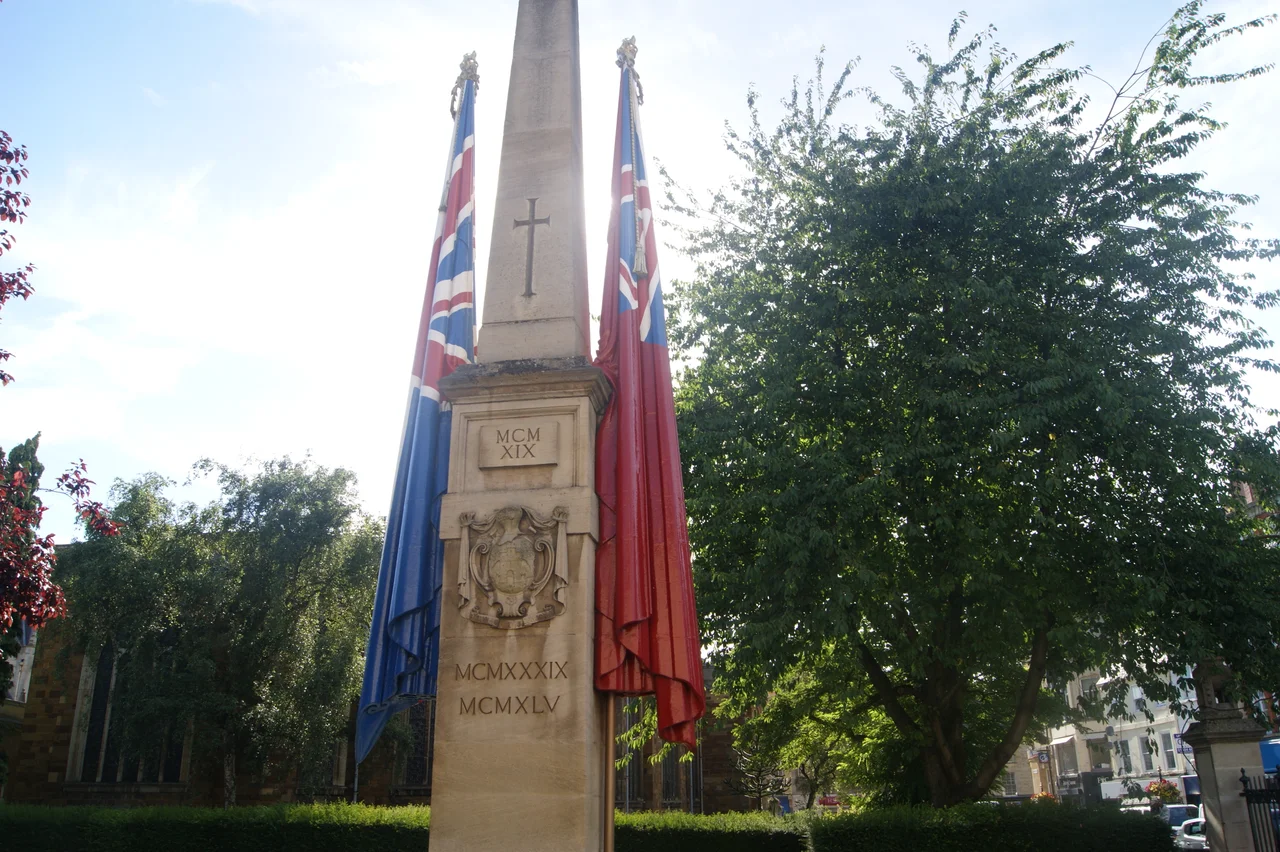
Edwin Lutyens wanted stone flags on the Cenotaph in Whitehall and he was overruled. The committee in London insisted on real fabric, the argument being that stone flags would look heavy, mannered, the wrong note. Lutyens disagreed politely and got on with other commissions. When Northampton's war memorial committee gave him a churchyard site behind All Saints' Church and asked him for something more elaborate than the standard cross, he took the chance to do what Whitehall had refused. The result is a pair of obelisks draped with painted stone flags that hang as if heavy fabric had been caught in mid-fall. Two banners on each obelisk, four flags in total, gold-wreathed at their tops: the Union Flag, the White Ensign of the Royal Navy, the Red Ensign of the Merchant Navy, the RAF Ensign. They have been hanging on Wood Hill since 1926.
Two villages out of every village in the county
The First World War took men from almost every settlement in Northamptonshire. Only two villages came out of it without a single name to inscribe: East Carlton in the north of the county and Woodend in the south. The term for such places is 'thankful villages', and there are fewer than sixty across the whole of England and Wales. Every other village in Northamptonshire lost at least one of its own. The town and county committee, formed shortly after the armistice in 1918, set about thinking what to build to honour them. A temporary wooden and plaster cenotaph went up on Abington Street in July 1919 and served as the focus for remembrance for the next seven years while the permanent memorial waited.
Six years to move some graves
Lutyens had been designing war memorials more or less continuously since 1919. By 1920 his plans for Northampton were complete and approved. What delayed installation was not money or design but consecrated ground: the chosen site was part of All Saints' churchyard, and several graves needed to be moved to make room. That required a faculty from the Diocese of Peterborough, a Church of England legal instrument, and the application had to be drafted, submitted by the vicar of All Saints', and supported by churchwardens and parishioners. The Reverend Geoffrey Warden filed in 1922. The bureaucracy ran its course. The committee, chaired by Lord Lilford with the local landowner himself contributing fifty pounds toward the cost, kept fundraising. On 11 November 1926, after a service and a parade including local schoolchildren, the memorial was unveiled. It had been eight years since the armistice.
The architecture of restraint
Each obelisk rises from a four-tiered rectangular column on a square plinth, with deep niches forming arch shapes beneath. The Northampton coat of arms is moulded into the columns. A narrow cross is cut into each obelisk. Between them sits a Stone of Remembrance, the form Lutyens designed for the Imperial War Graves Commission, twelve feet long and so subtly curved that the eye reads it as flat. The east face carries Rudyard Kipling's selection from Ecclesiasticus: 'THEIR NAME LIVETH FOR EVERMORE.' The west face is inscribed from the Wisdom of Solomon: 'THE SOULS OF THE RIGHTEOUS ARE IN THE HANDS OF GOD.' Both faces are unusual; Lutyens's other Stones of Remembrance bear only the Kipling line. The whole composition sits in a small garden with a low stone wall to the front, a yew hedge to the rear, and cast iron gates supported by stone piers with urn finials. Of all his war memorials in England, only Manchester's also uses paired flanking obelisks. Historian Richard Barnes wrote that in both designs Lutyens uses the obelisks 'with dignity and simple dramatic effect.' On a wet November morning, that is what they do.
The garden of names
The Town and County memorial holds no list of casualties, by design. Lutyens's vocabulary preferred abstraction, scale, and the deliberate refusal of decorative names; the Stone of Remembrance was meant to honour every soldier of every faith and none, including those whose bodies had never been recovered. But many families needed to see their dead by name, and the local Royal British Legion campaigned for a separate garden of remembrance. It was built in Abington Square on the site of the original temporary cenotaph and unveiled by Major General Sir John Brown in 1937. The fallen were inscribed on its walls. Into the garden was moved a bust of Edgar Mobbs, a professional rugby player for Northampton Saints who had raised his own company at the age of thirty-two, served on the Western Front, and been killed at the Battle of Passchendaele in July 1917. Mobbs was a local hero before the war and a more particular kind of hero after it, a man who would not let his celebrity excuse him from danger.
What it asks of the visitor
The memorial was upgraded from Grade II* to Grade I in 2015 when Lutyens's war memorials were declared a national collection. That listing recognised what was always intended: that these monuments, scattered across hundreds of English towns, should be read together as one extended argument for memory. The Northampton memorial sits behind All Saints' Church on a slight rise, a yew hedge enclosing it, two stone obelisks and a stone slab between them. The flags on the obelisks have been painted since 1926, and they still look, if you let them, like real cloth caught in a long fall. The garden is small and easily missed by a passer-by going about ordinary business in the town. The intent is the opposite of grandeur. The intent is that you remember by stopping.
From the Air
Coordinates 52.237°N, 0.896°W, in the centre of Northampton on Wood Hill behind All Saints' Church. Recommended viewing altitude 1,500-2,500 ft AGL given proximity to town centre. Visual landmarks: the bulk of All Saints' Church with its prominent portico and statue of Charles II, the market square one block north, and the National Lift Tower 1 nm to the northwest. Nearest airfield is Sywell Aerodrome (EGBK), 6 nm northeast. Cranfield (EGTC) lies 13 nm southeast for IFR diversions.
Nearby Stories
- Battle of Bosworth Field 3.6 km away
- Murder of Ross Parker 7.2 km away
- Royal Leamington Spa 8.8 km away
- Buckingham 9 km away
- St Neots 9.4 km away
- Letchworth 10 km away
- Uppingham School 11 km away
- Sudeley Castle 39 km away