
Norwich Cathedral
Construction began in 1096 at the command of Herbert de Losinga, the first Bishop of Norwich, and the building took nearly fifty years to complete. When the crossing tower went up in 1145, Norwich Cathedral was the largest building in East Anglia. It still dominates the city's skyline, its stone spire — the second tallest in England, built in 1480 to replace a wooden predecessor — rising above the River Wensum and the rooftops of the medieval city. Nearly a thousand years of continuous use and occasional upheaval show in every corner of the building, from the Norman arcade to the medieval graffiti scratched into interior stonework, including organ music inscribed on two four-line staves.
Cream Stone and Norman Scale
The cathedral is made primarily of flint and mortar, faced with cream-coloured Caen limestone shipped from Normandy — a material choice that makes the building visible for miles and gives it a warmth unusual in English Romanesque architecture. The ground plan, laid out in Norman times and unchanged in its essentials ever since, is unusually long: fourteen bays in the nave, transepts without aisles, an apse at the east end with an ambulatory. Two chapels of unusual plan open from the ambulatory, each based on two intersecting circles — an elegant solution to the problem of orienting altars correctly without resorting to the standard radial chapel design.
The tower is the most ambitious surviving Norman tower in England, decorated with geometric circles, lozenges, and interlaced arcading. The cloisters, begun in 1297 and finally finished in 1430 despite interruption by the Black Death, are the second largest in England. They are two storeys high — the only two-storey example in the country — and contain nearly 400 carved stone ceiling bosses.
The Bosses
The ceiling bosses of Norwich Cathedral are described as one of the world's greatest medieval sculptural treasures. They stud the stone vaulting of the nave, choir, and transepts, carved and painted and gilded, arranged in a tierceron vault whose lierne ribs form patterns of lozenges and stars along the ridge. Medieval craftsmen worked these in stone, which meant they were not easily destroyed — and so they survived the Tudor Reformation and the Civil War periods that wiped out so much English medieval religious art.
To see them properly, you need either to bring binoculars or to trust the mirror on wheels that the cathedral provides for visitors, laid flat on the floor and reflecting the vault above. In July 2019, the cathedral installed a temporary helter-skelter in the nave, partly to attract visitors and partly to give people a better view of the bosses. Reaction was divided. In August 2019, the Bishop of Lynn gave a sermon from halfway down the slide and sang a song by the Bee Gees. This also attracted divided reaction.
The Close and Its Graves
The cathedral close, which in medieval times occupied a tenth of the total area of the city, is enclosed within the limits of the former monastery and bordered by the Tombland area and the River Wensum. It contains buildings from the 15th to the 19th centuries and houses much of Norwich School — one of England's oldest schools. Statues of the Duke of Wellington and Admiral Nelson stand in the grounds, Nelson having attended that school before his naval career.
The grave of Edith Cavell is in the close. Cavell was a British nurse executed by the Germans in October 1915 for helping Allied soldiers escape from occupied Belgium during the First World War. She was shot at dawn in Brussels and buried there before her body was returned to Norfolk and interred here in 1919. Her grave is one of the most visited in the close — a simple stone that marks one of the more plainly courageous acts of the 20th century.
Music, Chocolate, and Ongoing Life
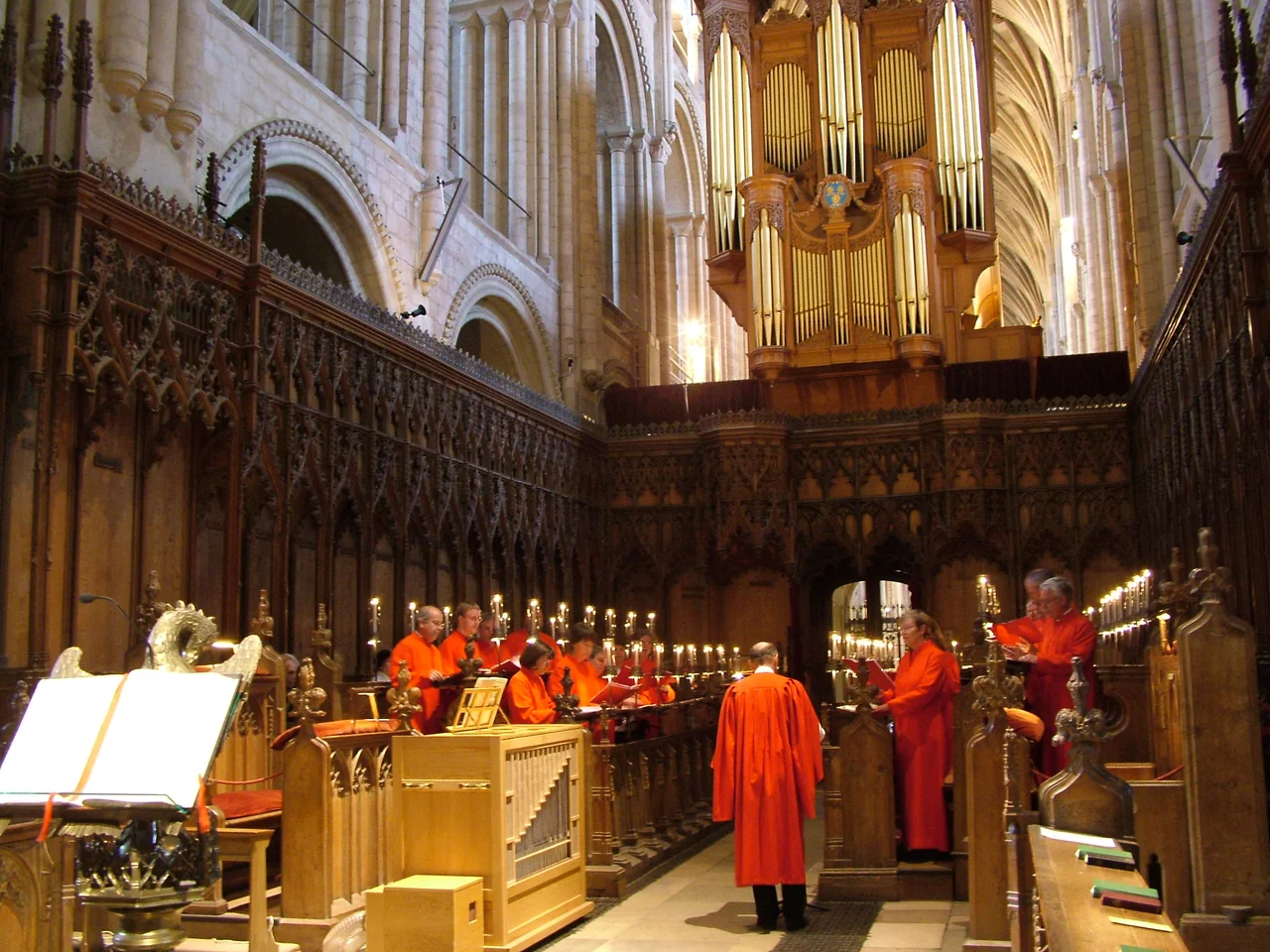
The cathedral's organ, built by local firm Norman and Beard in 1899, is one of the largest in the UK and was rebuilt by Harrison & Harrison of Durham in 2022-23, inaugurated in November 2023. The cathedral's choirs trace their tradition back to Adam the Organist, the earliest recorded organist, employed in 1333. The baptismal font in the nave has an unusual origin: it was fashioned from copper bowls previously used for making chocolate in the Norwich Rowntree's factory, donated after the factory closed in 1994. The cathedral that began as the largest building in East Anglia has, in nine centuries, accumulated a great deal of history and continues to accumulate more.
From the Air
Norwich Cathedral sits at 52.6319°N, 1.3011°E in the historic centre of Norwich, its stone spire the most prominent vertical element in the city's skyline. The cathedral and its close — a large walled precinct visible from altitude — are easily identified from the air. Norwich Airport (EGSH) is approximately 4 miles to the northwest. The spire is best seen from the west or northwest, where it aligns with the River Wensum. Recommended viewing altitude: 2,000 feet in clear conditions for the full close and city context; lower for the architectural detail of the spire itself.
Nearby Stories
- Sheringham 2.7 km away
- Wingfield Castle 4.4 km away
- Castle Acre Castle and Town Walls 6.3 km away
- Brancaster 7.1 km away
- West Stow Anglo-Saxon Village 9.3 km away
- Four Days' Battle 80 km away
- Battle of Lowestoft 80 km away
- SM U-97 110 km away