.jpg)
Norwich Market
The market at Mancroft was established by Normans, for Normans. When William the Conqueror's followers reshaped Norwich after 1066 — building the castle, relocating the cathedral, clearing large sections of the old Saxon town — a new Norman settlement called Mancroft grew west of the castle, and it needed a market to supply the merchants and settlers moving in. By the time the Domesday Book was compiled in 1086, the market was already trading. It has been trading on the same site ever since, which makes it one of the most persistently occupied pieces of commercial ground in England.
A Medieval Economy on One Slope
By the 14th century, Norwich was one of the largest cities in England — possibly the second, though historians debate the exact ranking. East Anglia was among the most densely populated regions in the country, producing grain, sheep, cattle, and cloth in quantities that demanded a trading hub, and Norwich, an inland port on the River Wensum, was that hub. The market at Mancroft was its engine.
The site sloped downwards from west to east. On market days — generally Wednesdays and Saturdays, though daily trading is recorded around 1300 — the northern section held fishmongers, butchers, ironmongers, and wool sellers. The southern section housed a bread market and stalls connected to the cloth and leather industries that drove the city's economy. A broad clearing at the east served country smallholders who set up temporary booths. A second market south of St Peter Mancroft church dealt in wheat, poultry, cattle, and sheep. Separate locations existed for pigs, horses, timber, and dye — the modern Norwich street names Timberhill and Rampant Horse Street record where those markets stood.
All stallholders retained the right to be married in St Peter Mancroft church and buried in its churchyard. That right still holds today.
Edward III and the Transfer of Power
In 1341, King Edward III visited Norwich for a jousting tournament. He and his mother, Isabella of France, were impressed by what they found — a prosperous, well-defended city that had borne the costs of its own defensive walls — and in gratitude, Edward granted the franchise of the market to the city of Norwich in perpetuity. The King's Clerk, who had controlled all trade at the market and collected tolls on behalf of the crown, was removed from the picture.
The city responded immediately. Trading rules were tightened to prevent 'forestalling' — the practice of intercepting merchants on their way to the market to buy their goods for resale, or to create artificial scarcity. Prices for bread and beer were fixed. Standardised weights and measures were introduced. The right to profit from resale was restricted to Freemen of the city. The market, freed from royal supervision, became an instrument of civic management.
Then, in March 1349, the Black Death reached East Anglia. What followed was catastrophic. In 1349-50 alone, more than half the population of East Anglia died. By 1377, Norwich's population had fallen from at least 20,000 before the outbreak to below 6,000. Stalls stood empty for years. The famine of 1369 overwhelmed the churchyards. The economy rebuilt slowly, and the market rebuilt with it.
Nine Centuries, Still Trading
The market was radically redesigned in the 1930s: stalls arranged into parallel rows, a new City Hall built along the entire western side to replace the by-then-inadequate Guildhall that had stood there since 1413. This arrangement survived until 2003, when proposals for another radical rebuilding provoked fierce controversy and were abandoned in 2004. A compromise scheme replaced the old stalls with steel units without changing the basic layout. The rebuilt market completed in early 2006 is one of the largest in Britain.
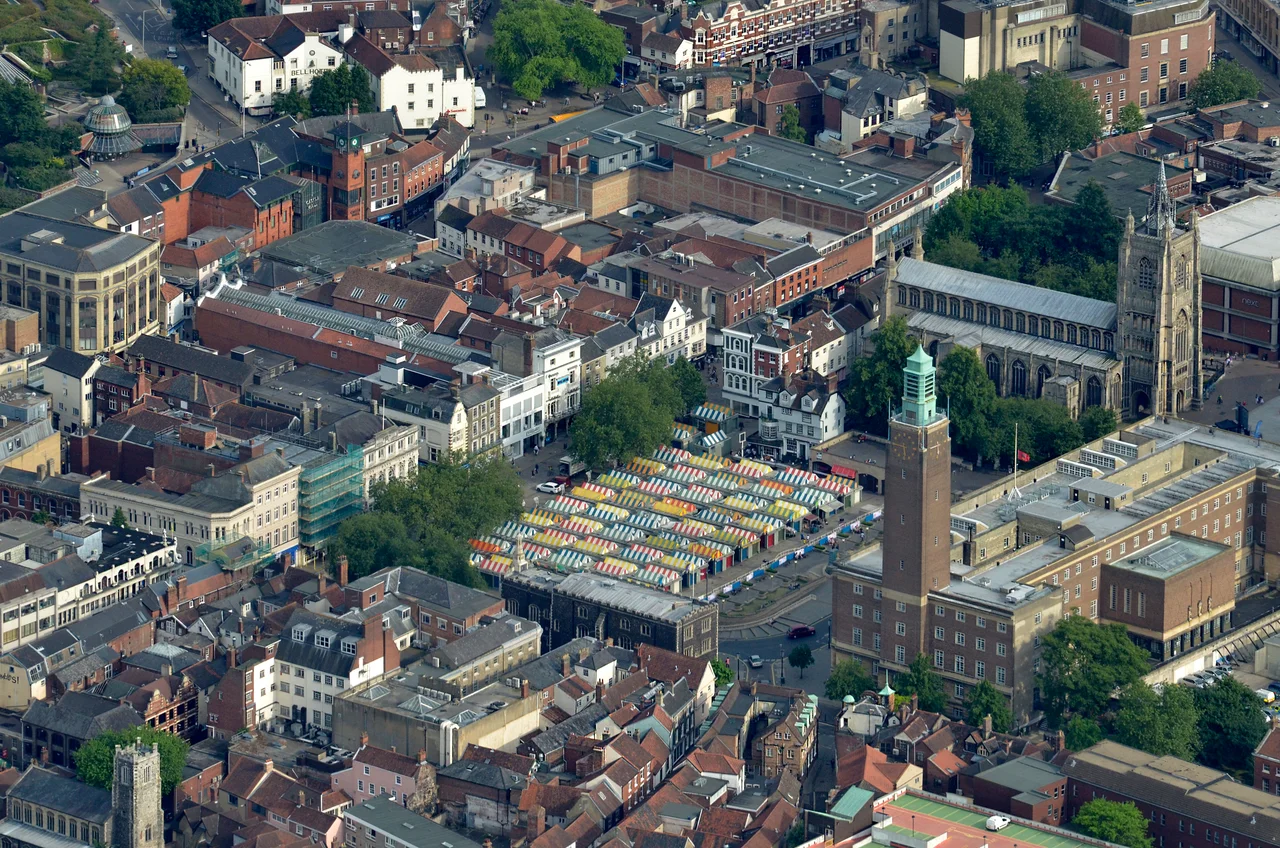
The coloured striped canopies over the roughly 200 stalls are one of the most recognisable visual features of Norwich city centre. The 15th-century Guildhall — the largest surviving medieval civic building in Britain outside London, which served as the seat of local government until 1938 and as a law court until 1985 — stands at the northern end. St Peter Mancroft church, financed by the market's merchants in the 15th century, stands at the southern end. The slope from west to east that shaped the medieval layout is still there, and on busy days the market still smells of fish and fresh bread, as it has for nine hundred years.
From the Air
Norwich Market is located at 52.6285°N, 1.2929°E in the city centre of Norwich, immediately west of Norwich Castle and directly north of St Peter Mancroft church. The distinctive coloured canopies of the market stalls are visible from low altitude on a clear day. Norwich Airport (EGSH) is approximately 4 miles to the northwest. The castle-market-church triangle at the centre of Norwich is one of the most clearly identifiable urban clusters in East Anglia from the air. Recommended viewing altitude: 1,500 feet in clear conditions for the full city context.
Nearby Stories
- Sheringham 2.7 km away
- Wingfield Castle 4.4 km away
- Castle Acre Castle and Town Walls 6.3 km away
- Brancaster 7.1 km away
- West Stow Anglo-Saxon Village 9.3 km away
- Four Days' Battle 80 km away
- Battle of Lowestoft 80 km away
- SM U-97 110 km away