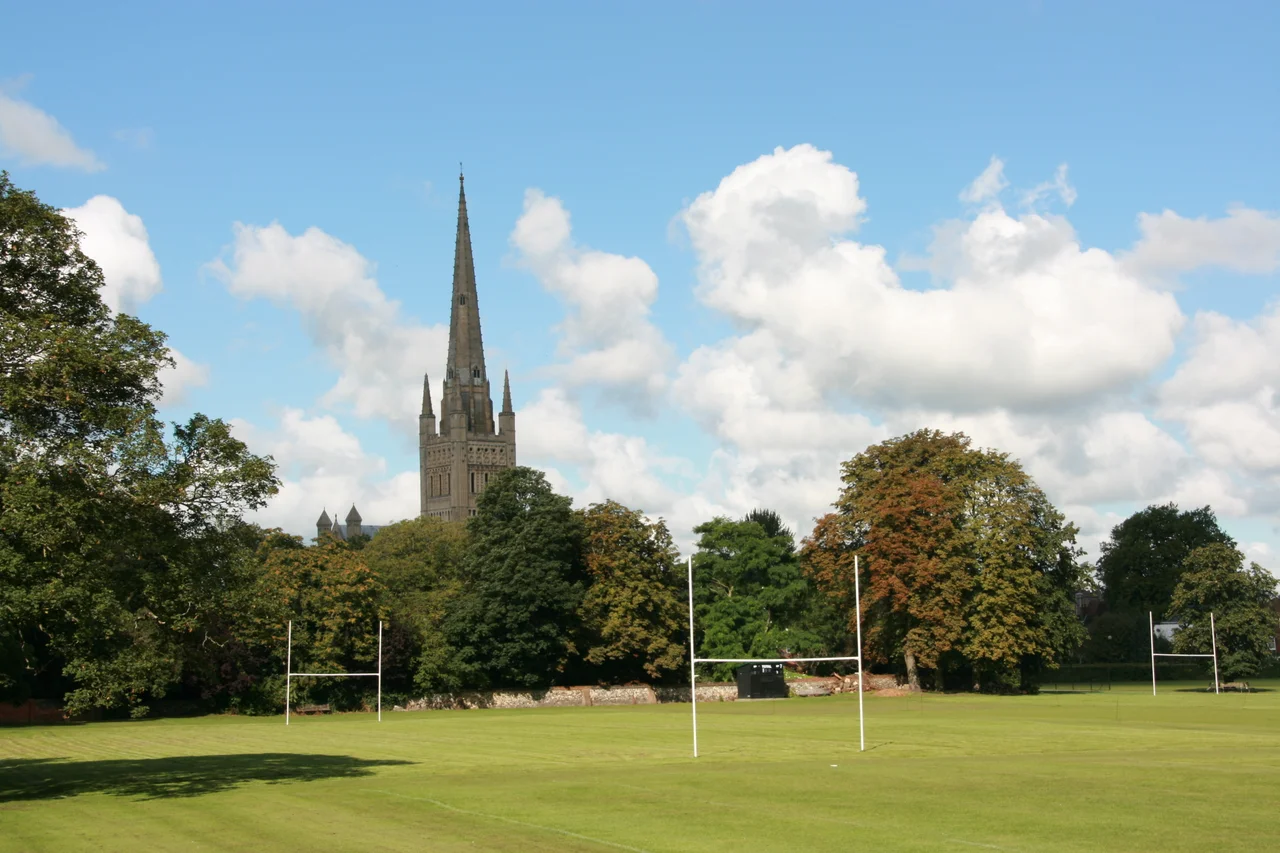

Norwich School
The school exists because Herbert de Losinga needed somewhere to educate the clergy his cathedral required. In 1096, simultaneously with beginning construction of Norwich Cathedral, de Losinga established an episcopal grammar school — and that school, through various reformations, royal charters, periods of near-extinction, and a Victorian revival, has continued in some form ever since. It is now known simply as Norwich School, formally King Edward VI Grammar School, Norwich, and it sits in the cathedral close where it has been since 1551, surrounded by nine centuries of accumulated history and next door to the building whose founding it predates.
John Crome and the Painters
The most unexpected thing the school produced was not an admiral or a jurist but an art movement. John Crome — landscape painter, founder of what became known as the Norwich School of painters — joined the school as a drawing master at the beginning of the 19th century and remained for many years. The Norwich School of painters was the first provincial art movement in England; Crome has been described, by those who study such things, as one of the most prominent British landscape painters alongside Constable and Gainsborough.
Several of the movement's notable artists were educated at the school: John Sell Cotman, James Stark, George Vincent, John Berney Crome (John Crome's son), and Edward Thomas Daniell. Frederick Sandys, the 'Norwich Pre-Raphaelite', also attended. The school's headteacher Dr. Samuel Forster became vice president of the Norwich Society of Artists, the organisation established in 1803 for artists of the movement. For several decades in the early 19th century, the cathedral close and the school it contained were the quiet centre of a genuine artistic revolution in English painting.
Nelson, Coke, and Other Graduates
The school lists Lord Nelson — Horatio Nelson, 1st Viscount Nelson, who defeated the French and Spanish at Trafalgar in 1805 — among its former pupils, a fact commemorated by one of the school's eight houses bearing his name. A statue of Nelson stands in the cathedral close, moved to its current position in 1856. The statue was sculpted by Thomas Milnes in 1847 and unveiled in 1852 before being relocated. It shows Nelson in vice admiral's uniform, his empty right sleeve pinned to his uniform — he lost most of his right arm in 1797 — and a telescope resting on a cannon at his feet.
Sir Edward Coke, the jurist who established foundational principles of English common law, also attended. The school counts 18 Fellows of the Royal Society among its Old Norvicensians — the name given to former pupils — across its history. In the 1860s and 1870s, the reforming headmaster Augustus Jessopp broadened the curriculum beyond classics, implemented the prefect system, introduced organised sport, and brought the school to a point where the Schools Inquiry Commission reported it 'gives the highest education in the county of Norfolk.'
The Close and Its Buildings
The school operates within the 44-acre cathedral close, using buildings spread through what was once the monastery precinct. Many are listed; several are scheduled monuments. The school chapel, built in 1316, was originally the chantry chapel and college of St John the Evangelist. Its crypt was used as a charnel house — storing the bones of people buried in Norwich churches to await resurrection — and its windows allowed visitors to view the remains. A chantry established by Henry V was located in the crypt from 1421 to 1476, for a veteran of Agincourt.
The Erpingham Gate, commissioned by Sir Thomas Erpingham — a commander at Agincourt — and built between 1416 and 1425, is the primary entrance to the north part of the close. Its motto, yenk (think), appears on small scrolls across the stonework. St Ethelbert's Gate was built in 1316 by the citizens of Norwich as penance for a riot in 1272 that damaged the priory buildings. The Bishop's Palace, used by the school since 1958, was originally a three-storey fortified tower connected directly to the cathedral. During the Second World War, American Red Cross personnel used it as a service club. In total, 102 former pupils died in the two world wars; they are remembered each November.
From the Air
Norwich School is located at 52.6318°N, 1.2993°E within the cathedral close of Norwich, immediately adjacent to Norwich Cathedral. The 44-acre walled precinct of the close is clearly visible from the air as a large open space within the urban fabric of the city, bounded by the River Wensum to the south and the Tombland area to the west. Norwich Airport (EGSH) is approximately 4 miles to the northwest. The cathedral spire and the close together provide one of the most distinctive aerial landmarks in East Anglia. Recommended viewing altitude: 1,500 to 2,000 feet in clear conditions.
Nearby Stories
- Sheringham 2.7 km away
- Wingfield Castle 4.4 km away
- Castle Acre Castle and Town Walls 6.3 km away
- Brancaster 7.1 km away
- West Stow Anglo-Saxon Village 9.3 km away
- Four Days' Battle 80 km away
- Battle of Lowestoft 80 km away
- SM U-97 110 km away