.jpg)
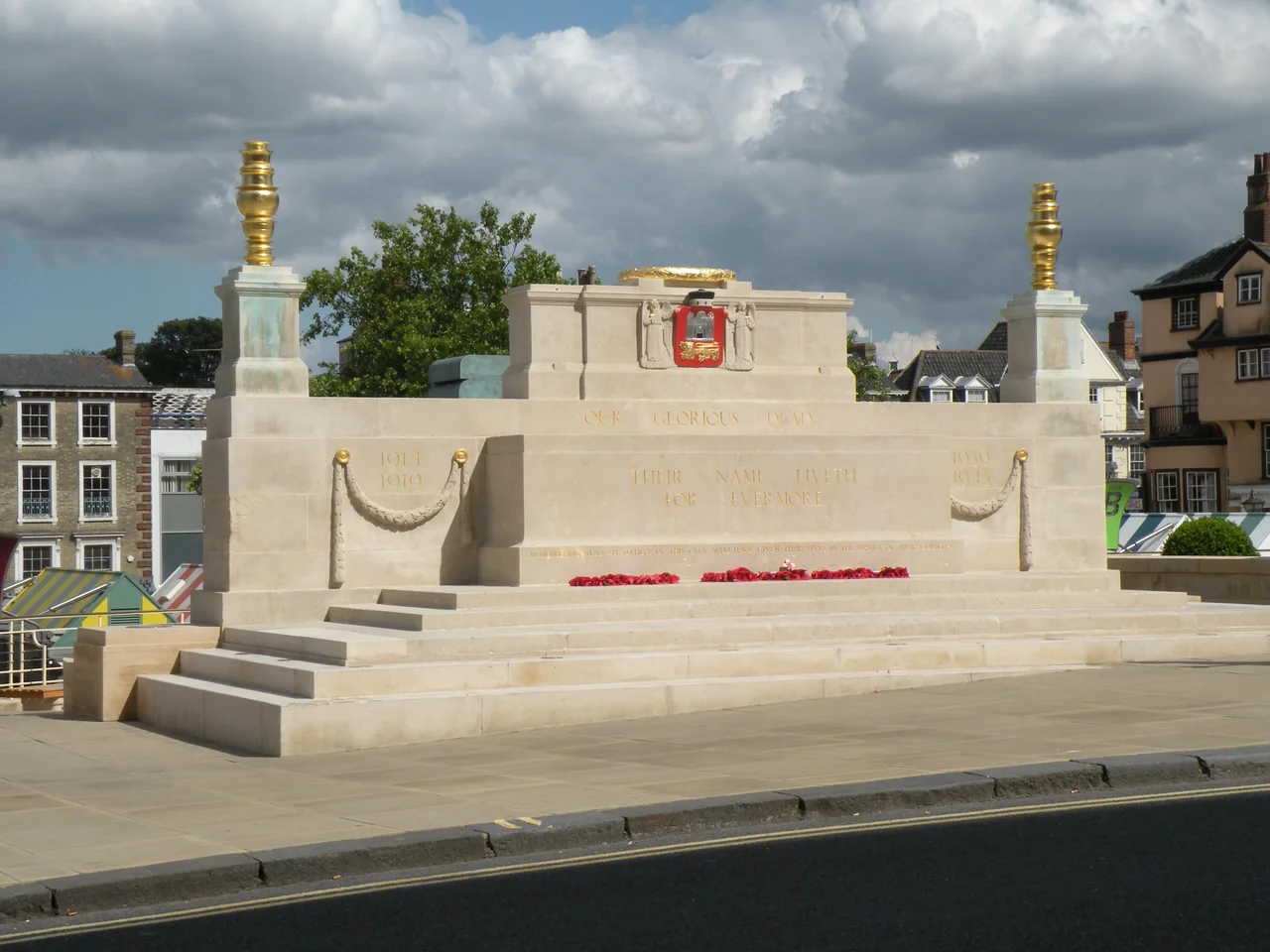
Norwich War Memorial
Bertie Withers had enlisted on 1 September 1914, fought at Gallipoli, rejoined his unit for the First Battle of Gaza, and lost his left leg below the knee before he ever came home. When Norwich finally built its war memorial thirteen years later, the city deliberately chose someone like him to pull back the cloth: a native of Norwich, someone who had volunteered before conscription, someone who had served overseas, someone who bore the mark of it. Withers was selected by lot from among those who met all four criteria. On 9 October 1927, he stood before the white Portland stone structure Edwin Lutyens had designed, and unveiled it to the crowd.
A City Slow to Grieve in Stone
Norwich was not quick to memorialize its dead. While other English cities raised monuments in the early 1920s, the county town of Norfolk had a string of failed proposals and abandoned schemes before a newly elected lord mayor took the matter personally in hand in 1926. He wanted the memorial built before he left office. He raised funds both for a physical monument and for local hospitals — the two purposes braided together, stone and care, the permanent and the practical.
Lutyens was the obvious choice for the commission. Historic England would later describe him as 'the leading English architect of his generation,' and his reputation had already been cemented by the Cenotaph in Whitehall. Norwich paid £2,700 in total; Lutyens took ten percent. His design for the city was an empty tomb — a cenotaph, from the Greek for 'empty grave' — set atop a low screen wall, with bronze flambeaux gilded with gold leaf standing at either end, capable of burning a real gas flame. The Stone of Remembrance protruding from the screen wall was the only one Lutyens ever designed to be integrated into a larger structure rather than standing free.
The Norfolks at War
The memorial speaks for approximately 33,000 men who served overseas with the Norfolk Regiment, among many more Norfolk men who joined other units. The regiment had deployed swiftly: the 1st Battalion left Belfast as part of the British Expeditionary Force and fought at the Battle of Mons in August 1914, one of the first major engagements of the war. The 2nd Battalion sailed from India to fight the Ottoman Empire in Mesopotamia. Territorial battalions defended the eastern coast of England, then raised pals battalions for the front. Norwich itself contributed three companies of Royal Engineers.
Two metal caskets were built into the memorial's structure at its dedication — one containing a list of the city's dead, the contents of the other sealed and still unknown. When restoration work was done decades later, the council decided it would have been inappropriate to open it. Whatever lies inside the second casket has remained there, private.
Moved, Neglected, Restored
The memorial did not stay where it was first placed. In 1938, as part of a civic redevelopment, it was moved to become the centrepiece of a memorial garden between the market and the new City Hall — a garden opened by King George VI that October. The structure was rotated to face the city hall, eight ornamental lamp-posts flanked it on either side, and brass reliefs of Peace and Plenty adorned the corners of the terrace.
Then, in 2004, structural problems were found in the undercroft beneath the garden. The memorial was fenced off. It sat that way for seven years while the council searched for funds. Martin Bell, the journalist, visited in 2007 and remarked that 'to find a war memorial in a state like that you would have to go to Iraq.' Restoration began in 2008 and finished in 2011. The memorial was rededicated on Armistice Day that year, now facing the city hall rather than the marketplace — a small but deliberate turn toward easier access for veterans on parade days. In 2015 it was formally recognized as part of Historic England's national collection of Lutyens war memorials.
The Roll of Honour
Lutyens also designed a roll of honour — a companion piece listing the names of Norwich's dead — which was installed in Norwich Castle in 1931. In 2016 it was moved to the city hall after suffering structural damage of its own, and restored with grant funding from the War Memorials Trust and several local charities.
These two objects, the cenotaph and the roll, form a single act of remembrance separated by geography. The stone stands in the open, facing daily life — the market, the buses, the children cutting across the square. The names are inside, in a building, more private. Between them they hold everything the city knew how to say: this is what was lost; these are the people who were lost. Bertie Withers, who unveiled the memorial with one leg, understood both.
From the Air
Norwich War Memorial sits at 52.628°N, 1.292°E in the heart of Norwich city centre, in the memorial garden between the Market Place and City Hall. The nearest airport is Norwich International Airport (EGSH), approximately 5 km north-northeast. From the air, look for the distinctive bulk of Norwich Castle mound to the east of Market Place — the memorial garden lies immediately to its west, nestled between the Art Deco city hall and the open market. Best viewed at low altitude on a clear day, when the Portland stone is visible against the surrounding flint and brick of the cityscape.
Nearby Stories
- Sheringham 2.7 km away
- Wingfield Castle 4.4 km away
- Castle Acre Castle and Town Walls 6.3 km away
- Brancaster 7.1 km away
- West Stow Anglo-Saxon Village 9.3 km away
- Four Days' Battle 80 km away
- Battle of Lowestoft 80 km away
- SM U-97 110 km away