_Dublin,_early_20th_century.jpg)
O'Connell Street
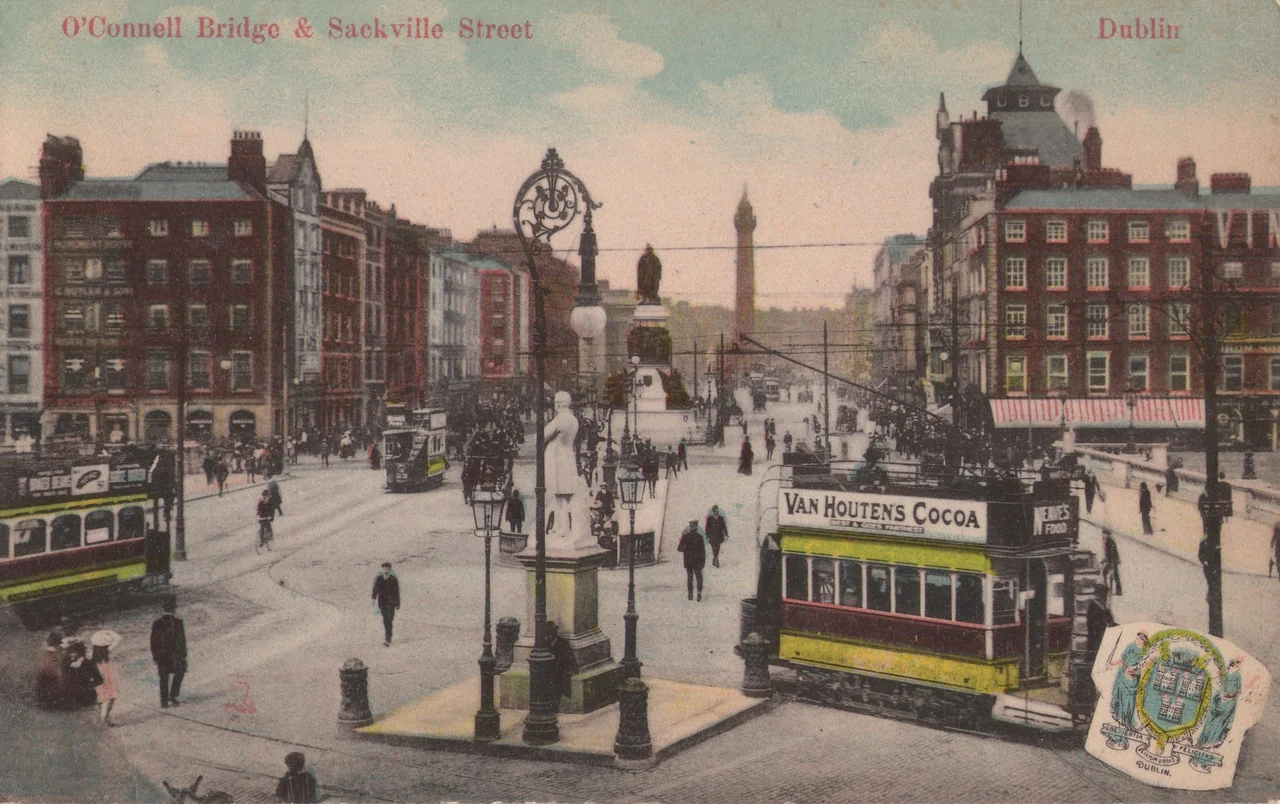
Stand at the south end of O'Connell Street with your back to the river, and the boulevard opens out in front of you to a width that surprises people - one hundred and fifty feet wide, almost two thousand feet long, a scale of urban gesture that does not really fit a city of Dublin's size. The central pedestrian island runs the full length, studded with monuments. Daniel O'Connell himself stands at the south end, bronzed and orated, by John Henry Foley. Charles Stewart Parnell stands at the north end. James Larkin spreads his arms in the middle. The Spire of Dublin rises silver and almost weightless from the spot where Nelson stood for a century and a half. Behind that line of monuments, every important moment of modern Irish history has played out at some point on these stones.
From Drogheda Street to Sackville Street
Until the eighteenth century the boulevard did not exist. In its place ran a narrow seventeenth-century lane called Drogheda Street, named for Henry Moore, 1st Earl of Drogheda - about a third the width of the present street, occupying what is now the eastern carriageway and running only from Parnell Street down to Abbey Street. In the 1740s the property speculator Luke Gardiner demolished the eastern side of the lane and rebuilt the whole thing as an enormous Georgian thoroughfare lined with grand townhouses, renaming it Sackville Street in honour of Lionel Sackville, Duke of Dorset, who was Lord Lieutenant of Ireland from 1731 to 1737 and again from 1751 to 1755. Carlisle Bridge (now O'Connell Bridge) was completed in 1758, extending Sackville Street across the Liffey and turning what had been a north-side residential set-piece into one of Dublin's principal north-south arteries. The Wide Streets Commission supervised further enlargement at the end of the century. By 1800 the boulevard had reached more or less its modern dimensions.
Nelson, O'Connell, and the Long Quarrel
In 1809 the Nelson Pillar went up in the centre of Sackville Street, a 134-foot Doric column topped by a statue of Horatio Nelson, paid for by public subscription after Trafalgar. It would dominate the boulevard for the next century and a half, both a beloved landmark and a permanent political irritant - a memorial to a British naval hero standing at the heart of an increasingly nationalist Ireland. The arrival of Foley's massive bronze of Daniel O'Connell, the Liberator, at the south end of the street in 1882 was the first answer; through the 1860s, 1870s, 1880s and into the early 1900s the central reservation gradually filled up with monuments to William Smith O'Brien, John Gray, Father Mathew, and finally Charles Stewart Parnell. The renaming of the street itself from Sackville to O'Connell came in 1924, two years after independence. Nelson kept his column until 1966, when republican explosives finally took it down at the start of the fiftieth-anniversary year of the Easter Rising.
Lockout, Rising, Civil War
Three times in the first quarter of the twentieth century, O'Connell Street was the stage on which Irish history was written. In August 1913, during the great Dublin lockout, the trade union leader Jim Larkin defied a police ban on assembly by speaking from a balcony of the Imperial Hotel in disguise; police charged the crowd that gathered to hear him, killing two and injuring hundreds in what became known as Bloody Sunday. In April 1916, the Irish Volunteers and Irish Citizen Army seized the General Post Office on the western side of the street, where Patrick Pearse read the Proclamation of the Irish Republic from the steps. The week that followed turned much of the street into burning rubble; the GPO was destroyed except for its facade, the Imperial Hotel and surrounding buildings were lost, and only Nelson's Pillar and a few stone facades survived intact. In June 1922, during the early weeks of the Irish Civil War, Free State artillery shelling drove the Anti-Treaty IRA out of buildings along the street's east side; the boulevard was once again left in ruins, and reconstruction took most of the next decade. Larkin's bronze, by Oisin Kelly, was unveiled outside the GPO in 1979 with arms thrown wide as if he were still addressing the lockout crowds.
The Spire
After Nelson came down in 1966, the central reservation held a stump, then briefly a wooden cross at the spot, then nothing of consequence for thirty-seven years. The site was haunted by Nelson's ghost and a long succession of failed proposals - Patrick Pearse, Robert Emmet, the Holy Trinity, a monument to peace, an angel - all of which were debated, contested, voted on, and discarded. In January 2003 the Spire of Dublin (Monument of Light) was finally installed: a 121-metre needle of polished stainless steel, designed by London architect Ian Ritchie and rising almost three times the height of Nelson's column. The Spire is tapered to a slim point and lit subtly from inside. It collects no pigeons, attracts no graffiti above the ground floor, can be seen across the city, and conveys almost nothing in particular about Ireland - which is, perhaps, exactly the kind of monument that this much-argued-over patch of ground had earned.
The Twenty-First-Century Street
A long-term restoration plan begun in the late 1990s and largely completed in the 2000s widened the central pavement, repaved the carriageways, replanted trees, and reinstated nineteenth-century street furniture, much of which had been removed in mid-twentieth-century traffic schemes. The Luas Cross-City tram line now runs the length of the boulevard, with stops at O'Connell GPO and O'Connell Upper, restoring the kind of central-axis public transport the street had lost decades earlier. The General Post Office, rebuilt to its original facade in the 1920s, has reopened part of its interior as the GPO Witness History exhibition, telling the story of the 1916 Rising on the very ground where it happened. Riots in November 2006, and again in November 2023, briefly broke the calm. But on most days the boulevard does what its eighteenth-century planners imagined: it carries the city through itself. Stand at the south end facing north, with O'Connell in bronze behind you and the Spire glinting two thousand feet ahead, and Dublin is still showing you the full shape of itself - layered, scarred, rebuilt, and stubbornly grand.
From the Air
O'Connell Street runs north from the River Liffey through central Dublin at approximately 53.3494 degrees N, 6.2603 degrees W. From altitude the boulevard appears as the broad bright axis running north-south through the city centre, between the dome of the Custom House to the east and the spire of St Mary's Pro-Cathedral to the north-west. The Spire of Dublin is visible as a thin metallic line rising near the centre of the street. Dublin Airport (EIDW) is about 9 km north. The Liffey provides the most useful east-west reference line. Best viewed in clear morning or evening light when the Spire catches the sun.
Nearby Stories
- Wicklow Mountains 12 km away
- Mornington 14 km away
- German submarine U-1051 16 km away
- Abbey of Kells 18 km away
- Irish Military Intelligence Service 20 km away
- HMS Manners (K568) 37 km away
- Templemore 42 km away
- Irish Sea Bridge 43 km away