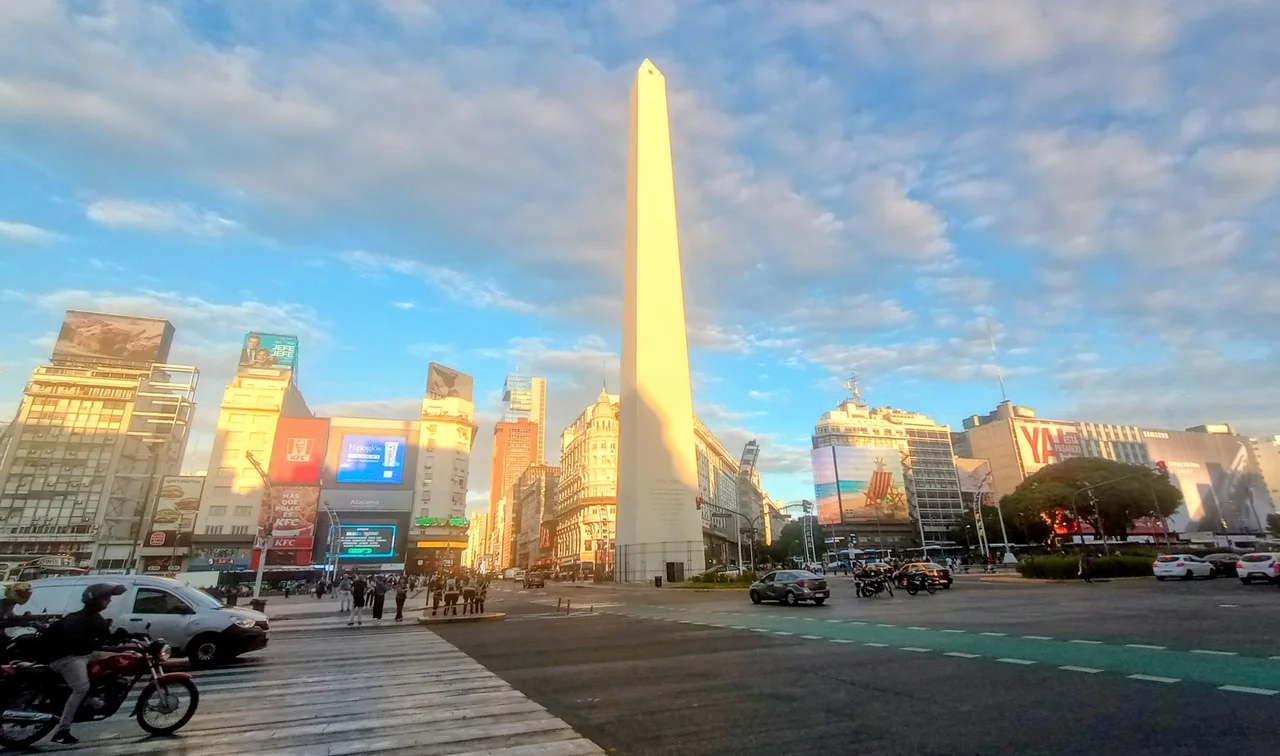

Obelisco de Buenos Aires
It took 157 workers just 31 days to raise it, and nearly a century later the city still cannot imagine itself without it. The Obelisco de Buenos Aires stands where twelve lanes of Avenida 9 de Julio collide with the bright theaters of Corrientes, a blunt white needle of reinforced concrete that has become the agreed-upon center of a city that otherwise sprawls without a clear heart. When Argentina wins, this is where the crowds come. When Argentina mourns, this is where the candles burn. The monument was meant to mark a birthday. It ended up marking everything.
Built in a Hurry, Meant Forever
Construction began on March 20, 1936, and finished on May 23 of the same year, a sprint of just 31 working days. The architect was Alberto Prebisch, a leading figure of Argentine modernism who also gave Corrientes its sleek Teatro Gran Rex, and his design is an exercise in stripped-down confidence: no ornament, no statuary, just a tapering shaft that rises 67.5 meters to a blunt tip 40 centimeters across. A German engineering consortium poured it in two-meter sections of rapid-hardening Incor cement so the concrete could keep climbing without pause. Inside, a single straight staircase of 206 steps leads up to four small windows near the apex. There is only one door, on the west side. The monument commemorates the four-hundredth anniversary of the city's first, doomed founding in 1536. The ground it occupies carries its own history: on this spot once stood the church of San Nicolás de Bari, demolished to make way for the obelisk and the widening of the avenue. It was inside that vanished church, back in 1812, that the Argentine flag was first raised in Buenos Aires, a fact now recorded in one of the inscriptions carved into the monument's northern face.
The City That Wanted It Gone
Argentines did not all love it at first. In 1938, sheets of the limestone cladding began peeling off and crashing down, one of them just a day after President Ortiz had stood at its base. The solution, reached in 1943, was drastic and a little absurd: strip the stone entirely and recoat the obelisk in polished cement, scored with fake joints to imitate the masonry that had failed. Buried under that resurfacing went an inscription crediting Prebisch as the architect. There were even serious proposals to tear the whole thing down. It survived them all, and over the decades it absorbed the city's restless energy instead, becoming the favorite target of political graffiti until the government finally ringed its base with a fence in 1987.
A Monument With a Sense of Humor
Few landmarks anywhere have been dressed up so often, or so boldly. In 1973 the city wrapped it like a Christmas tree. On World AIDS Day in 2005, it was sheathed head to foot in a giant pink condom, an awareness campaign visible from blocks away. To mark thirty years since the Night of the Pencils, when teenage activists were abducted under the dictatorship, the obelisk was transformed into an enormous pencil. The artist Leandro Erlich once made its peak appear to vanish entirely. The shaft has been a sword in a famous sonnet by Baldomero Fernández Moreno, written at a banquet honoring Prebisch, who imagined it as a blade the city had suddenly unsheathed against the blue sky.
Where a Country Comes Together
Three lines of the Buenos Aires Metro converge in the passages beneath it, and the streets above belong to whoever needs them most that day. The Obelisco hosted the opening ceremony of the 2018 Summer Youth Olympics. But its truest function is improvised. When Argentina lifted the 2022 FIFA World Cup, several million people flooded 9 de Julio Avenue to sing beneath the monument, a sea of blue and white so dense the celebration had to be rerouted around it. To stand at its base is to understand that this plain concrete spike means nothing on its own, and everything as a gathering point. It is the spot the whole country agrees to meet.
From the Air
The Obelisco sits at 34.604 degrees south, 58.382 degrees west, in the San Nicolás barrio at the crossing of Avenida 9 de Julio and Corrientes. From the air it is unmistakable: a slender white spike standing in the center of the widest avenue in the Americas, with the long open corridor of 9 de Julio running north to south. The nearest field is Aeroparque Jorge Newbery (SABE), roughly 3 km northeast along the Río de la Plata waterfront, while Ministro Pistarini International (SAEZ, Ezeiza) lies about 30 km southwest. Best viewed from lower altitudes on a clear day; the open avenue and the monument's pale shaft make it a reliable visual reference over the dense downtown grid.
Nearby Stories
- Ezeiza Massacre 1.9 km away
- Luján, Buenos Aires 5.1 km away
- Curutchet House 13 km away
- Colonia del Sacramento 17 km away
- Martín García Island 28 km away
- Atucha Nuclear Power Plant 37 km away
- Lobos 43 km away
- Cry of Asencio 87 km away