
Oireachtas (Irish Free State)
Thirty-seven senators returned home to find their houses burning. Others were kidnapped. A few were nearly assassinated. This was the welcome that Ireland's first independent parliament in over a century gave to those who agreed to serve in its upper house. The Oireachtas of the Irish Free State convened in Leinster House in late 1922, in a country still bleeding from civil war, and somehow held together long enough to draft the legal architecture of a nation - then dissolved itself fifteen years later, when that nation outgrew it.
A Parliament Forged in Treaty
The Anglo-Irish Treaty of 1921 had given Ireland a dominion, not a republic, and the Oireachtas was the price of that compromise. Its three components mirrored Westminster: a directly elected Dáil Éireann of 153 seats, a Seanad of 60, and the King - represented in Dublin by a Governor-General. Members had to swear an oath of fidelity to that distant monarch before they could take their seats. For Irish republicans who had fought a war of independence, the oath was a wound that never quite healed. Éamon de Valera and his followers boycotted the chamber for years rather than swear it. The whole edifice was built on a treaty most Irish people had only reluctantly accepted, and amending the constitution would consume the next decade and a half of political life.
The Yeats Senate
To launch the Seanad, President of the Executive Council W. T. Cosgrave made a deliberate gesture: half its initial members would be his appointees, and he would use that power to seat the Protestant minority left stranded in the new state. The result was the most extraordinary legislative body in modern Irish history. Among the sixty senators sat twenty Protestants, three Quakers and one Jew alongside thirty-six Catholics - and within that mix, seven peers, a dowager countess, five baronets, and the poet William Butler Yeats. Oliver St. John Gogarty was there too, and General Sir Bryan Mahon. The New York Times called the Seanad 'representative of all classes.' A less charitable historian later called it 'the most curious political grouping in the history of the Irish state.' Both verdicts were correct.
Houses Burned, Voices Heard
Anti-Treaty republicans treated the new senators as collaborators. The arson campaign that burned thirty-seven of their homes was not symbolic - it was meant to terrify the chamber into silence. It failed. The first Seanad amended legislation, slowed bad bills, and pushed the Free State toward something resembling normal parliamentary life. By 1928 its powers were curtailed; by 1936 de Valera, frustrated when the upper house delayed his constitutional reforms, abolished it outright. The last chairman, Thomas Westropp Bennett, fought to save the institution he led. The Dáil overrode him. For its final eighteen months, the Oireachtas was unicameral - one chamber, one voice, hurtling toward something new.
The Quiet Revolution
Between 1936 and 1937, the Free State quietly dismantled the monarchy's role in Irish government. The Constitution (Amendment No. 27) Act removed Royal Assent; from then on the Ceann Comhairle, the speaker of the Dáil, signed bills into law. The King ceased to be part of the Oireachtas. The oath was gone. The Seanad was gone. What remained was a single elected chamber, sovereign in fact if not yet in name. On 29 December 1937 de Valera's new Constitution of Ireland came into force, replacing the Free State entirely. The Ninth Dáil, elected six months earlier as the lower house of the Free State Oireachtas, woke up that morning as the lower house of a new legislature in a new country called simply Ireland.
Leinster House Today
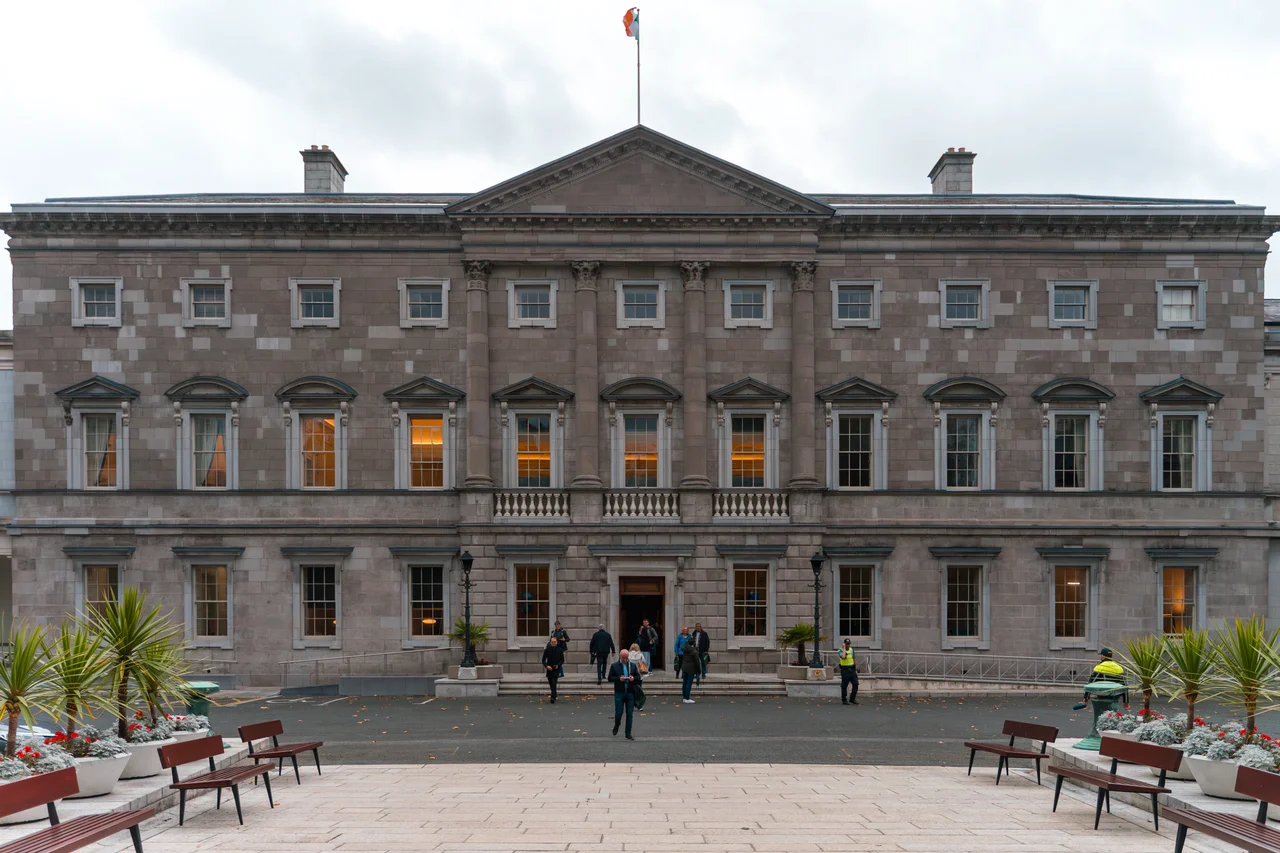
Leinster House still stands on Kildare Street in the heart of Dublin, its grey Georgian facade now sheltering the modern Oireachtas - the direct legal descendant of the body that burned and rebuilt itself between 1922 and 1937. The Dáil chamber retains an unusual layout where the government sits on the Speaker's left rather than the right, a quiet inversion of Westminster custom. Walk past on a sitting day and the building looks much as it did when Yeats arrived for his first session, when the air still smelled of cordite from a civil war just ended, and a chamber full of poets, peers and revolutionaries sat down together to invent a country.
From the Air
Leinster House sits at 53.34°N, 6.25°W in Dublin city centre, just south of the Liffey between Kildare Street and Merrion Square. From altitude the grey Georgian quadrangle is recognisable by its symmetric forecourt and the green expanse of Merrion Square Park immediately to its east. The National Library and National Museum flank it. Dublin Airport (EIDW) lies 9 km north; the Wicklow Mountains rise visibly to the south on clear days.
Nearby Stories
- Wicklow Mountains 12 km away
- Mornington 14 km away
- German submarine U-1051 16 km away
- Abbey of Kells 18 km away
- Irish Military Intelligence Service 20 km away
- HMS Manners (K568) 37 km away
- Templemore 42 km away
- Irish Sea Bridge 43 km away