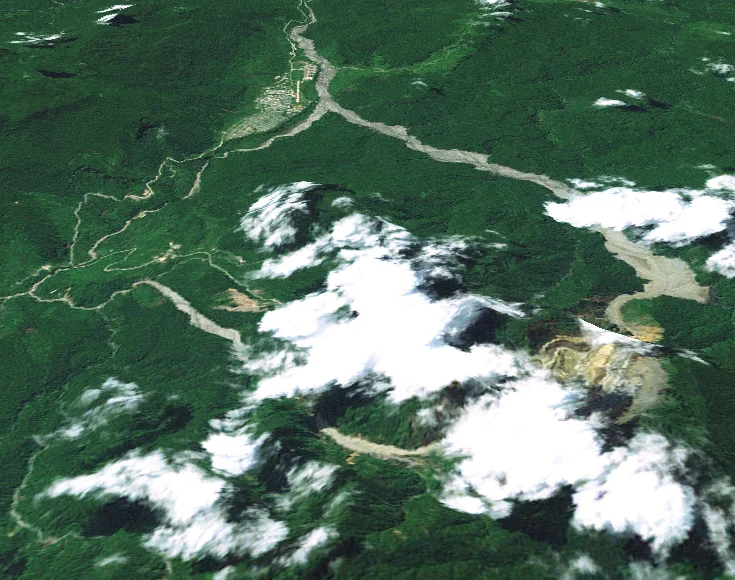

Ok Tedi Mine
Mount Fubilan was described, before the drilling started, as a copper mountain with a gold cap. That phrase turned out to be literally true. For four years, from 1984 to around 1988, BHP stripped the gold off the top using cyanide extraction. Then the company went after the copper underneath — at the time thought to be the largest copper deposit in the world. Today there is no Mount Fubilan. Where the mountain used to stand there is a pit, open-cut, cut steadily deeper into the earth. Around it is a region of extraordinary rainfall, landslides, and earthquakes, at altitudes above 2,000 meters in the Star Mountains of Papua New Guinea. None of the conditions are friendly to mining. The mine was built anyway.
A Mountain Built for Mining, Almost
Exploratory drilling in the area began in the 1970s, run by the Kennecott Copper Corporation. In the early 1980s, the Australian mining company BHP secured a special mining lease. The first gold was mined in 1981. Bechtel, in a joint venture, handled the engineering, procurement, and construction services that let a world-class operation rise out of montane rainforest. Four years later, when the gold cap was exhausted, BHP surveyed for the copper below and formed a partnership with the Papua New Guinea government, Amoco, and Inmet Mining. BHP kept the controlling share. Throughout the project, mine headquarters have been at Tabubil — the service town about 20 kilometers south — in a building everyone calls the White House.
The Pit, the Pipe, the Port
The operation is at industrial scale even by global mining standards. Two SAG mills, each with two associated ball mills, grind ore into copper concentrate slurry. The slurry is piped 137 kilometers southeast to the port town of Kiunga, on the Fly River, along the Kiunga-Tabubil Highway. Barges then carry the concentrate down the Fly to the sea. Power comes from a hydroelectric plant on the Ok Menga, a tributary of the Ok Tedi, with backup diesel generators at Tabubil for when the river flow drops. By the end of 2004, the mine had produced 8,896,577 tonnes of copper concentrate — including 2.85 million tonnes of copper metal and 7,035,477 ounces of gold. Between 1985 and 1990 alone, 47.642 tonnes of gold bullion were produced. For a single province with a population well under a million, the mine has accounted for over half of Western Province's economy and 25.7% of Papua New Guinea's entire export earnings.
The Tailings Question
A proper tailings dam was specified in the original environmental plan. Construction began. In 1984, an earthquake brought the half-built dam down. BHP argued that rebuilding would be too expensive; the PNG government, with the separate disaster of the Panguna mine closure fresh in view, concurred. There are no waste retention facilities on the premises. All ore processing residues, waste rock, and overburden have been discharged directly into the Ok Tedi River. The UN Environment Programme has described the resulting discharge — roughly 70 million tonnes of waste annually — as having caused "flooding, sediment deposition, forest damage, and a serious decline in the area's biodiversity" along a thousand kilometers of river. Downstream the effects on the 50,000 people living in 120 villages along the Fly are well-documented and ongoing. The river-based disposal is, in environmental terms, the defining choice of this mine.
The Wopkaimin, Before and After
The mine sits on country that belonged, and belongs, to the Wopkaimin people, a Min-speaking group with limited pre-mining exposure to the outside world. During regulatory negotiations in the late 1970s and early 1980s, PNG government negotiators were, by their own later admission, ill-equipped to deal with a project of this scale. National environmental studies received inadequate funding; studies of social impact were largely rejected. Ok Tedi Mining's promotional material went out of its way to depict the Wopkaimin as "primitive," even hiring an ethnically Wopkaimin employee to partially disrobe for publicity photographs so the people would appear less developed than they were. Ultimately, compensation was set at one kina per person per day, with an explicit understanding that the Wopkaimin were expected to move from "traditional" to "modern." About half of Wopkaimin men worked for Bechtel as construction labor between 1981 and 1984, mostly at low wages; when the mine was finished, they were laid off en masse. The Wopkaimin word for the mine became, by local usage, "the place without work." Women's traditional subsistence yam farming fell outside the new cash economy. Alcohol arrived with the construction camps. By 1984, Christian missionaries had converted much of the community and had discouraged the traditional songs that were central to Wopkaimin life.
Nationalization and the 2025 Question
BHP Billiton withdrew from the mine in 2002, transferring its majority shareholding to the PNG Sustainable Development Program in direct response to the environmental disaster. After the transfer, the Program held 52%, the state of Papua New Guinea 30%, and Inmet Mining 18%. In 2013 the government seized 100% ownership outright. Community consent for a mine-life extension to 2025 had been endorsed in late 2012 and early 2013 by 156 villages in the Mine Associated Communities, through Community Mine Continuation Extension Agreements. The mine continues. The copper concentrate still flows down the pipeline to Kiunga. The river still runs gray below the pit. Mount Fubilan is still a hole.
From the Air
Located at 5.24 S, 141.18 E in the Star Mountains of Western Province, Papua New Guinea, at 2,000 to 2,700 meters elevation. Tabubil Airport (TBG/AYTB), about 20 km south, is the only practical access; its 1,280-meter dirt and gravel strip handles Dash 8 service from Port Moresby (POM/AYPY) and Mount Hagen (HGU/AYMH). From 8,000 to 12,000 feet AGL in clear weather, the open-pit mine is a visible scar in the otherwise green mountains, with the gray line of the Ok Tedi River tracing south from it. Clouds build quickly on these peaks; morning flying is essentially required.
Nearby Stories
- Trigana Air Flight 267 18 km away
- Merpati Nusantara Airlines Flight 9760D 53 km away
- Boven-Digoel Concentration Camp 81 km away
- 2018 Papua New Guinea Earthquake 143 km away
- Porgera Gold Mine 161 km away
- 2024 East Sepik Earthquake 186 km away
- 1981 Irian Jaya Earthquake 216 km away