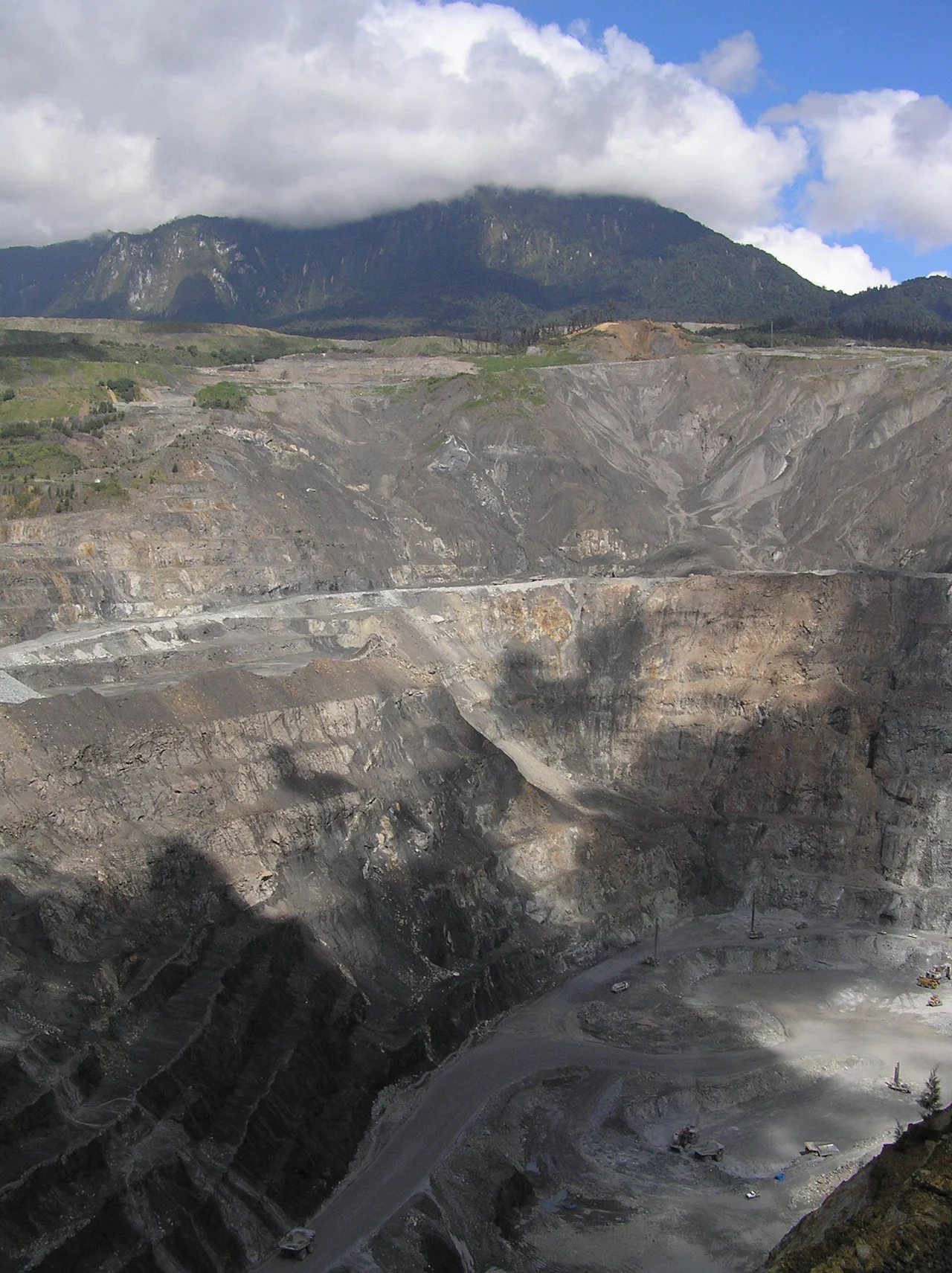

Porgera Gold Mine
In January 2009 the Norwegian government's sovereign wealth fund — one of the largest pools of investment capital on the planet — announced it was divesting from Barrick Gold. The reason was Porgera. The mine's practice of dumping tailings directly into the river system, Norway's finance ministry concluded, constituted "severe environmental damage" and was "in breach of international norms." Barrick's assurances that the operations caused no long-term or irreversible harm, the ministry added, carried "little credibility." The decision was unusual both in its bluntness and in its subject. Norway's fund had not divested from any other gold mine in the world. Porgera, in the high rainforest of Papua New Guinea's Enga Province, had become something the international community could no longer hold at arm's length.
A Mine at 2,500 Meters
The Porgera Gold Mine sits at the head of the Porgera Valley in Enga Province, on rainforest-covered slopes between 2,200 and 2,700 meters. The region gets extraordinary rainfall, is prone to landslides, and sits on active fault zones. Production began in 1990 under Placer Dome, which was absorbed by Barrick Gold in 2006. The Emperor Gold Mine's 20% minority stake was bought out by Barrick in April 2007, giving the company 95% of the operation. At its peak, the open-pit mine could move 160,000 tonnes of rock and ore a day; the underground mine over 2,000 tonnes. A fleet of Cat 777 and Cat 789 trucks worked the surface, fed by O&K shovels. Ore was processed through SAG and ball mills, autoclaves, flotation cells, and Knelson concentrators. In 2009 alone, the mine produced 572,595 ounces of gold and 94,764 ounces of silver. Across its operating life, Porgera has produced more than 16 million ounces of gold and almost 3 million ounces of silver — around 12 percent of all Papua New Guinea's exports.
The Security Force
The mine employs a private security force of between 400 and 500 people, some licensed to use lethal force. Over ten years, according to the company's own figures, these guards killed eight people; community associations put the figure at 14. Rising insecurity around the mine led the PNG government in 2009 to deploy mobile police squads to Porgera. Amnesty International documented the result: eviction of nearby villagers and the burning of their homes. Human Rights Watch conducted its own investigation and documented reports of abuse by security personnel including brutal gang rapes and beatings. In 2010 Barrick Gold acknowledged the history of sexual violence perpetrated at the mine and established a compensation scheme. The company paid 119 survivors of sexual violence approximately CAD$8,000 each, on the condition that they agreed not to sue Barrick. These are not peripheral details. They are part of what produced Norway's decision and the sustained international criticism that followed.
The Wopkaimin Scale, the Porgeran Scale
In 2009, of 2,427 employees at the mine, 93.49% were Papua New Guinean nationals — 1,606 of them Porgerans, 33 from elsewhere in Enga, 630 from other parts of PNG, and 158 expatriates. With another 500 contractors on top of a 2,500-person payroll, Porgera ranks among the largest gold mines in Australasia and one of the world's top ten producing gold operations. The mine runs an extensive training and apprenticeship program; graduates of it have found work at Porgera and other operations around the country. And yet — none of the mine's management team lives in the Porgera region. All are housed in camp facilities. Journalist Richard Poplak, reporting for the Canadian podcast Canadaland in 2022, characterized the company's post-Placer Dome approach to community relations as "more vicious" and "more cruel," and described the mine's community investment as "ghost work": buildings provided without the maintenance or staff to keep them running.
Closure and Reopening
The Porgera Gold Mine closed in April 2020 when the PNG government declined to renew Barrick's special mining lease. Barrick responded with litigation in Papua New Guinean courts and at an international tribunal. Negotiations dragged on for years. The site of the last open pit excavated before closure was Mt Waruwari. In 2023 a new special mining lease was finally issued — not to Barrick alone, but to New Porgera Limited, a restructured entity 51% owned by PNG stakeholders (including state-owned Kumul Minerals Holdings Limited, local landowners, and the Enga provincial government) and 49% by Barrick Niugini Limited, which is itself a joint venture between Barrick Gold and Zijin Mining of China. Reopening was announced in December 2023. First production from the restart was expected in the first quarter of 2024.
The Explosions and the Daily Cost
Two blasts bracket the mine's operational history. In August 1994, eleven workers were killed when an explosion destroyed the Dyno Wesfarmers explosives factory at the mine; the blast left a crater 40 meters across and 15 meters deep, damaging property up to two kilometers away. The cause was never determined. On 3 March 2012, five people were killed and at least one injured in what was described as a routine blast. Police said the victims had entered the mine illegally in search of gold. Three survivors were arrested and charged with trespassing. Illegal mining, alcoholism, and lawlessness have all increased in Porgera across the mine's operating life, even as some of its employees became the most skilled heavy-equipment operators in the country. The mine has three vast dumps of uneconomic waste rock — stone containing gold, just not enough of it. Porgera is one of the great gold mines of the world. It is also, simultaneously and inseparably, a community in which more than a hundred women accepted CAD$8,000 in settlement for what the company acknowledged had been done to them by its own guards.
From the Air
Located at 5.46 S, 143.10 E in the highlands of Enga Province, Papua New Guinea, at 2,200 to 2,700 meters elevation. The nearest major regional airport is Mount Hagen (HGU/AYMH), about 100 km to the east; Porgera itself has a small airstrip. From 10,000 to 14,000 feet AGL on clear mornings, the open pit at Mt Waruwari and the three enormous waste rock dumps are visible as mineral scars in an otherwise intensely green landscape. Steep terrain, frequent cloud buildup, and afternoon thunderstorms make this a strictly early-morning destination. Port Moresby (POM/AYPY) is the main international gateway.
Nearby Stories
- Highlands Highway 2.1 km away
- Southern Highlands Province 41 km away
- Mount Hagen 48 km away
- Great Papuan Plateau 91 km away
- 2024 East Sepik Earthquake 127 km away
- Fly River 137 km away
- Territory of New Guinea 138 km away
- Ok Tedi Mine 172 km away