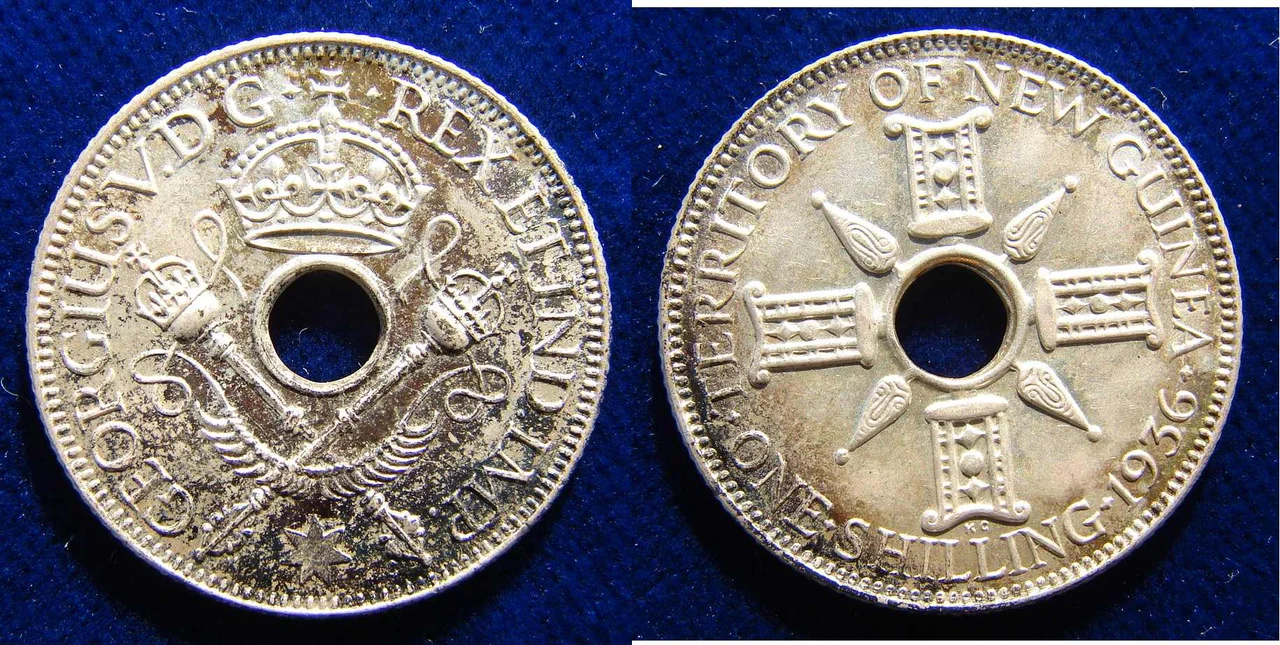

Territory of New Guinea
On 11 September 1914, barely six weeks after the start of the First World War, a Royal Australian Navy force arrived off Rabaul and put troops ashore at Herbertshöhe and Kabakaul. They were looking for German radio stations. They met minor resistance, occupied Rabaul the next day, and accepted Germany's surrender of the colony on 17 September. In the course of a week, the northeastern quarter of the island of New Guinea changed empires. Australia would govern it - first under military control, then a League of Nations mandate, then a United Nations trust - for the next sixty-one years, until the Territory of New Guinea ceased to exist at Papua New Guinea's independence in 1975.
Two Colonies, Two Halves
The island of New Guinea had been sliced between three empires in the 1880s. The Dutch had long claimed the western half. In 1884 Germany formally took the northeast quarter, naming it German New Guinea; the same year, Britain proclaimed a protectorate over the southeast, which it annexed outright on 4 September 1888. In 1902 Britain transferred the southeast to the newly federated Commonwealth of Australia, where it became the Territory of Papua in 1906 under Australian administration. So when Australia seized German New Guinea in 1914, the peculiar result was that one country now governed the northern and southern halves of the same island - but as two legally distinct territories, with separate administrations, separate laws, and separate identities that would persist until independence.
A Mandate, a Gold Rush, and a Volcano
The Treaty of Versailles divided the old German and Central Powers' possessions among the victorious Allies. In the Pacific, Japan got Germany's islands north of the equator; New Zealand got German Samoa; Australia took German New Guinea, the Bismarck Archipelago, and Nauru as League of Nations Mandates. Britain formally assumed the mandate on Australia's behalf on 17 December 1920. German missionaries were initially to be expelled, but American and Australian Lutherans intervened on behalf of the Neuendettelsau and Steyler missions, and from 1928 the Germans were allowed back. In 1921 gold was struck at Wau. By 1926 an even richer field was found at Edie Creek. With no roads, heavy mining equipment had to be flown in. In 1937 and 1938, Bulolo Gold Dredging and Guinea Airways moved more air freight with four Junkers G 31 cargo planes between Lae and Wau than was moved by air anywhere else in the world combined. Then, on 29 May 1937, the volcanoes Mount Tavurvur and Vulcan erupted in Rabaul harbour, devastating the territorial capital. The administration moved to Lae. Five years later Lae would be destroyed by Japanese air raids, and the capital moved again, this time to Wau.
Invasion
The Pacific War reached New Guinea almost immediately. On 22-23 January 1942, Japanese forces overwhelmed Rabaul and turned it into one of their major forward bases. From there they landed on mainland New Guinea and pushed south toward Port Moresby and Australia itself. A seaborne attack on Port Moresby was turned back by the U.S. Navy at the Battle of the Coral Sea. The Japanese tried again overland, across the Owen Stanley Range via the Kokoda Track. A handful of young, untrained Australian reserve battalions fought a stubborn rearguard from July 1942, slowing the advance while the injured were escorted down the track by local Papuans the Australian soldiers called the Fuzzy Wuzzy Angels. Regular troops of the Second AIF, returning from the Mediterranean, relieved the militia in late August. When Japanese strategy pivoted toward Guadalcanal, the Australians pursued the retreating Japanese to the coast.
The Largest Australian Campaign
What followed - the Battle of Buna-Gona and the offensives of 1943 and 1944 - was the single largest series of connected operations ever mounted by the Australian armed forces. Tropical disease, impossible terrain, and entrenched Japanese defences made every mile expensive. Supreme command lay with the U.S. General Douglas MacArthur; Australian General Thomas Blamey directed planning, and New Guinea Force headquarters in Port Moresby ran operations on the ground. Fighting continued in New Guinea between the largely Australian ground force and the Japanese 18th Army - the same army that would launch its doomed Driniumor counter-offensive in July 1944 - until Japan's formal surrender on 2 September 1945. In the end, roughly 200,000 Japanese soldiers, sailors, and airmen died in the New Guinea campaign. Australian and American losses each ran to about 7,000.
Two Territories, One Country
After the war, civil administration of both Papua and New Guinea was restored under the Papua New Guinea Provisional Administration Act of 1945-46. In 1949 the Papua and New Guinea Act formally united the two territories into the Territory of Papua and New Guinea - a legal fiction more than a merger, since for purposes of Australian nationality law the two remained distinct. A Legislative Council was established in 1951, a judicial system, a public service. The administrative union was renamed simply Papua New Guinea in 1971. On 16 September 1975 the Independent State of Papua New Guinea took the name and the territory both, and the Territory of New Guinea - first German, then Australian-mandated, then UN-trusteed - ended quietly after sixty-one years. The legal ghosts still matter in property law. The rest belongs to memory, and to the country that New Guinea's former colonies eventually became.
From the Air
The former Territory of New Guinea covered the northeastern quarter of the island of New Guinea and the Bismarck Archipelago (New Britain, New Ireland, Bougainville, Admiralty Islands). Its wartime capitals moved between Rabaul on New Britain, Lae on the mainland, and Wau in the Bulolo Valley. Centre point used here lies near 5.0 degrees south, 145.0 degrees east, a few miles west of Madang. Key airports include Madang (AYMD / MAG), Lae-Nadzab (AYNZ / LAE), Rabaul-Tokua (AYTK / RAB), Wewak (AYWK / WWK), and Port Moresby (AYPY / POM) in former Papua. From altitude the former territory spans an immense swath of tropical terrain - coral reefs and volcanic islands in the Bismarck Sea, then the Finisterre and Owen Stanley ranges rising abruptly from the northern coast. Expect year-round tropical weather and heavy afternoon cloud buildups, especially over the mountains.
Nearby Stories
- Naval Base Alexishafen 30 km away
- Airlines PNG Flight 1600 47 km away
- Curt von Hagen 48 km away
- Karkar Island 48 km away
- Kuk Swamp 59 km away
- Manam Motu 74 km away
- Highlands Highway 98 km away
- 2024 East Sepik Earthquake 163 km away