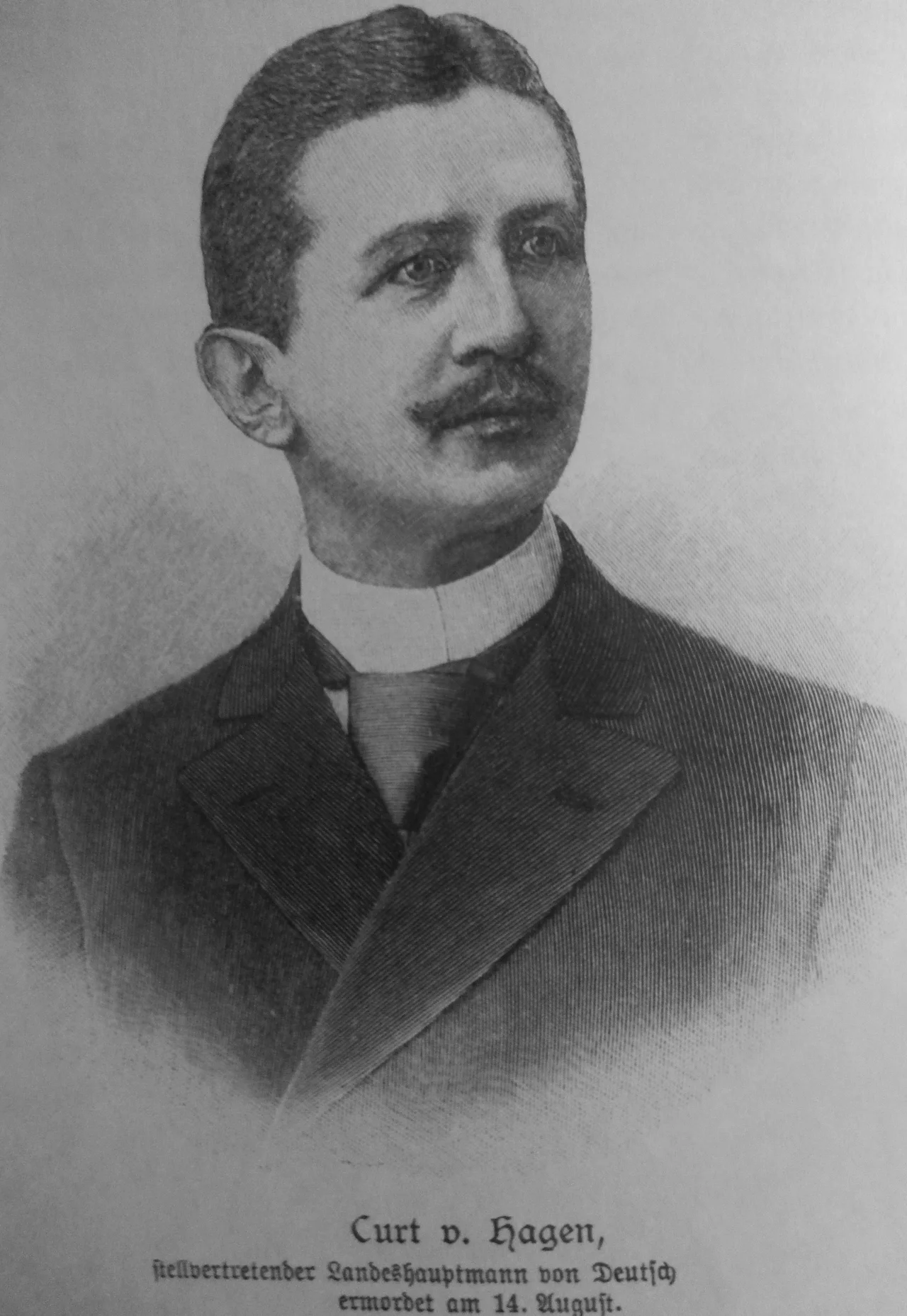

Curt von Hagen
The city of Mount Hagen is the largest settlement in the Papua New Guinea highlands, a trading hub in a region that grows coffee, tea, and gold. Its name is not Engan, or Melpa, or any of the local languages. It belongs to a Prussian artillery officer who never set foot in the place, who ran a tobacco plantation on the coast for three years before being killed in the jungle on the morning of 13 August 1897, trying to avenge the murder of a travel writer whose bones had been buried in the bush for two years. Curt von Hagen was thirty-seven. The colonists he was hunting shot him in an ambush a few hours into their pursuit. His name attached itself to the highlands long after his death, and to a volcano 3,765 metres tall.
A Philosopher's Bloodline
Curt von Hagen was born on 12 September 1859 in Schippenbeil, an East Prussian town now called Sepopol in Poland. He came from a family of scholars and soldiers. His father was a Prussian Generalleutnant, founder of the noble von Hagen line. His grandfather, Ernst August Hagen, was a novelist and the first professor of aesthetics and art history at the University of Konigsberg. His great-grandfather, Karl Gottfried Hagen, was the court pharmacist, a polymath, and personally acquainted with Immanuel Kant - a friend and philosophical discussant of the man who reshaped Western thought. Curt could have followed any of those paths. Instead, in 1878, at the age of eighteen, he enlisted in the Prussian Army as a field artillery officer.
A Riding Accident, a Bankruptcy, a Tropical Fresh Start
His military career ended early. In 1886 a riding accident forced him out of the army, and Hagen turned to business. He married Helene Winkler, the daughter of a factory owner, in 1881, and they had a single daughter, Else. Looking to make a new life, he invested in a joint-stock tobacco company in Deli on Sumatra, one of many such ventures Europeans tried in the Dutch East Indies. It went bankrupt. From 1893 onward he was working for someone else - the Astrolabe Company - managing the Jomba tobacco plantation near Friedrich-Wilhelmshafen (now Madang) in German New Guinea. Tobacco grew. Workers were recruited. The administration of a struggling plantation in a remote colony taught him to handle men, supplies, and the particular logistical misery of the tropics.
From Overseer to Landeshauptmann
He must have done it well, because within three years he had become general director of the German New Guinea Company. He shut down the old station at Friedrich-Wilhelmshafen and relocated operations, building a new port facility and the Erima station. On 22 September 1896 he was appointed acting Landeshauptmann - the senior colonial administrator - of all of German New Guinea. The job's authority was greater than its resources. The German colonial presence was thin, malarial, and unpopular with the peoples it claimed to govern. Into this ran an unresolved crime: in 1895, the German travel writer Otto Ehrenfried Ehlers and some of his accompanying police soldiers had been killed inland. Their murderers had never been brought in. Hagen, learning the story from Albert Hahl during a trip to Herbertshöhe in May 1897, decided to act.
The Pursuit
In July 1897 the two men identified as ringleaders in the Ehlers murder, Ranga and Opia, were arrested on Hagen's initiative and held in Stephansort. They escaped. During their flight they robbed and killed a Chinese merchant and stole his rifles. At the start of August, Hagen and a group of colonists organised a pursuit into the interior. On the morning of 13 August, 1897, they set out inland from the Jomba tobacco plantation. A few hours later, in the bush, Hagen was fatally shot - by Ranga, according to later accounts. The local population, after the Imperial German Navy bombarded an island with the cruiser five days later, killed both Ranga and Opia and turned their bodies over to the colonial authorities. The heads were placed on display in Stephansort on 19 August as a deterrent. The punitive logic of late nineteenth-century colonial rule was on full display.
A Posthumous Empire of Names
Hagen's widow had difficulty claiming a pension. The German New Guinea Company argued that her husband had died pursuing vigilante justice outside his official duties - 600 marks were eventually approved for her, 150 for their daughter. A bronze eagle memorial was cast for him. In 1956 that eagle was removed from its original monument and placed on a new one in the highland town that by then bore his name: Mount Hagen, capital of the Western Highlands Province and one of the largest cities in modern Papua New Guinea. Around 1990 the eagle itself was replaced with an imprecise replica of the Imperial Reichsadler. The 3,765-metre volcano Hagensberg - ranked among the tallest volcanoes on the Australian continent - also carries his name. A man who died in a jungle ambush chasing his predecessor's killers has become the namesake of a city and a mountain he never saw.
From the Air
Curt von Hagen died near Friedrich-Wilhelmshafen (modern Madang) on the north coast at roughly 5.28 degrees south, 145.45 degrees east. Madang airport (AYMD / MAG) serves the area. The city of Mount Hagen, named after him, lies far inland in the central highlands at Mount Hagen airport (AYMH / HGU), about 5.83 degrees south, 144.30 degrees east. The Mount Hagen volcano (Hagensberg, 3,765 metres) rises northwest of the city. From altitude, the contrast between Madang's coastal palm-and-reef landscape and the steep green ridges of the highland interior is striking - a single name now linking two very different topographies. Expect year-round tropical weather along the coast and rapidly changing mountain conditions inland.
Nearby Stories
- 1993 Finisterre Earthquakes 32 km away
- Mount Wilhelm 42 km away
- Territory of New Guinea 43 km away
- Karkar Island 52 km away
- Kuk Swamp 60 km away
- Landing at Saidor 70 km away
- Mount Hagen 89 km away
- Sepik 144 km away