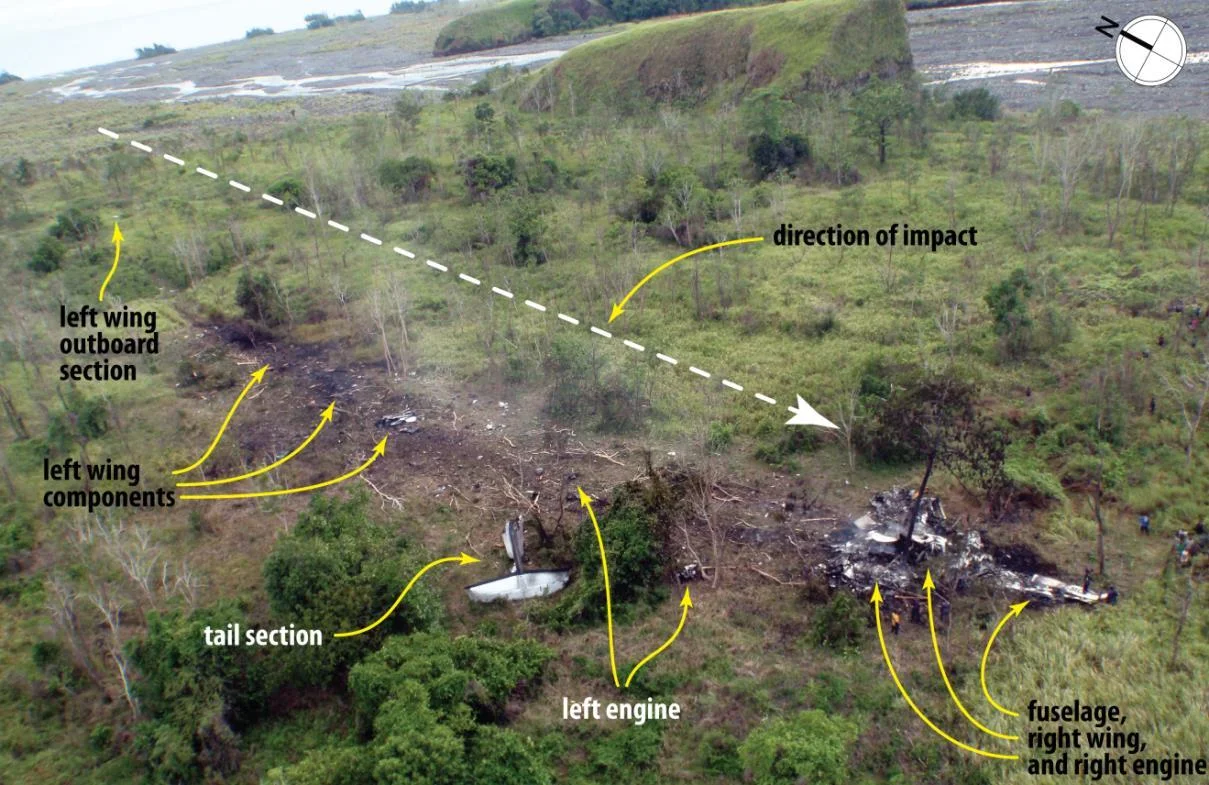

Airlines PNG Flight 1600
Most of the people on board were parents. Their children were graduating from Divine Word University in Madang, and thanksgiving ceremonies were planned for the next morning. The Dash 8 lifted off from Lae at 16:47 on 13 October 2011, carrying two flight crew, a flight attendant, and twenty-nine passengers into weather that had already forced the pilots to divert right of their planned track to skirt thunderstorms. A ceremony was waiting in Madang. Only one passenger would arrive.
A Mechanical Detail That Killed Twenty-Eight
The crash hinged on a small metal barrier called a flight idle gate. On a de Havilland Dash 8, pulling the power levers past that gate in flight releases the propellers into their reverse-pitch range, which is meant only for decelerating on the ground. The manufacturer had developed a safeguard called a Beta Lockout that physically prevents this from happening in the air at high speeds. After a series of earlier incidents, the U.S. Federal Aviation Administration required American operators to fit the modification. Airlines PNG, like most operators outside the United States, had never been formally notified of the fix. The aircraft registered as P2-MCJ, a 1988-built DHC-8-103 with over 38,000 airframe hours, carried no Beta Lockout on the afternoon it departed Lae.
Descent Into Weather
The route into Madang called for a steep descent. The captain, sixty-four-year-old Australian William "Bill" Spencer, had logged 18,200 flight hours across his career but only 500 on the Dash 8. His first officer, Campbell Wagstaff, was forty, a New Zealander with 390 hours on the type. As the aircraft dropped through the storm clouds of coastal New Guinea, the propellers were still set to their cruise speed of 900 rpm. Airspeed climbed. The overspeed warning began to sound as the aircraft passed through its maximum operating speed, and both pilots, later investigators wrote, were distracted by the weather. Spencer raised the nose. He asked Wagstaff to increase the propeller speed to slow the aircraft down. Then he reached for the power levers and pulled them past the flight idle gate.
The Sound of Sound Itself
What happened next produced a noise the survivors and investigators would never forget. With the propellers freed into reverse pitch, both overspeed uncontrollably. Their tips accelerated past the speed of sound, generating a sonic roar that filled the cabin. Smoke seeped into the cockpit as the bleed-air system failed. The drag was enormous. Both engines were destroyed. One engine was still capable of providing hydraulic and electrical power to help with the forced landing, but the pilots shut it down, losing systems that might have made the final impact more survivable. The aircraft came down in forest near the mouth of the Guabe River, about 33 kilometers southeast of Madang. Twenty-eight people died. The only passenger survivor was a Malaysian-Chinese national; both pilots and the flight attendant also lived.
Candles at Divine Word
The graduation ceremony went ahead in Madang without the parents. Four years later, on the anniversary of the crash, students and staff at Divine Word University gathered for a candlelight memorial, the small flames standing in for the mothers and fathers who had been on their way. The investigation released by the PNG Accident Investigation Commission in June 2014 criticized the crew but reserved its sharpest conclusions for the regulatory gap that had left PNG-registered aircraft without a safeguard American aircraft had carried for years. Airlines PNG fitted Beta Lockouts to its entire Dash 8 fleet. Transport Canada and the manufacturer subsequently issued an airworthiness directive making the modification mandatory worldwide. The 170-plus Dash 8s flying without it are now all fitted. The modification exists because of the people who died over the Guabe River on their way to watch their children graduate.
From the Air
Crash site is located at 5.51°S, 145.90°E, roughly 33 km southeast of Madang near the mouth of the Guabe River in dense coastal rainforest. The flight departed Lae Nadzab Airport (AYNZ) bound for Madang Airport (AYMD). A cruising altitude of 6,000-8,000 feet approaching Madang from the southeast traces the accident flight's approximate path. Coastal weather in this region is dominated by convective buildups in the afternoon; the thunderstorms that distracted the crew are a near-daily feature of Papua New Guinea's north coast.
Nearby Stories
- Battle of Madang 11 km away
- Landing at Saidor 27 km away
- Mount Wilhelm 34 km away
- 1993 Finisterre Earthquakes 34 km away
- Territory of New Guinea 37 km away
- Markham, Ramu and Finisterre Campaigns 43 km away
- Highlands (Papua New Guinea) 93 km away
- Vitu Islands 345 km away