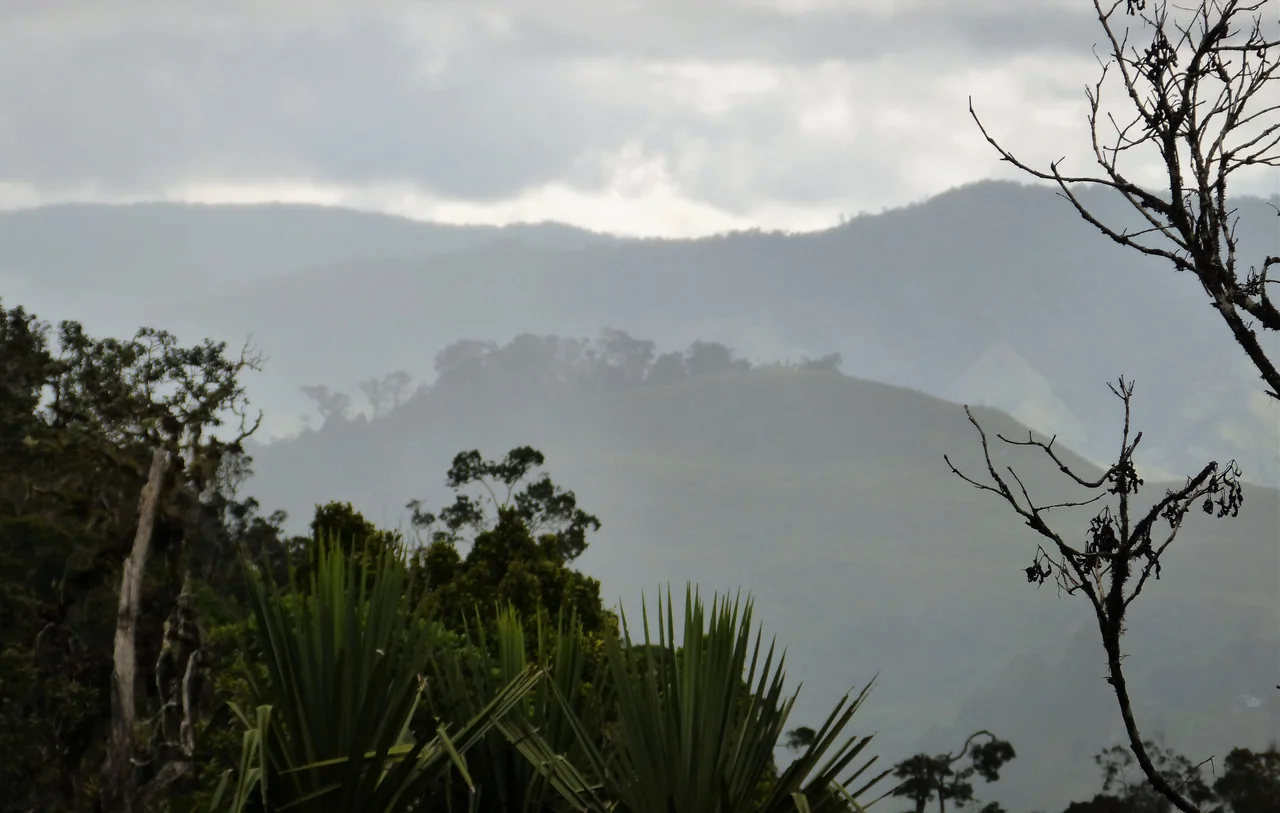

Highlands (Papua New Guinea)
As late as 1930, Australian gold prospectors setting off inland from the New Guinea coast had been told the same thing everyone told them: there's no one up there. The interior was blank on maps. The mountains were assumed to rise into empty country. In 1933 Mick and Dan Leahy flew over the Wahgi Valley and saw smoke from thousands of cooking fires. A civilization of hundreds of thousands of people, living in an advanced agricultural society with terraced gardens and elaborate ceremonial culture, had been invisible to the rest of the world. The Highlands is that plateau, a region of Papua New Guinea split across five provinces, home to the Huli, the Melpa, the Enga, the Chimbu, and dozens of other peoples whose languages and traditions had developed in isolation for thousands of years before the airplane found them.
Five Provinces, One Plateau
The Highlands region divides into five provinces. Southern Highlands, capital Mendi, has the highest population - well over half a million - and a reputation for both traditional culture and periodic lawlessness. Western Highlands, capital Mount Hagen, is a Wild West frontier town by PNG standards, its wealth rooted in coffee and its supply lines stretching up the Highlands Highway from the coast. Eastern Highlands, with its capital at Goroka, covers 11,200 square kilometers, speaks some 20 languages, and is home to the Asaro Mudmen whose mud-covered masks have become one of the visual signatures of the region. Chimbu Province, also called Simbu, packs close to 300,000 people into 6,100 square kilometers, the highest population density of any Highlands province. Enga, westernmost and highest - much of it over 2,000 meters - covers 12,800 square kilometers and hosts the world's largest gold mine outside South Africa at Porgera.
Clans and the Land
In the Highlands, every square meter of ground is owned by a clan. Not a legal fiction, not a pre-modern echo - actually, practically, enforceably owned. Customary land rights in Papua New Guinea cover roughly 97 percent of the country, and in the Highlands the knowledge of who owns what is as precise as a surveyor's map. Travelers passing through someone else's territory customarily pay. Guides who come from one valley may not be able to safely accompany visitors into the next. Clans fight over three things, the local saying goes: land, pigs, and women. Compensation ceremonies - moka exchanges of pigs and shell valuables and cash - have long been the mechanism for settling disputes without escalation. When they fail, skirmishes erupt. When the skirmishes end, more pigs are slaughtered and more promises made.
Sing-Sing
The great festivals of the Highlands are the sing-sings - massed gatherings where tribes from across the region arrive in full ceremonial dress to sing, dance, and compete. The two most famous are the Goroka Show, held each September in Eastern Highlands, and the Mount Hagen Cultural Show in August. Thousands of performers paint their faces with ochre and soot, don headdresses of bird-of-paradise feathers, wear pig-tusk necklaces and bark-cloth skirts, and move through choreographed dances that can last hours. Film crews come from around the world. David Attenborough has filmed here. Tourists fly in from Port Moresby, Brisbane, and beyond. The shows are tourist events, yes, but they are also the real thing - the actual costumes, the actual songs, the actual lineage groups who have been singing these songs for longer than anyone can reliably trace.
Kuk and the Origins of Agriculture
The Kuk Early Agricultural Site, in the Wahgi Valley near Mount Hagen, was inscribed on the UNESCO World Heritage List in 2008 and remains the only UNESCO World Heritage Site in Papua New Guinea as of 2021. Archaeology has established that people here independently developed agriculture around 9,000 years ago - one of only a handful of places on Earth where agriculture was invented rather than imported. They dug drainage ditches, planted taro, and later cultivated bananas and sugar cane in planned wetland systems. The Highlands, in other words, are not a backwater that the rest of the world happens to have reached late. They are one of the original cradles of farming. The irony of calling this region the Land That Time Forgot, as Mick Leahy did, is sharpened by the realization that this was one of the places where time-on-the-farm actually started.
Getting Around
The Highlands Highway runs from the port of Lae on the coast up through Goroka, Kundiawa, and Mount Hagen, then splits - one branch heads into Enga toward the Porgera gold mine, another turns south toward Mendi and Tari. After Mount Hagen, four-wheel drive is the baseline requirement. Landslides close sections regularly. Holdups occur. For practical travel most visitors fly, using Air Niugini or PNG Air to reach the regional capitals, and then hire local transport for the final legs. Mission Aviation Fellowship, headquartered in Mount Hagen, operates a dozen aircraft across tiny airstrips dotted through the valleys, supplying mission stations and occasionally carrying non-mission passengers. The food is starch-heavy - taro, kaukau sweet potato, rice - with pigs reserved for feasts and weddings. The coffee, grown at elevation on volcanic soil, is world-class.
The Huli Wigmen and Birds of Paradise
The Huli, based around Tari in the Southern Highlands, have one of the most visible traditional cultures in Papua New Guinea. Young men go into the forest alone for months at a time, following food taboos and avoiding contact with women, growing their hair long in preparation for shaping their first ceremonial wig. The wigs are worked from the grower's own hair, shaped and decorated with feathers - especially the iridescent plumes of birds of paradise, which still inhabit these forests in remarkable numbers. Ambua Lodge, built near Tari in Huli round-house style, has hosted filmmakers and birdwatchers for decades. It costs about 200 dollars a night and is considered one of the most spectacular lodges in Papua New Guinea. Down the road is the more modest Warili Lodge, locally run at around 20 dollars a night, with birding opportunities just as good. Both sit in country that flies passing overhead still reveals as a mosaic of green ridges, garden plots, and smoke from cooking fires rising through cloud.
From the Air
The Highlands region covers central Papua New Guinea with a mean elevation above 1,500 meters. Coordinates at 6.09 degrees S, 144.41 degrees E fall near the region's center. Mount Hagen's Kagamuga Airport (AYMH / HGU) is the second-busiest airport in PNG and the main gateway to the region. Goroka Airport (AYGA / GKA) serves Eastern Highlands; Mendi (AYMN / MDU), Tari (AYTA), and Wapenamanda (AYPM / WBM) serve other provinces. Recommended viewing altitude 15,000-25,000 feet to appreciate the plateau surrounded by higher ranges. Mount Wilhelm, PNG's highest peak at 4,509 meters, dominates the Chimbu Province. Weather: afternoon thunderstorms typical; morning flights strongly preferred. Planes are restricted from landing at Mount Hagen during thunder and lightning events, so early bookings are advised.
Nearby Stories
- Kuk Swamp 2.5 km away
- Purari River 11 km away
- Diocese of Mendi 17 km away
- Mount Wilhelm 21 km away
- Enga Province 46 km away
- Lake Kutubu 51 km away
- Goroka 60 km away
- Ukarumpa 117 km away