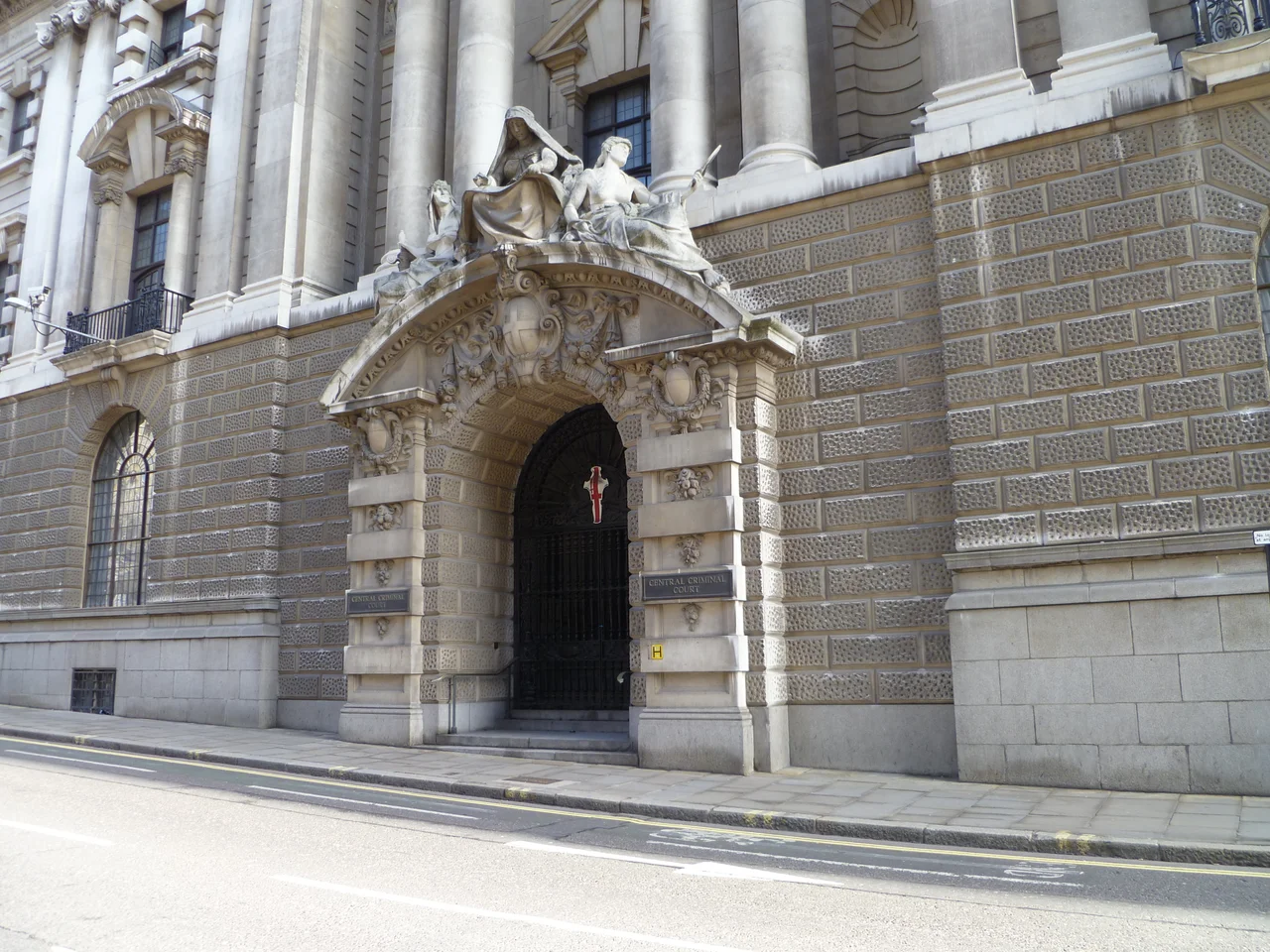

Old Bailey
Above the main entrance, carved in stone, is the admonition: "Defend the Children of the Poor & Punish the Wrongdoer." Four words for each command. The Old Bailey has been trying to do both since at least 1585, with results that have ranged from the noble to the catastrophic — sometimes in the same session.
Built on a Bailey
The name comes not from a person but from a place: the street follows the line of the ancient defensive wall around medieval London, and a bailey was the open courtyard between a castle's inner and outer walls. The court grew up in the gap between city and suburb, attached to Newgate Prison, which itself was built into the Roman and medieval wall. By the 16th century this junction of justice and incarceration had become the principal criminal court for London and Middlesex. It burned down in the Great Fire of 1666, was rebuilt in 1674 — this time open to the weather, to slow the spread of disease — and was re-fronted in 1734. That enclosure proved costly: in 1750, an outbreak of typhus killed 60 people in and around the courtroom, including the Lord Mayor Sir Samuel Pennant and two judges. The irony of justice killing its own administrators was not lost on observers.
Dead Man's Walk
For most of its history, the Old Bailey did not merely try criminals — it helped kill them in public view. Hangings took place in the street outside until May 1868, drawing rowdy crowds who pelted the condemned with rotten fruit and stones. The passage between the court and Newgate Prison was known as Dead Man's Walk. Those executed were often buried in the walk itself. Over 100,000 criminal trials took place at the Old Bailey between 1674 and 1834, making it the busiest criminal venue in England and Wales. The proceedings were eventually digitised and published online, providing an extraordinary window into the texture of London crime across two centuries: theft, fraud, assault, and occasional catastrophe. In 1856, public outrage over the poisoner William Palmer — who feared he could not receive a fair trial in his native Staffordshire — led Parliament to pass legislation enabling high-profile cases from anywhere in England and Wales to be heard here.
The Building and Its Symbols
The present building opened in 1902 and was formally unveiled by King Edward VII on 27 February 1907. Architect Edward William Mountford designed a Baroque civic monument with a copper dome, now listed as a Grade II* building. On that dome stands Lady Justice, a gilt bronze figure by sculptor F. W. Pomeroy, completed between 1905 and 1906. She carries a sword in her right hand and scales in her left. She is not blindfolded — the courthouse's own brochures explain that her "maidenly form" is supposed to guarantee impartiality without the symbol being required. Whether that argument convinces is another matter. The Grand Hall beneath the dome was bombed and damaged during the Blitz, restored by the early 1950s, and decorated with paintings commemorating the bombing alongside quasi-historical scenes of nearby St Paul's Cathedral. A 1972 extension, the South Block, was built over the former site of Newgate Prison, which had been demolished in 1904.
Bombs and Echoes
The Old Bailey has absorbed violence throughout its existence. In 1973, the Belfast Brigade of the Provisional IRA exploded a car bomb in the street outside, killing one person and injuring 200. A fragment of glass from the blast is preserved in the wall at the top of the main stairs — a small, deliberate memorial in a building accustomed to keeping records of harm. The court has not escaped fiction either: Charles Dickens set scenes here in A Tale of Two Cities; Agatha Christie staged a murder trial within its walls in Witness for the Prosecution; the fictional barrister Horace Rumpole spent a career in its courtrooms. The building has become shorthand in popular culture for English justice itself, not always flatteringly. In the film V for Vendetta, the title character demolishes it. In real life, it remains the Central Criminal Court, hearing the most serious cases brought from Greater London, its doors open to the public, its proceedings a matter of record.
From the Air
Located at 51.5158°N, 0.1019°W in the City of London. The copper dome of the Old Bailey is visible at low altitude, positioned northwest of St Paul's Cathedral. Look for the dome's distinctive green patina on the roofline near Newgate Street. Nearest airports: London City (EGLC) approximately 6 miles east; Heathrow (EGLL) approximately 15 miles west.
Nearby Stories
- Stevenage 5.7 km away
- Malling Abbey 5.7 km away
- 1952 Farnborough Airshow Crash 7.7 km away
- Ingatestone Hall 8.2 km away
- Hellfire Caves 9.1 km away
- The Carrington Event: The Solar Storm That Could Happen Again 9.8 km away
- Bletchley Park 16 km away
- Castle Hedingham 23 km away