.jpg)
Old Dongola
In February 2023, Polish archaeologists brushing plaster in a medieval Nubian ruin uncovered something no one expected: a painted scene of the archangel Michael cradling a Nubian king in his arms, presenting him to Jesus, who sits on a cloud and extends a hand for the king to kiss. The team leader, Artur Oluski, noted dryly that this degree of intimacy between mortal and immortal is "completely uncommon for Byzantine Christian art." But this was not Byzantium. This was Old Dongola - Tungul, in Old Nubian - and the Makurians had always done things their own way.
Capital in the Desert
The archaeological site sprawls across 200 hectares on the Nile's east bank, opposite the mouth of Wadi Howar. A fifth-century fortress came first - a walled citadel with palaces and public buildings, guarding the river and the caravan routes that led west to Darfur and Kordofan. Then in the mid-sixth century, Christianity arrived, and the fortress became the capital of the Nubian kingdom of Makuria. The city spilled beyond its walls. Churches went up: first Building X and the Church with the Stone Pavement, standing a hundred meters apart outside the original ramparts. Both were destroyed in the middle of the seventh century, almost certainly during the First and Second Battles of Dongola (642 and 652), when Arab armies pushed south from newly conquered Egypt and were fought, remarkably, to a standstill. The Makurians rebuilt. They always rebuilt.
The Church of the Granite Columns
At the end of the seventh century, over the foundations of the battered Old Church, the Makurians raised the Church of the Granite Columns. Sixteen granite columns held up its roof, each topped with a richly carved capital. It may have been the cathedral of the city - the heart of a Christian kingdom that had just proven it could say no to the caliphate. Old Dongola's heyday ran from the ninth through the eleventh centuries, though builders kept building into the fourteenth. About 1.5 kilometers northeast of the citadel, on a mound archaeologists call Kom H, stood the Great Monastery of St Anthony. Archbishop Georgios was buried in one of its crypts in 1113, and the inscription on his funerary stela tells us the monastery's patron. Its walls stood 6.5 meters on the ground floor, 3.5 on the upper - a serious building, for serious monks.
A City Empties Out
The thirteenth and fourteenth centuries were cruel. Arab raids came again and again. An inscription dated 1317 records an expedition sent by the Sultan of Egypt to install his own nominee - Abdullah, possibly a Muslim Nubian - on the Makurian throne. The royal court left Dongola in 1364. Trade with the Far East and Europe continued, but the capital had been hollowed out. In 1812, Mamluks fleeing Muhammad Ali's purges in Egypt conquered what was left. They founded New Dongola downriver. The urban center shifted 80 kilometers to the opposite bank of the Nile, and Old Dongola, Tungul, was left to the sand.
What Polish Trowels Keep Finding
A Polish team from the University of Warsaw's Polish Centre of Mediterranean Archaeology has been digging here since 1964 - six decades of patient, careful work. In May 2021 they announced the discovery of a church apse preserved to about nine meters deep, with two rows of colossal painted figures on its walls. Oluski compared the preservation to Faras, the Nubian Christian site flooded by Lake Nasser. In February 2023 they found Egyptian hieroglyphs carved into stone blocks - reused, clearly, from some earlier Pharaonic temple, a reminder that Nubia's layers keep deepening. And they found the paintings: the Virgin Mary. The archangel Michael holding the king. Thirteenth-century Nubian art that argues, one brushstroke at a time, that Makurian Christianity was its own thing, neither Egyptian nor Byzantine but Nubian, confidently reaching out to touch the divine.
From the Air
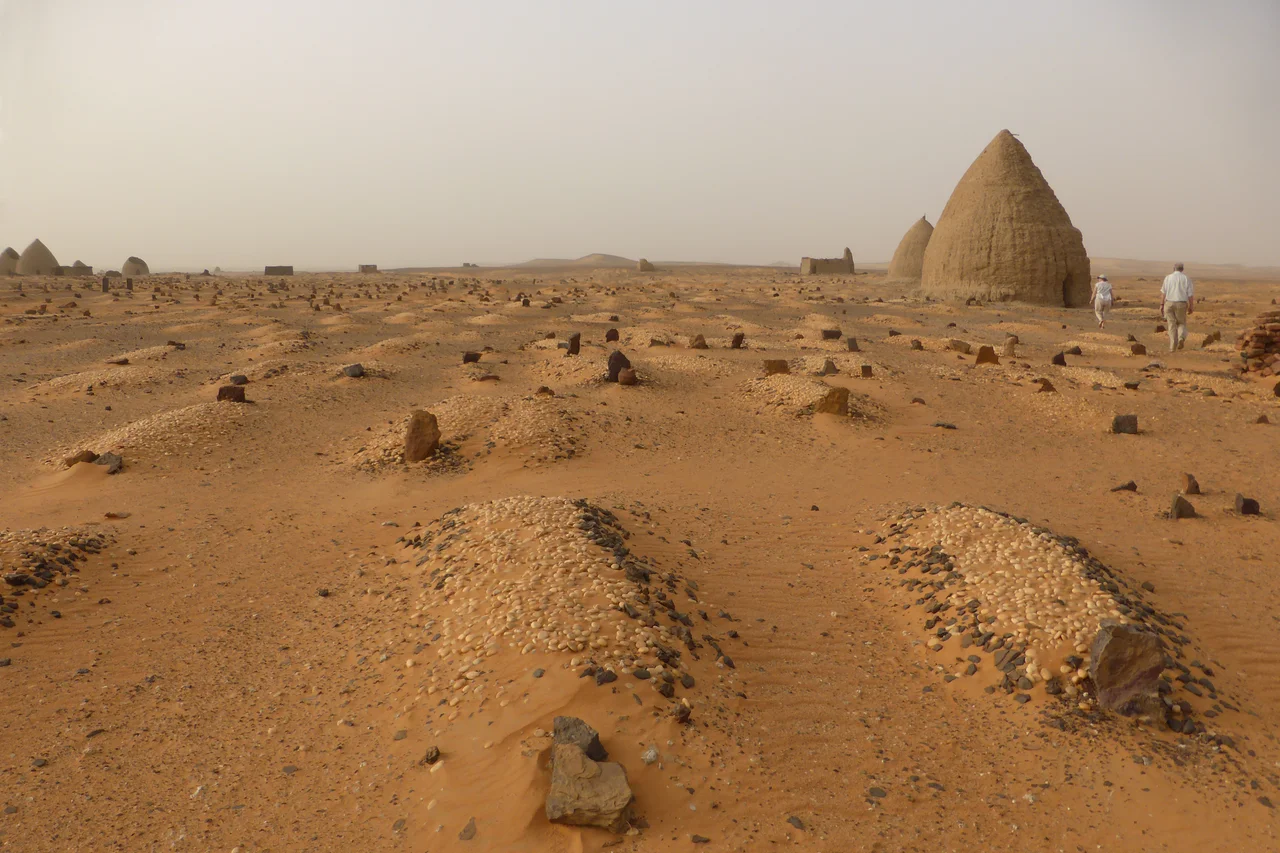
Located at 18.22N, 30.74E on the east bank of the Nile in Sudan's Northern State, roughly 80 km upstream of modern Dongola. Recommended viewing altitude: 3,000-6,000 feet AGL to see both the citadel and the Kom H monastery site in one pass. Look for the domed Islamic tombs on the hillside above the river and the distinctive rectangular outline of excavated building foundations. Nearest major airport is Dongola (HSSW) about 80 km to the northwest; Khartoum International (HSSS) is approximately 500 km to the south. The site sits at the edge of the Nile floodplain where green abruptly becomes beige desert - a useful visual contrast for pilots on VFR transits.
Nearby Stories
- El Khandaq 26 km away
- Northern Sudan 45 km away
- Nubia 49 km away
- Zuma, Sudan 52 km away
- Northern State (Sudan) 93 km away
- Esh Shaheinab 281 km away
- Selima Oasis 338 km away