
Where a Sultan Was Crowned and a Constitution Was Born
The microphones are still on the table. Old-fashioned, heavy things, the kind that amplified speeches and proclamations in the 1950s, they sit atop a large U-shaped table surrounded by leather chairs that have not been replaced since the day Sultan Omar Ali Saifuddien III used them. Walk into the Old Lapau on Jalan James Pearce in Bandar Seri Begawan and you step into a room where the furniture remembers what happened here -- where a sultan was crowned and a constitution was signed, and where Brunei's modern identity began to take shape in a building so modest that its greatest architectural ambition was to be the city's first concrete structure.
Concrete in a City of Wood
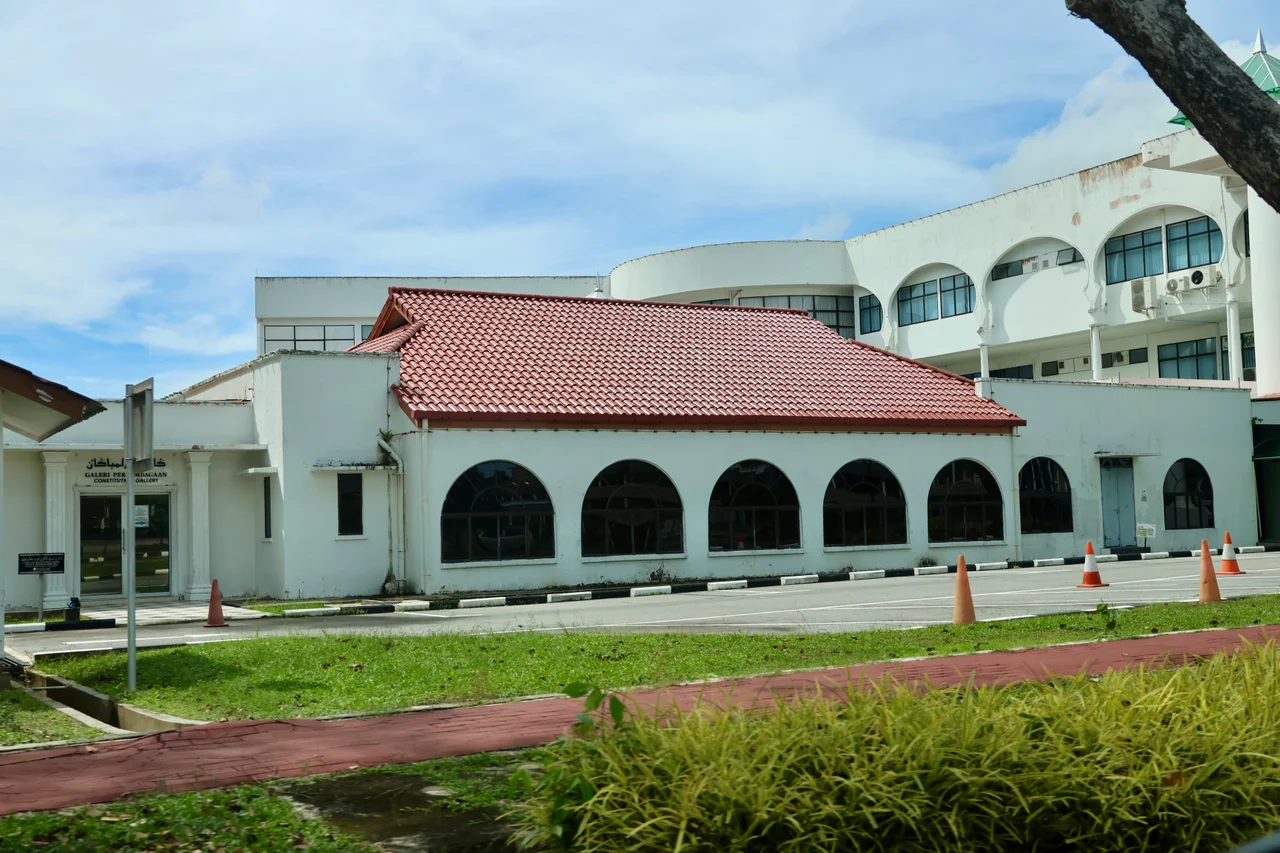
When the Old Lapau was built on 1 July 1950, Brunei Town was still largely a place of timber and thatch. Concrete structures were practically nonexistent, and the tools required to work with the material had to be specially sourced. The result was something revolutionary for its setting: a one-story, rectangular building painted white, with five semi-circular arch windows on each side and a roof built in the potong limas style borrowed from the stilt houses of Kampong Ayer. It replaced the Lapau Kajang, a traditional ceremonial hall that had served the sultanate throughout the reign of Sultan Ahmad Tajuddin. The new Lapau formally took over on 10 May 1951, and just three weeks later, on 31 May, it hosted the coronation of Omar Ali Saifuddien III as the 28th Sultan of Brunei.
The Day the Constitution Was Signed
If the coronation gave the Old Lapau its first great moment, the second came eight years later. On 29 September 1959, Sultan Omar Ali Saifuddien III and Sir Robert Heatlie Scott signed the Brunei Agreement and promulgated the Constitution of Brunei within these walls. It was the document that formalized the sultanate's system of governance and laid the groundwork for the nation's eventual independence. A replica of the Pataratna, the ceremonial dais used for the coronation and other state rituals, still stands at the rear of the room. The first Legislative Council posed for a group photograph outside the building that same year, the white facade of the Old Lapau visible behind them -- a backdrop to the beginnings of constitutional governance in a nation that had been ruled by sultans for over five centuries.
Architecture as Memory
The Old Lapau's design speaks a quiet language of transition. Its potong limas roof -- a pyramid shape with an inverted V at the peak, now covered in Spanish tiles -- anchors it to the traditional architecture of Kampong Ayer and the waterborne world that defined Bruneian life for centuries. But its concrete walls and rectangular form point forward, toward the modernizing ambitions that would soon produce the Omar Ali Saifuddien Mosque and a new, larger Lapau to replace this one in 1968. The five arched windows on each side were originally open to the tropical air, a nod to the ventilation design of the older Lapau Kajang. Renovations later filled them with opaque glass, sealing the building against the climate but also against the sensory connection to the city outside. Even the paint tells a story: the building has always been white, and white it remains.
A Museum of Its Own History
Since the late 1980s, the Old Lapau has served as a museum and exhibition gallery dedicated to the 1959 Constitution. The verandahs on both wings have been enclosed and incorporated into the display space, but the core of the building remains deliberately unchanged. The original flooring is intact. The fans darken with age on the renovated ceiling, and the chandeliers still hang where they always have. The U-shaped table and leather seats from the constitutional proceedings occupy the center of the room, preserved as though a meeting might reconvene at any moment. Behind a wall in the back once lay a hidden office with a vault believed to have held old state records, along with a concealed pillar from the original construction. The building has been officially designated a historic site under the Antiquities and Treasure Trove Act, its interior a carefully maintained blend of pragmatism and simplicity -- qualities the Bruneian philosophy of Melayu Islam Beraja holds in high regard.
From the Air
Coordinates: 4.8915N, 114.9418E. Situated in the Pusat Bandar district of Bandar Seri Begawan, Brunei's capital. From the air, the Old Lapau sits along Jalan James Pearce near the waterfront, dwarfed by the golden dome of the Omar Ali Saifuddien Mosque just to the southwest and the stilted expanse of Kampong Ayer stretching along the Brunei River. Brunei International Airport (WBSB) is approximately 9 km to the northeast. Best viewed at 2,000-4,000 feet for architectural context. The equatorial climate brings afternoon convective buildup; morning flights offer clearer conditions.
Nearby Stories
- From Residency to Memory 28 km away
- Twenty Years on the Seattle Run 30 km away
- The Abode of Peace on Borrowed Coastline 31 km away
- USS Salute: The Minesweeper That Found the Last Mine 33 km away
- The Ants of Borneo 50 km away
- Sabah State Railway 55 km away
- Starcevich Monument 74 km away
- Luconia Shoals 209 km away