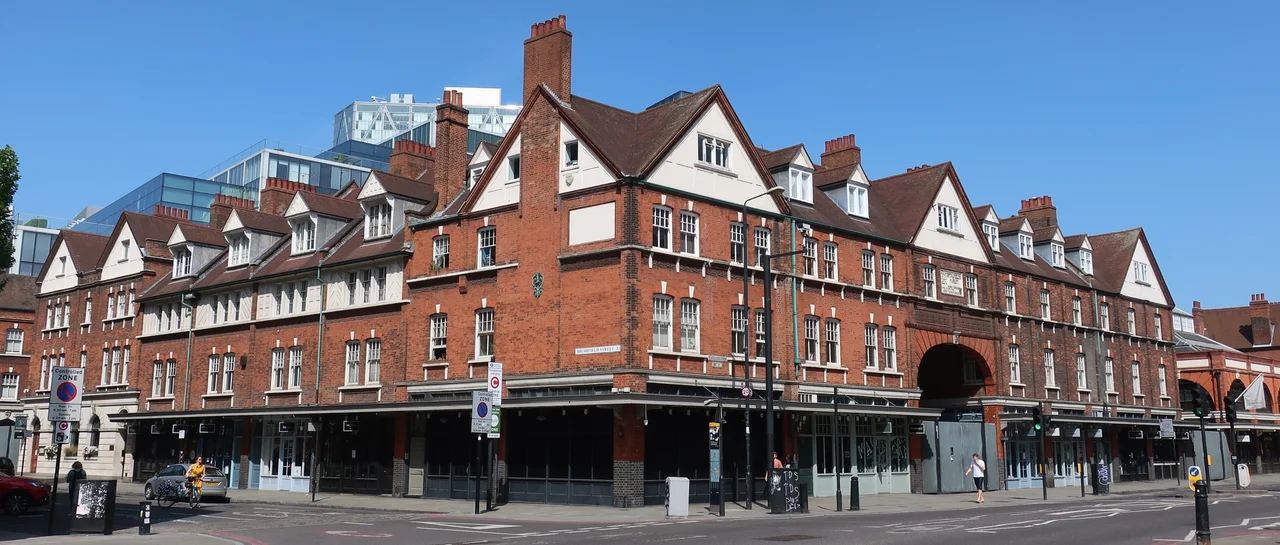

Old Spitalfields Market
King Charles I handed out the licence in 1638 — flesh, fowl, and roots to be sold on Spittle Fields, then open countryside on London's eastern fringe. Nearly four centuries later, the market is still there. The players have changed, the goods have changed, and much of the architecture has changed, but the transaction continues on the same rectangular patch of ground.
From Royal Licence to Horner Buildings
The original licence lapsed during the years of the Commonwealth, when such arrangements tended to fall through the cracks of a country at war with itself. Charles II revived it in 1682, responding to the pressure of a rapidly expanding city that needed reliable places to buy food. The market grew along streets that still carry their old names — Crispin Street, Lamb Street, Brushfield Street — demarcating a rectangular zone that has retained its identity across centuries of change. The current market buildings were commissioned by Robert Horner, the last private owner, and constructed between 1885 and 1893 to designs by architect George Campbell Sherrin. They remain known as the Horner Buildings, and their Victorian ironwork and red brick are Grade II listed. The Cinema Museum in London holds film footage of the market and its refrigeration systems in operation between 1928 and 1930 — a rare visual record of a wholesale market at work in that era.
A Market Reborn
In 1920, the City of London Corporation bought the market to run it as a wholesale operation. Westward expansion followed in 1926. By 1991, the practical needs of a modern wholesale trade had outgrown the Victorian infrastructure — refrigeration, loading, and parking all demanded space the site couldn't provide. The fruit and vegetable operation moved to the purpose-built New Spitalfields Market in Leyton, and the old site was left to find a new purpose. What followed was not straightforward. A drawn-out dispute between the Corporation, developers, and local residents over the future of the 1926 western extension eventually resulted in a Norman Foster-designed office block on the western side, with two-thirds of the historic market rebuilt to include restaurants, shops, and an indoor arts and crafts market. The eastern Horner Buildings and Horner Square kept their Victorian character. The compromise left neither side fully satisfied, but it left the essential bones of the market intact.
Layers of the Neighbourhood
The market sits at the centre of a neighbourhood whose history is almost entirely a story of successive arrivals. The Huguenots came in the late 17th century, fleeing religious persecution in France, and set up their weaving trade in Spitalfields. The chapels they built later became synagogues when Jewish immigrants fleeing Eastern European pogroms arrived from the 1880s onward. The same buildings became mosques as the area's Bangladeshi community grew through the 20th century. The Gun pub to the south of the market carries a memory of the Tudor period, when the Old Artillery Ground nearby was used by the Honourable Artillery Company for crossbow and later gun practice. Across Commercial Street stands Christ Church, designed by Nicholas Hawksmoor and completed in 1729, its massive white Portland stone tower visible from most approaches.
What Remains
Today Old Spitalfields Market runs a different kind of trade. Thursday brings a vintage market; some Fridays see a vinyl fair; arts and crafts fill the weekend. Independent stalls mix with permanent restaurants. The market won the National Association of British Market Authorities' "Best Private Market" award in January 2011. It is a place to browse rather than to stock a restaurant at 4 a.m. — that work moved to Leyton decades ago. What Old Spitalfields retained is something harder to replicate: a sense of place built from almost 400 years of continuous exchange, where the architecture carries the weight of all those transactions, and where the smell of street food now mingles with the memory of ancient commerce.
From the Air
Located at 51.5194°N, 0.0753°W in the London Borough of Tower Hamlets, just north of Liverpool Street station. From altitude, look for the distinctive Victorian roofline of the Horner Buildings east of Bishopsgate. The white tower of Christ Church Spitalfields to the east is a useful navigation landmark. Nearest airports: London City (EGLC) approximately 5 miles southeast.
Nearby Stories
- Stevenage 5.7 km away
- Malling Abbey 5.7 km away
- 1952 Farnborough Airshow Crash 7.7 km away
- Ingatestone Hall 8.2 km away
- Hellfire Caves 9.1 km away
- The Carrington Event: The Solar Storm That Could Happen Again 9.8 km away
- Bletchley Park 16 km away
- Castle Hedingham 23 km away