
Old St Paul's Cathedral
On the night of 4 September 1666, John Evelyn watched a six-acre sheet of lead melt off the cathedral roof and pour through the vaulted ceiling into the crypt below. Inside St Faith's, the stationers' booksellers had stacked their entire stock - believing the great Gothic building above them was the safest vault in London. The books burned for a week. Old St Paul's Cathedral, perhaps the fourth church to stand on Ludgate Hill since the seventh century, had taken more than 200 years to build and was 586 feet long - one of the largest churches in Europe. It died in a single night. The walls survived a little longer, leaning and groaning, while Christopher Wren came up to inspect what was left.
Stone from a Vanished Tower
Work began after a fire destroyed the previous church in 1087. William the Conqueror, in what tradition holds was one of his last acts, donated stone from the demolished Palatine Tower on the River Fleet toward the new Romanesque cathedral. Construction stretched across more than two centuries, with the architecture evolving from Norman Romanesque to early English Gothic as the work progressed. Bishop Maurice oversaw the preparations; Richard de Beaumis pressed the work forward with help from Henry I, who granted the bishop rights to all fish caught in the cathedral neighbourhood and tithes on venison from Essex. The church was consecrated in 1240, enlarged in 1256, and lengthened again in the early fourteenth century. By 1314 the New Work was complete: 586 feet long, 100 feet wide, with one of Europe's tallest spires. The traditional height of 489 feet was almost certainly an overestimate; Christopher Wren later judged the spire at 460 feet, and in 1664 Robert Hooke used a plumb-line to measure the tower itself at "two hundred and four feet very near."
Paul's Walk: The Marketplace of Gossip
Long before it burned, the cathedral was already failing as a sacred space. By the fifteenth century the nave - known as Paul's walk - had become the social hub of London. Bishop Braybrooke, who served from 1381 to 1404, issued an open letter complaining that the building was being used "for selling wares, as if it were a public market" and that others, "by the instigation of the Devil," were using "stones and arrows to bring down the birds, jackdaws and pigeons which nestle in the walls and crevices." Some played ball games and shattered the painted windows. By the early seventeenth century the practice was simply accepted. Francis Osborne described how "the principal gentry, lords, courtiers" met daily at eleven to walk the middle aisle, discussing business and news until twelve, then returning from three to six. The satirist John Earle, writing in 1628, called Paul's walk "the land's epitome" - "a heap of stones and men, with a vast confusion of languages; and were the steeple not sanctified, nothing liker Babel." Beggars worked the aisles. Prostitutes plied their trade. News-mongers gathered to weigh, as Osborne put it, "the most intrinsic actions of the state." The cathedral was where London found out what London was doing.
Royal Weddings, Anglo-Saxon Kings
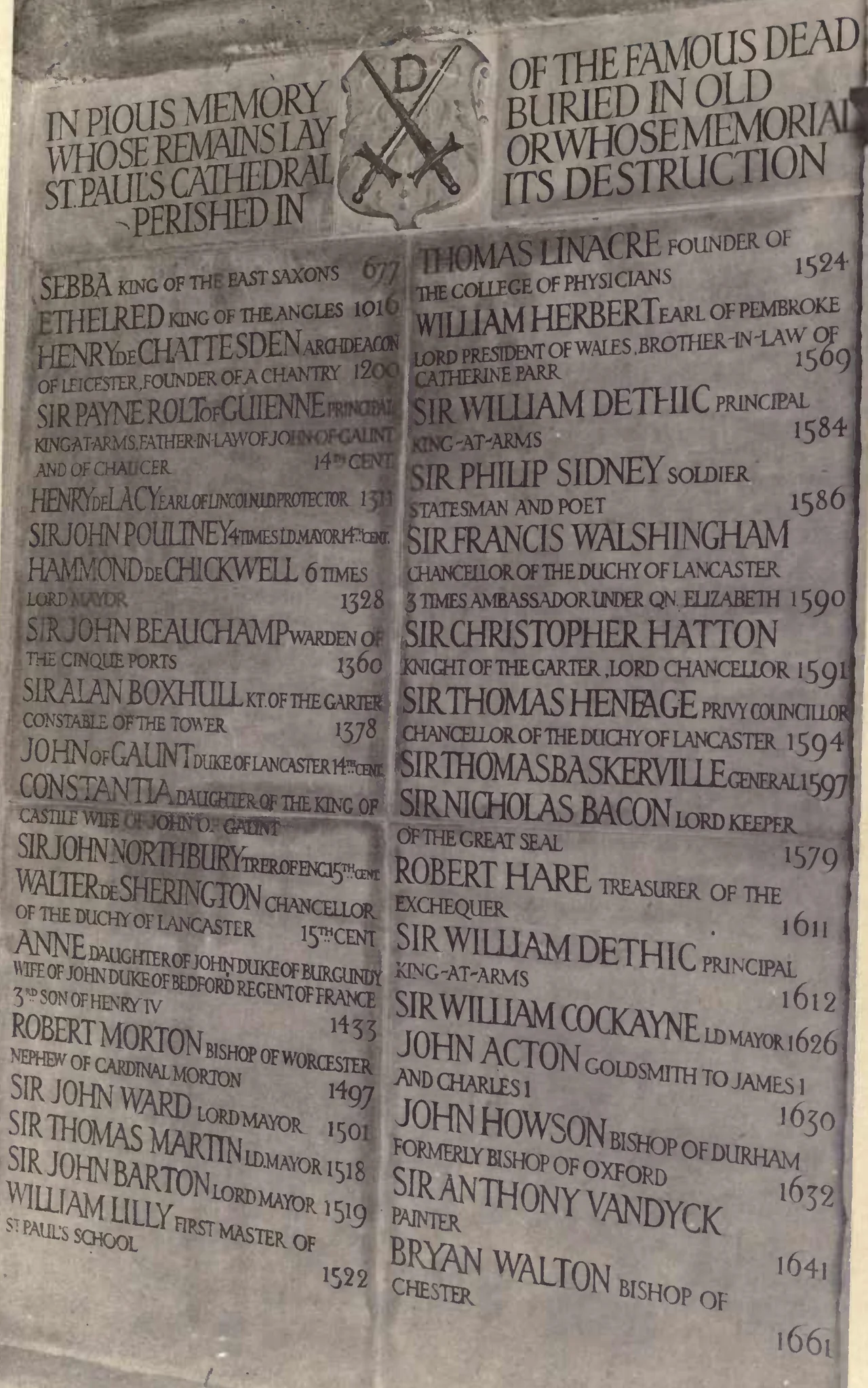
The Gothic cathedral was not only a market. Anglo-Saxon kings were buried inside - Sebbi of the East Saxons and Æthelred the Unready. The shrine of the seventh-century bishop Erkenwald drew pilgrims from across England; under Bishop Maurice, reports of miracles increased dramatically, and in 1339 three London goldsmiths spent an entire year rebuilding the pyramidal shrine in gold, silver, and precious stones. John of Gaunt's tomb dominated the choir. Sir Philip Sidney and the poet John Donne were buried here. On 14 November 1501, Arthur, Prince of Wales - the son of Henry VII - married Catherine of Aragon in this cathedral. Arthur died five months later at fifteen, and the question of whether that marriage had been consummated would shape English history for the next thirty years. Open-air sermons at St Paul's Cross in the churchyard became the central pulpit of the English Reformation, where Protestant tracts were preached and sold. In 1535, when Henry VIII began the Dissolution of the Monasteries, much of the cathedral's medieval ornamentation was destroyed. The interior began its long decline.
The Spire Falls, Then Inigo Jones Arrives
On 4 June 1561, the spire caught fire. According to a newsheet published days afterward, a lightning strike was to blame. The flames crashed through the nave roof. Bishop Edmund Grindal gave £1,200 for repairs, but the spire was never rebuilt. The cathedral now stood truncated, a great Gothic body without its crown. King James I appointed Inigo Jones, the classical architect, to restore the building in the 1620s. Jones added a classical-style portico to the west front in the 1630s - magnificent in itself but, as one Victorian critic put it, "altogether incongruous with the old building." During the English Civil War, Parliamentarian forces used the nave as a stable for cavalry horses; ancient documents and charters were dispersed and destroyed. By the 1660s a young Christopher Wren had been brought in to consider the cathedral's future. Wren proposed something radical: replace the existing tower with a dome, modelled on the central lantern of Ely Cathedral where his uncle was bishop. The plan was still under discussion in the summer of 1666 when the building was wrapped in wooden scaffolding.
Four Days of Fire
The Great Fire reached the cathedral on the night of 4 September 1666. The scaffolding caught first, then everything. Samuel Pepys recorded the building in flames in his diary. John Evelyn returned to the site on 7 September and found "that goodly Church St Paules now a sad ruine, and that beautiful portico now rent in pieces, flakes of vast stone split asunder." The Portland stone had been so heated that the columns and capitals flew off the building. The sheet of lead covering the roof - more than six acres of it - melted entirely, fell through the vaults, and ignited the booksellers' stock in St Faith's chapel below. The books burned for a full week afterward. Of the medieval cathedral, only a few remarkable things survived. The lead over the altar at the east end was untouched. The body of one bishop, Evelyn reported, was found intact. And Nicholas Stone's 1631 monument to John Donne - depicting the poet rising from his urn for the moment of judgment, sculpted from a painting Donne had posed for in his own shroud - survived the fire. It still stands in Wren's cathedral today, the only memorial that remembers what stood here before.
From the Air
Old St Paul's Cathedral stood at 51.5136N, 0.0983W on Ludgate Hill in the City of London - the current St Paul's Cathedral occupies the same site today. Recommended viewing altitude is 1,500-2,500 feet AGL to take in the cathedral, the Thames, and the medieval street pattern around it. The site is in central London Class A airspace, heavily restricted. Nearest airport is London City (EGLC) approximately 4 nm east; Heathrow (EGLL) lies about 15 nm west. The dome of the current cathedral - Wren's masterpiece, which replaced the medieval Gothic structure - is the dominant landmark and a useful reference point for orienting historical maps of the medieval City.
Nearby Stories
- Stevenage 5.7 km away
- Malling Abbey 5.7 km away
- 1952 Farnborough Airshow Crash 7.7 km away
- Ingatestone Hall 8.2 km away
- Hellfire Caves 9.1 km away
- The Carrington Event: The Solar Storm That Could Happen Again 9.8 km away
- Bletchley Park 16 km away
- Castle Hedingham 23 km away