.jpg)
Omo remains
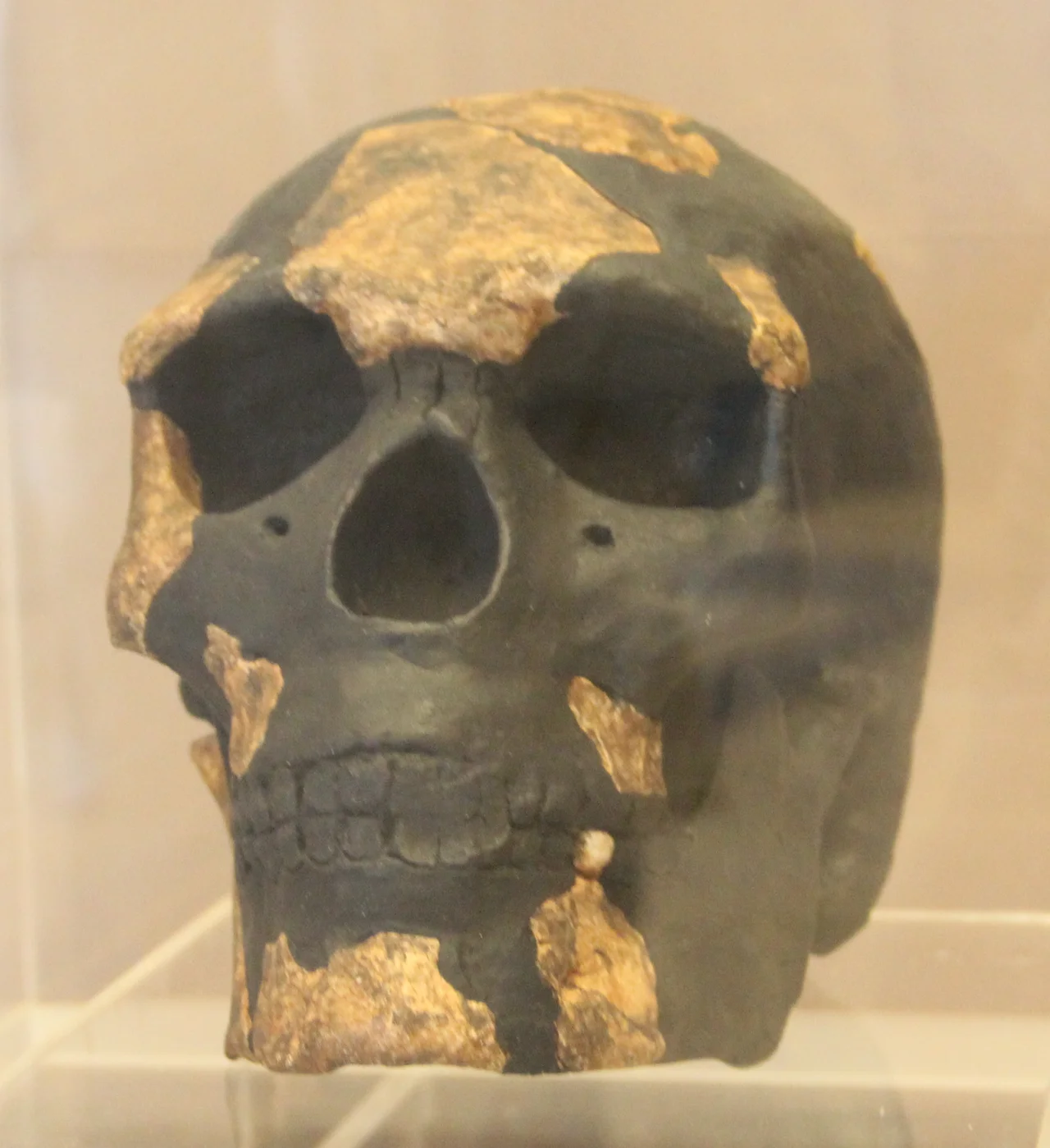
Somewhere in the badlands above the Omo River in southwestern Ethiopia, between 1967 and 1974, a scientific team led by Richard Leakey gathered up fragments of skull, jaw, and limb that turned out to be the oldest fossils of Homo sapiens ever found. They are not much to look at - two partial skulls, four jaws, a legbone, roughly two hundred loose teeth. But these scattered bones, known as the Omo remains, carry the earliest recognizable face of our own kind, and the ground that held them has been dated to a minimum of around 233,000 years ago. This is where we begin.
Two Sites, Two Skeletons
The fossils come from the Omo Kibish sites, and they fall into two groups named for the people who found them. The remains from Kamoya's Hominid Site - named for the legendary fossil-hunter Kamoya Kimeu - are called Omo I. Those from Paul Abell's Hominid Site became Omo II. The two have long fascinated researchers because they seem subtly different from each other, hinting that the early human population here was already varied, not a single uniform type. Omo I, with its high forehead and rounded braincase, looks strikingly modern; Omo II carries some more archaic features. Together they capture a moment when our species was still settling into the form we recognize in the mirror today.
The Trouble With Time
Dating the Omo remains has been a decades-long detective story. The original finds came with little surrounding fauna and only a handful of stone artifacts, leaving their true age frustratingly uncertain. Early on, freshwater mollusk shells found near Omo I suggested an age of roughly 130,000 years - old, but not yet the headline figure it would become. Roughly thirty years after the discovery, geologists returned to study the layers of rock around the fossils in far greater detail. They argon-dated the lower Member I layer to about 195,000 years ago and the higher Member III to about 105,000 years, with stone-tool evidence tying both to the Middle Stone Age. For a time, 195,000 years stood as the accepted age - already enough to make the Omo fossils the earliest known Homo sapiens. But the rock had more to say.
Older Than We Thought
In 2022, a team led by the volcanologist Celine Vidal cracked the puzzle from a new angle: the volcanoes. A thick blanket of ash lay above the sediments that held Omo I, and by matching its unique chemical fingerprint to a known eruption, the researchers could date the eruption itself - and so set a firm floor beneath the fossils. The result pushed Omo I back to a minimum of roughly 233,000 years, give or take 22,000 - older than the previous estimate by tens of thousands of years. These bones are not merely ancient; they are the deepest anchor point yet for the appearance of anatomically modern humans in the place where our species arose.
The First of Us
Parts of the Omo remains were the earliest fossils Richard Leakey classified as Homo sapiens, and that label still carries weight. In the long debate over where and when modern humans first appeared, Omo Kibish is a cornerstone of the case that we emerged in eastern Africa, in the broader Turkana-Omo basin that has yielded so many chapters of our story. A reconstruction of the Omo skull now sits in a museum in Dakar, a continent's width away, but the bones belong to this valley. There is something quietly profound in the modesty of these fragments. They are not the relics of kings or the ruins of cities, only the scattered remains of a few individuals who lived and died long before history began. No grand monument marks the spot - just eroding sediment under a hard sun, the slow Omo River below, and the knowledge that the oldest recognizable members of humankind once walked here, looking out at a landscape not so different from the one that remains.
From the Air
The Omo Kibish sites lie at roughly 4.80 degrees N, 35.97 degrees E in the lower Omo Valley of southwestern Ethiopia, within Omo National Park, north of where the Omo River empties into Lake Turkana. The terrain is arid badlands and riverine bush; the Omo River's winding green corridor is the main landmark, leading south toward the jade expanse of Lake Turkana. Recommended viewing altitude is 5,000-8,000 feet above ground in the typically clear, hot, dry air. The region is remote with minimal aviation infrastructure; Omorate (HAOM) is the nearest airstrip to the south near the Kenyan border, while Jinka (HAJK) serves the wider South Omo region to the northeast. Expect strong heat haze and few ground references.
Nearby Stories
- Ilemi Triangle 27 km away
- Lower Valley of the Omo 35 km away
- Lake Turkana 58 km away
- Omo National Park 103 km away
- Konso 112 km away
- Kakuma 119 km away
- Chalbi Desert 192 km away
- Pibor 324 km away