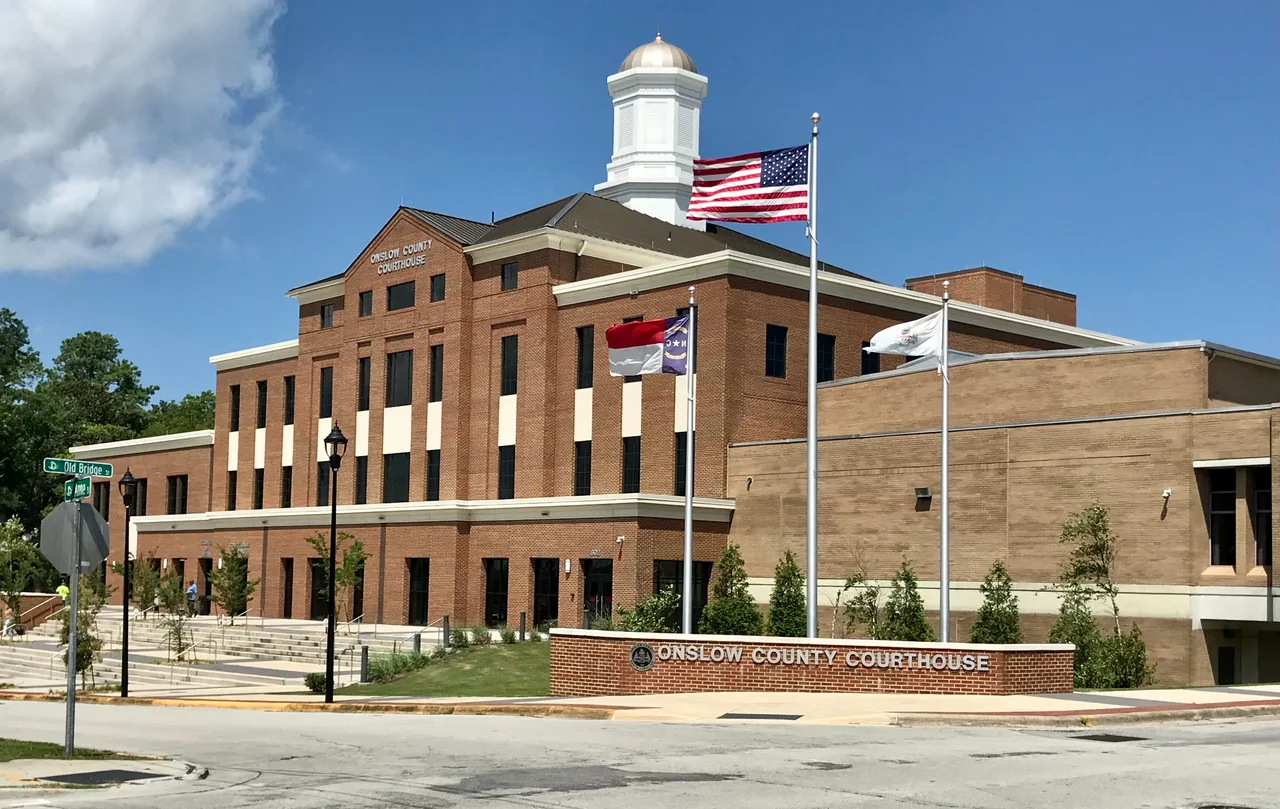

Onslow County, North Carolina
In 1941, about 2,400 people in Onslow County, North Carolina, were told to leave their land. The federal government had decided that the flat sandy farms along the New River would become a Marine Corps base. The families packed up, the engineers moved in, and within a few years a quiet agrarian county had become something else entirely. Today Onslow County still has hog farms and tobacco fields, but it also has 43,000 Marines and sailors stationed at Camp Lejeune. The county's identity sits on that hinge.
Before the Marines
Onslow County was created in 1734 and named for Arthur Onslow, the longest-serving Speaker of the British House of Commons. English settlers had been pushing inland from the coast since 1713, building plantations and small ports up the New River. After a lethal hurricane wiped out the original county seat at Town Point in 1752, the courthouse moved upriver to a settlement called Wantland's Ferry. In 1842 the town was incorporated and renamed Jacksonville after President Andrew Jackson. For nearly two centuries Onslow remained a thinly settled coastal plain county, its economy built on naval stores, tobacco, hogs, and the maritime trades. By 1940 the population still hovered around 17,000. Then came Camp Lejeune.
The Marines Arrive
Construction on Marine Barracks New River began on 1 May 1941 under Lieutenant Colonel William P.T. Hill. By the end of the year the United States had entered World War II and the construction tempo was frantic. About 2,400 county residents were displaced to make room for what would eventually become a 156,000-acre training facility. The base was renamed Camp Lejeune in late 1942, honoring the recently deceased John A. Lejeune, 13th Commandant of the Marine Corps. Marine Corps Air Station New River, originally an auxiliary airfield carved out of tobacco land bought for $64,502, was commissioned separately in 1944. Albert J. Ellis Airport in Richlands rounds out the county's aviation infrastructure. The Marines, once they arrived, did not leave.
A Coastal Plain Without Drama
The land itself is flat. Onslow County covers 905 square miles, 143 of them water. Pine forests give way to salt marsh and barrier island as you move south toward the Atlantic. Hammocks Beach State Park guards a stretch of undeveloped shoreline reachable only by ferry. Bald eagles, dolphins, and cownose rays cruise the lower New River. Inland, the Croatan Game Land sprawls across the northern half of the county, home to black bear and white-tailed deer. The towns are small. Holly Ridge, Richlands, Swansboro, North Topsail Beach, Sneads Ferry. Jacksonville is the county seat and the only city, the urban heart that grew up to serve the base outside its gates.
A Marine Town
About 200,000 people live in Onslow County now, more than ten times the population a century ago. The median age in the 2020 census was 28, the lowest in North Carolina, because so much of the population is young Marines and their young families. For every 100 women there are 123 men, again because of the Marines. Jacksonville's main strip is a corridor of tattoo parlors, used car lots, pawn shops, and chain restaurants pitched to a transient population that ships out every few years. The Camp Lejeune water contamination, which exposed perhaps half a million Marines and family members to trichloroethylene and benzene between 1953 and 1987, is part of the county's story too, a part still being litigated, still being grieved, still being uncovered. The 2022 Camp Lejeune Justice Act gave families the right to sue. By August 2024, more than 546,500 claims had been filed.
Flight Context
Onslow County stretches from roughly 34.5 to 35.0 degrees north, 77.1 to 77.8 degrees west. View from 5,000 to 8,000 feet AGL to take in the full sweep: the New River basin, Camp Lejeune's huge footprint, the Atlantic barrier islands. Nearest airports: Albert J. Ellis (KOAJ), MCAS New River (KNCA), Camp Lejeune (KNJM). Restricted airspace covers most of the base. Coastal weather can change quickly; afternoon thunderstorms are common in summer.
From the Air
Onslow County, roughly 34.5 to 35.0 degrees north, 77.1 to 77.8 degrees west. View from 5,000 to 8,000 feet AGL. Airports: KOAJ (Albert J. Ellis), KNCA (MCAS New River), KNJM (Camp Lejeune). Restricted airspace over the base. Watch for summer thunderstorms.
Nearby Stories
- Emerald Isle 5.7 km away
- Topsail Beach, North Carolina 13 km away
- Jones County, North Carolina 14 km away
- Arapahoe, North Carolina 16 km away
- Sampson County, North Carolina 30 km away
- HMT Bedfordshire 43 km away
- National Airlines Flight 2511 43 km away
- Lake Waccamaw, North Carolina 62 km away