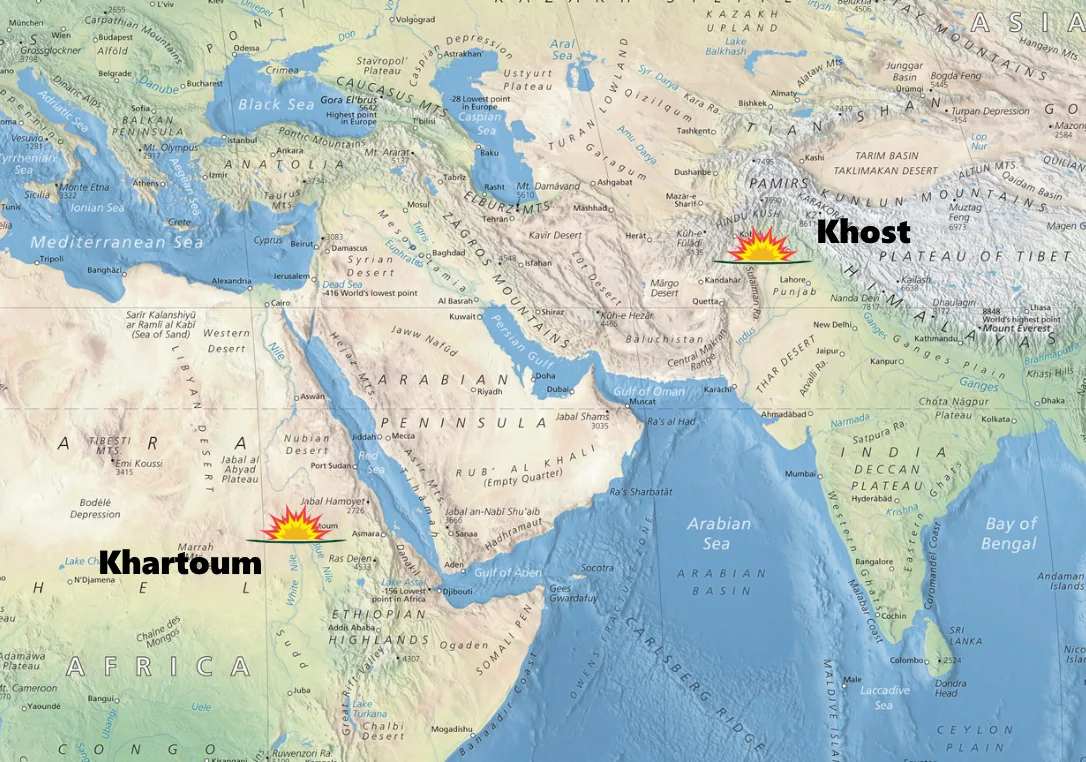

Operation Infinite Reach
A pharmacy chemist named Salah Idris had bought the al-Shifa pharmaceutical factory five months earlier, in March 1998. On the night of August 20, 1998, Tomahawk cruise missiles launched from U.S. Navy ships in the Red Sea destroyed the plant. Idris was in London at the time. One of his night watchmen was killed. The factory had been producing, by most accounts, roughly half of Sudan's medicines, including antibiotics for tuberculosis and drugs for the parasitic disease leishmaniasis. President Bill Clinton, announcing the strike from Martha's Vineyard, said the target was terror. The Sudanese government, looking at the wreckage, asked for an apology. It never came.
The August 7 Bombings
Thirteen days earlier, on August 7, 1998, truck bombs had detonated outside the U.S. embassies in Nairobi, Kenya, and Dar es Salaam, Tanzania. The Nairobi bomb killed 213 people, most of them Kenyans. The Dar es Salaam bomb killed 11, most of them Tanzanians. More than 4,000 people were wounded. Osama bin Laden's al-Qaeda claimed responsibility, and American intelligence agencies rapidly assembled evidence tying the attacks to his network. The Clinton administration, operating under the cloud of the Lewinsky scandal and impeachment proceedings, needed to respond decisively. Within twelve days they planned Operation Infinite Reach: simultaneous cruise missile strikes on al-Qaeda training camps in Khost Province, Afghanistan, and on a target in Sudan that intelligence suggested was producing chemical weapons precursors.
The Al-Shifa Plant
The al-Shifa pharmaceutical factory sat in Khartoum North, a modern industrial-scale facility. American intelligence, based on a soil sample collected covertly outside the plant, reported finding the chemical EMPTA, a precursor to VX nerve gas. The CIA assessed that al-Shifa was producing VX precursors on behalf of al-Qaeda. The Clinton administration did not share this intelligence with the State Department, the FBI, or Congressional leaders before ordering the strike. Thirteen Tomahawk missiles hit the plant at approximately 7:30 PM local time on August 20, 1998. The night watchman died. The factory burned. The next morning, Khartoum woke to the news that the United States had launched an act of war against Sudan and destroyed a significant portion of the country's pharmaceutical supply.
The Evidence Unravels
In the weeks and months after the strike, the al-Shifa case fell apart publicly. The soil sample chain of custody was questioned. Independent chemists pointed out that EMPTA also has legitimate industrial uses, including as a commercial pesticide. Idris, the owner, hired a British firm to analyze remaining materials from the site; they found nothing consistent with chemical weapons production. Journalists from The New York Times, The Washington Post, and British papers investigated Idris's background and found no al-Qaeda connections. The State Department and FBI officials, excluded from the planning, told reporters privately that they had doubts. Idris sued the U.S. government to recover frozen assets and eventually won a settlement. By 1999, the al-Shifa strike was being treated in much of the American press not as a successful counterterrorism operation but as an intelligence failure and a possible political diversion.
What Sudan Lost
The al-Shifa factory produced medicines that Sudanese hospitals and clinics had relied on. In the months after the strike, tuberculosis drugs became scarce. Antimalarial drugs ran short. Drugs for leishmaniasis, a parasitic disease endemic to parts of Sudan and often fatal if untreated, were especially affected. A German chargé d'affaires, Werner Daum, later estimated that tens of thousands of Sudanese died from the lack of medicines in the year following the strike, although the counterfactual is impossible to prove. What is undeniable is that Sudanese children, pregnant women, tuberculosis patients, and leishmaniasis sufferers lost access to medicines because of an American strike. The night watchman who died at al-Shifa had a name and a family. Neither made it into American headlines at the time. The Bush administration, inheriting the diplomatic mess in 2001, declined to formally apologize.
The Target That Mattered More
The Afghanistan strikes that same night hit al-Qaeda training camps but missed bin Laden, who had left the vicinity hours earlier. The 9/11 Commission Report later described Operation Infinite Reach as a failure that may have emboldened al-Qaeda. Bin Laden's stature in militant circles grew after the strikes. His ability to recruit increased. The 1998 embassy bombings had been the prelude; 9/11 was still three years away. The al-Shifa strike did not disrupt al-Qaeda. It devastated Sudanese public health, poisoned U.S.-Sudan relations for a decade, and left a physical ruin on the east bank of the Nile that was, for years, a Sudanese tourist attraction of the darkest kind. The people who visited it were not looking at a successful counterterrorism strike. They were looking at what happens when a superpower makes a decision too fast and refuses to admit it was wrong.
From the Air
The al-Shifa pharmaceutical factory strike site is at approximately 15.65°N, 32.56°E in Khartoum North (Bahri), Sudan, on the east bank of the Nile. Elevation ~380 meters. Recommended viewing altitude: 3,500-6,000 feet for urban context. Khartoum International Airport (HSSS) lies approximately 7 km south-southwest across the Blue Nile. Wadi Seidna Air Base (HSSW) lies north of Omdurman. The factory ruins became a tourist site in the 2000s. The broader context of Operation Infinite Reach includes strikes at 33°N, 70°E in Khost Province, Afghanistan, where Zhawar Kili al-Badr camp was hit. Expect hot desert climate conditions and possible haboobs affecting visibility.
Nearby Stories
- Kalakla 3.6 km away
- Esh Shaheinab 7.7 km away
- Naqa 39 km away
- Musawwarat es-Sufra 82 km away
- Gezira State 118 km away
- Northern Sudan 196 km away